
BusinessMarkets, money & strategy
TripleTen survey finds finance workers far more likely than healthcare or education staff to be asked to use AI
A TripleTen worker survey, published as sponsored content in MIT Technology Review, ranks finance workers ahead of education and healthcare staff in being asked to use AI. Federal firm data support that order but show lower adoption that has stayed flat and depends on survey design.
From the MIT Technology Review · AI article of October 20, 2026 and cited sources: The survey says 48% of finance workers, 25% of education workers and 18% of healthcare workers have been asked to use AI chatbots. [1] [4]
SOURCES[1] AI adoption by industry shows what other sectors can learn… technologyreview.com[4] Large Firms With at Least 20 Employees Biggest AI Users… census.gov
 AT Pulse research deskPublished · Updated · 5 min read · AI-assisted analysis
AI-assisted, not human-edited. Methodology Corrections Who owns this site
- What happened
- The survey says 48% of finance workers, 25% of education workers and 18% of healthcare workers have been asked to use AI chatbots. [1] [4]
- Original source
- MIT Technology Review · AI article, independent perspective
- Brief by
- AT Pulse research desk AI-assisted; publisher and contact on the desk page
- When
- October 20, 2026 article published
- Covered
- Oct 21 edition
- Evidence
- 6 sources across 6 sites
- 1AI adoption by industry shows what other sectors can learn…technologyreview.com
- 2Anthropic Economic Index: economic primitivesanthropic.com
- 3Monitoring AI Adoption in the U.S. Economy…federalreserve.gov
- 4Large Firms With at Least 20 Employees Biggest AI Users…census.gov
- 5AI adoption in business grows steadily but unevenly…minneapolisfed.org
- 6CompTIA AI Skills Tracker release (Webull)webull.com
Reach: not measured yet
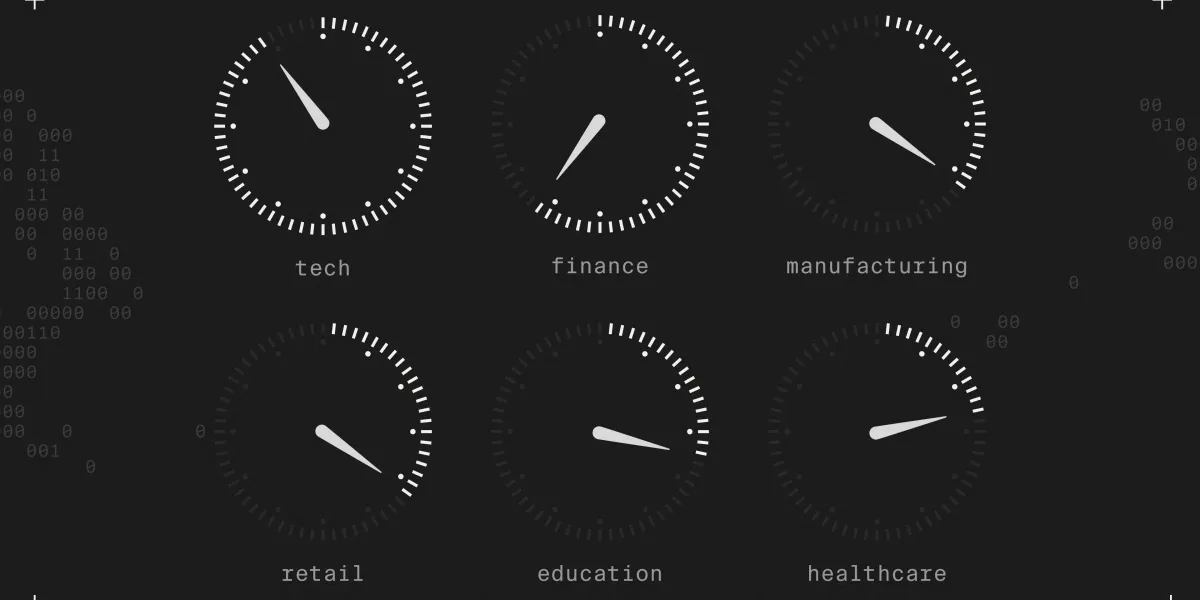
The survey says 48% of finance workers, 25% of education workers and 18% of healthcare workers have been asked to use AI chatbots. Census firm-level data show a similar order: about 40% of information businesses, about 34% in finance and about 14% in retail use AI. [1] [4]
How adoption is measured changes the result a lot. A Federal Reserve note found firm-level adoption estimates ranging from about 18% to 78%, mainly because surveys sample firms of different sizes. Counting workers asked to use AI, firms using AI and actual chatbot usage gives numbers that can't be compared directly. [3] [4] [2]
Adoption is wide but shallow. About 20% of businesses use AI in some function, but only about 10% use it in core production, and about 96% of firms using AI report no change in headcount. Census data show overall business use holding at 17–20% from December 2025 to May 2026. That cuts against the piece's claim that tech's changes will inevitably spread to other sectors. [5] [4]
Tech workers report spending $1,758 of their own money on training on average, compared with $990 in healthcare, where 45% spent nothing. These figures come only from the sponsor, which sells paid training, so read them with that in mind. [1]
Federal data show AI use growing slowly, often outside core production, with little change in headcount. That suggests the gaps between sectors are about how deeply AI is used, not a sudden transformation.
Read the full assessment
Leaders should compare themselves with official sector rates and pay for training on purpose.
Sources gathered; writing the dossier now.
Executive brief
The most important fact about this story is that it isn't MIT Technology Review journalism. The page says it was produced by TripleTen, a tech-training company, and that the magazine's editorial staff did not write it. Its figures come from TripleTen's own worker survey, and the page gives no sample size or fieldwork dates. Its main claim is that tech and finance lead and healthcare and education follow. Federal firm surveys show the same broad ranking, but they put adoption well below the "asked to use AI" rates reported here. They also show that measured adoption depends heavily on how a survey samples firms or workers.
Read the full section
The most important fact about this story is that it isn't MIT Technology Review journalism. The page says it was produced by TripleTen, a tech-training company, and that the magazine's editorial staff did not write it. MIT Technology Review. Its figures come from TripleTen's own worker survey, and the page gives no sample size or fieldwork dates. Its main claim is that tech and finance lead and healthcare and education follow. Federal firm surveys show the same broad ranking, but they put adoption well below the "asked to use AI" rates reported here. They also show that measured adoption depends heavily on how a survey samples firms or workers.
What changed and event timeline
Anthropic maps uneven usage
Anthropic analyzed 2 million Claude conversations and API transcripts. Computer and math tasks made up about a third of consumer use and nearly half of API traffic.
Fed reconciles conflicting surveys
A Federal Reserve note found firm adoption ranging from about 18% to 78%, depending on the survey. It attributes the gap mainly to sampling by firm size.
Census publishes sector split
Business AI use stayed between 17% and 20% from December 2025 to May 2026. Information was near 40%, finance about 34% and retail about 14%.
Minneapolis Fed stresses unevenness
About 20% of businesses use AI in some function, but only about 10% use it in core production. About 96% of AI-using firms reported no change in headcount.
TripleTen's sponsored piece runs
It reports that 48% of finance workers, 25% of education workers and 18% of healthcare workers have been asked to use AI chatbots.
Capabilities and access
No model or product is involved. The piece names chatbots, workflow automation, prompting and output checking as skills workers are being asked to learn. It ties none of them to a specific model or version.
Read the full section
No model or product is involved. The piece names chatbots, workflow automation, prompting and output checking as skills workers are being asked to learn. It ties none of them to a specific model or version. MIT Technology Review
Technical analysis for researchers and developers
- TripleTen counts workers who were asked to use AI. Census counts firms that use AI. Anthropic counts what people actually do in conversations.
- Sampling drives the results. Surveys that weight by employment or oversample large employers show much higher adoption. Fed note
- The TripleTen results can't be reproduced. The piece gives no sample size, fieldwork dates or question wording.
Read the full section
- The metrics differ. TripleTen counts workers who were asked to use AI. Census counts firms that use AI. Anthropic counts what people actually do in conversations. These numbers can't be compared directly.
- Sampling drives the results. The Census survey mirrors the overall firm population, which is mostly small businesses. Surveys that weight by employment or oversample large employers show much higher adoption. Fed note
- The TripleTen results can't be reproduced. The piece gives no sample size, fieldwork dates or question wording.
- Usage logs measure what people do with AI rather than what they say. They cover only one vendor's users. Anthropic
Claims and evidence
- The sector ranking (tech, then finance, ahead of healthcare and education). The ranking comes from TripleTen's own survey.
- "79% asked to learn a new skill" and "88% of employee-led AI innovations became standard practice."
- Training spend: tech workers average $1,758 out of pocket versus $990 in healthcare, and 45% of healthcare workers spent nothing.
Read the full section
- The sector ranking (tech, then finance, ahead of healthcare and education). The ranking comes from TripleTen's own survey. Firm-level Census data independently shows finance high and retail low. Census
- "79% asked to learn a new skill" and "88% of employee-led AI innovations became standard practice." These are TripleTen-only figures, and no independent source corroborates them. MIT Technology Review
- Training spend: tech workers average $1,758 out of pocket versus $990 in healthcare, and 45% of healthcare workers spent nothing. This is also TripleTen-only data. Read it in light of the sponsor's business: it sells paid training.
Context and prior work
Federal data agree that adoption is concentrated in knowledge work. The Fed found professional services and finance at about 30–33% in firm surveys, with manufacturing well behind. Fed note The Minneapolis Fed reports that AI use in health care more than tripled between 2023 and 2025, and manufacturing use more than doubled.
Read the full section
Federal data agree that adoption is concentrated in knowledge work. The Fed found professional services and finance at about 30–33% in firm surveys, with manufacturing well behind. Fed note The Minneapolis Fed reports that AI use in health care more than tripled between 2023 and 2025, and manufacturing use more than doubled. Minneapolis Fed A separate 2026 CompTIA survey of business and tech leaders found heavy use of AI tools but little self-reported deep familiarity with them. Webull/CompTIA release
Limitations, safety and contested findings
- Undisclosed methodology: the piece does not describe how the survey was run.
- The "inevitable spread" framing is contested. The piece says tech's changes will inevitably filter into other sectors.
- Employment effects: about 96% of AI-using firms reported no headcount change, which undercuts any implied urgency. Minneapolis Fed
Read the full section
- Undisclosed methodology: the piece does not describe how the survey was run.
- The "inevitable spread" framing is contested. The piece says tech's changes will inevitably filter into other sectors. Census data instead show overall adoption flat at 17–20% for six months, and retail at about 14%. Census
- Employment effects: about 96% of AI-using firms reported no headcount change, which undercuts any implied urgency. Minneapolis Fed
- Verification as a skill: only 30% of managers rated checking AI output as essential, despite its role in catching errors. This is a TripleTen figure.
Business and practitioner implications
- Benchmark against federal data: use Census sector rates as a baseline, not vendor surveys of workers.
- Distinguish depth from breadth: using AI in any function (about 20% of firms) is different from using it in core production (about 10%).
- Invest in verification: checking AI output is cheap to train and catches errors before they spread.
Read the full section
- Benchmark against federal data: use Census sector rates as a baseline, not vendor surveys of workers.
- Distinguish depth from breadth: using AI in any function (about 20% of firms) is different from using it in core production (about 10%).
- Invest in verification: checking AI output is cheap to train and catches errors before they spread.
- Fund training directly: in TripleTen's data, nearly half of healthcare and education workers spent nothing on training. If employers don't pay, uptake in those sectors is likely to stay low.