
ResearchPapers, evidence & method
Biohub's Alex Rives says better measurement is the key to virtual cell models as the Virtual Biology Initiative grows to $1.8B
Biohub head of science Alex Rives argues that today's 'virtual cell' models can't yet simulate cells reliably, mainly because biology lacks the right measurements. Biohub and partners including DOE, NIH, Google DeepMind, Isomorphic Labs and Meta have committed $1.8B to generate open, AI-ready cell data.
From the The Cognitive Revolution podcast episode of October 20, 2026 and cited sources: Rives says the models now called virtual cells can't yet stand in for experiments. [1] [11]
SOURCES[1] A World Model of Life: Biohub's Alex Rives on Virtual… cognitiverevolution.ai[11] Ahlmann-Eltze et al., *Nature Methods* 2025 pmc.ncbi.nlm.nih.gov
 AT Pulse research deskPublished · Updated · 5 min read · AI-assisted analysis
AI-assisted, not human-edited. Methodology Corrections Who owns this site
- What happened
- Rives says the models now called virtual cells can't yet stand in for experiments. [1] [11]
- Original source
- The Cognitive Revolution podcast episode, independent perspective
- Brief by
- AT Pulse research desk AI-assisted; publisher and contact on the desk page
- When
- October 20, 2026 podcast episode published
- Covered
- Oct 20 edition
- Evidence
- 12 sources across 10 sites; transcript sourced
- 1A World Model of Life: Biohub's Alex Rives on Virtual…cognitiverevolution.ai
- 2Biohub: $1.8B expansionbiohub.org
- 3The Next Webthenextweb.com
- 4Gunderson: EvolutionaryScale joins Biohubgunder.com
- 5Biohub: Virtual Biology Initiative (April)biohub.org
- 6News-Medical: laser phase platenews-medical.net
QuietHow it’s measured
YouTube video · 40 views · 5 likes
Reach blends public engagement (views, likes, comments, shares, stars) from the platforms where the story or its original source lives: YouTube, Hacker News, GitHub, Substack and similar. A video and the article written from its transcript share one score, taken from the video. Platforms with no data are left out rather than counted as zero, and the age of a story never lowers its score.
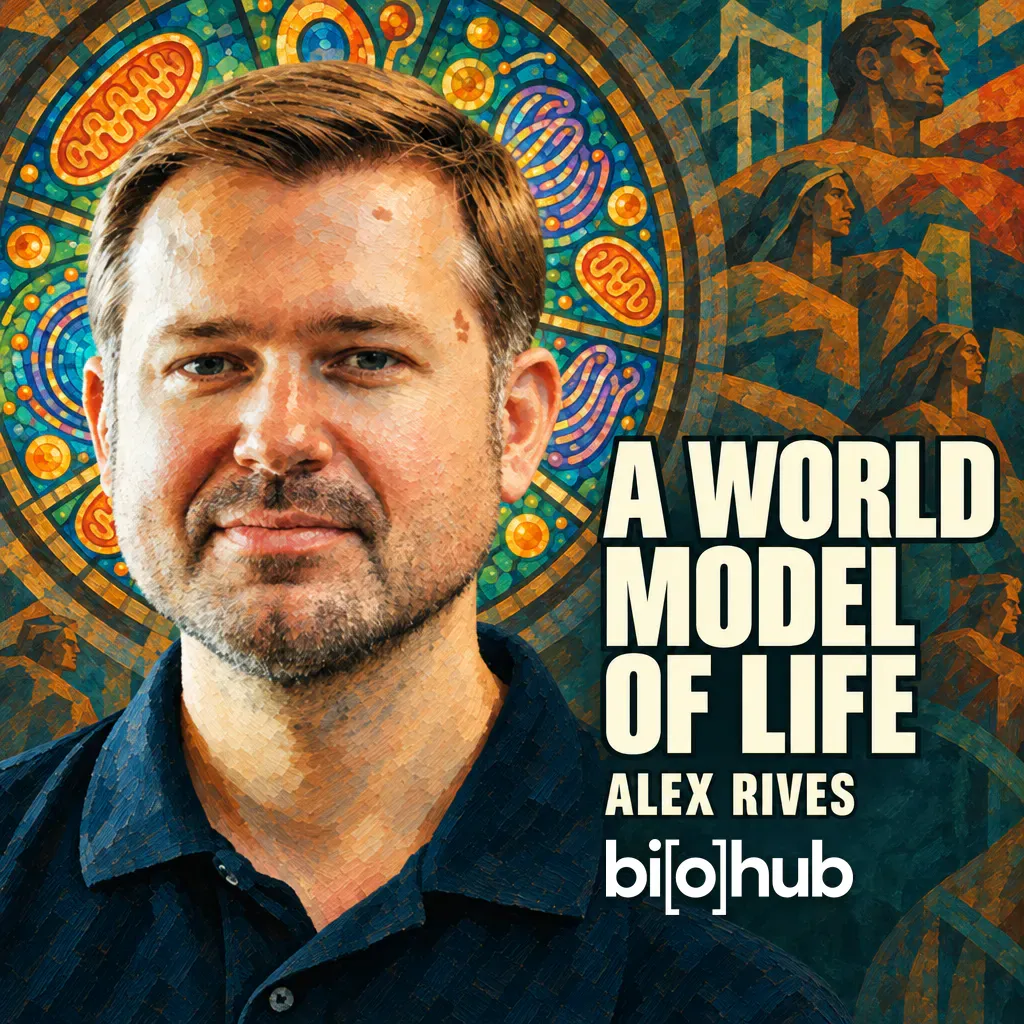
Rives says the models now called virtual cells can't yet stand in for experiments. He sees measurement and observability as a bigger limit than model architecture, though he notes that Transformers have no built-in multiscale structure. This fits a Nature Methods benchmark in which deep models, including scGPT and Geneformer, did not beat simple linear baselines at predicting perturbation effects. [1] [11]
The Virtual Biology Initiative launched in April with $500M over five years and has now grown to $1.8B. The new money includes more than $500M from DOE over five years and $300M from Google DeepMind, Isomorphic Labs and Meta. NIH's share of more than $500M counts datasets it already has, not new funding. These totals come from Biohub's own announcement and coverage that repeats it. The data will be open, but commercial funders get one year of exclusive access first. [2] [3] [5] [7]
Rives's target model is a probabilistic transition function: given a cell or tissue state and a set of inputs, it predicts a distribution of next states, linking genetic, transcriptomic, epigenetic and imaging readouts. The proposed training recipe follows LLMs: self-supervised pretraining, then elicitation, then reinforcement learning with verifiable rewards, where lab experiments do the verifying. He expects training across species to help, as it did for ESM and AlphaFold. [1]
Funding also goes to new measurement tools. One example is a laser phase plate that boosts cryo-EM contrast. Berkeley's results appeared in Science, while Biohub's dual-laser version is described only in a preprint. Rives says the device shows only part of a cell at atomic resolution. He expects first drafts of cell atlases covering health and disease within one to two years. [1] [6] [10]
Big Tech and government funders are paying for biology's data layer rather than new models.
Read the full assessment
Implication: teams building cell models should plan for spatial and imaging data, a one-year head start for commercial funders, and testing against linear baselines.
Executive brief
Biohub's head of science, Alex Rives, says the AI models now called "virtual cells" do not yet meet his definition of a virtual cell: a model that could simulate a cell well enough to act as an "oracle" for experiments. In his view the main bottleneck is measurement, not model architecture (episode, 00:10:05). Biohub is acting on that view. On October 7, 2026, it and its partners committed $1.8B to generating open, AI-ready biological data (Biohub). Commercial funders get one year of exclusive access before the data goes public (The Next Web). Rives expects first drafts of health-and-disease cell atlases within one to two years.
What changed and event timeline
EvolutionaryScale joins Biohub
The ESM model team joined Biohub in a transaction with the Chan Zuckerberg Initiative (CZI), and co-founder Rives became head of science. The deal was part of folding CZI Science into Biohub ().
Virtual Biology Initiative launched
Biohub committed $500M over five years: $400M for data generation and measurement technology, $100M for external research. Early partners included NVIDIA, Arc Institute, the Allen Institute and the Human Cell Atlas ().
Laser phase plate demonstrated
UC Berkeley and Biohub showed that a laser phase plate raises cryo-electron microscopy (cryo-EM) contrast, with bigger gains on smaller proteins. Berkeley's results appeared in Science; Biohub's dual-laser version is described in a bioRxiv preprint ().
$1.8B expansion
DOE (>$500M over five years) and NIH (>$500M in existing datasets) joined, along with $300M from Google DeepMind, Isomorphic Labs and Meta (;).
Rives interview published
On The Cognitive Revolution, Rives describes the target model as a probabilistic transition function over cell states, leading toward a "world model of life" ().
Capabilities and access
- No new model or version was announced. The initiative produces data and measurement tools.
- Planned data types include cryo-electron tomography (3D electron imaging of cell interiors), microscopy of millions to billions of cells, X-ray and neutron scattering, and autonomous labs (Biohub).
- Access: data will be open. Commercial funders get a one-year head start; government-funded data has no embargo (The Next Web).
Read the full section
- No new model or version was announced. The initiative produces data and measurement tools.
- Planned data types include cryo-electron tomography (3D electron imaging of cell interiors), microscopy of millions to billions of cells, X-ray and neutron scattering, and autonomous labs (Biohub).
- Access: data will be open. Commercial funders get a one-year head start; government-funded data has no embargo (The Next Web).
- Scale: Rives speaks of "hundreds of billions or more" cells in spatial maps (episode, 00:23:21). Biohub's announcement cites millions to billions.
Technical analysis for researchers and developers
- A stochastic transition function: given a cell or tissue state plus inputs, predict a distribution of next states.
- Rives argues that the Transformer has no native multiscale structure.
- Self-supervised pretraining, then "elicitation." Later, reinforcement learning with verifiable rewards (RLVR), with the verification done by lab experiments rather than computation (00:43:08).
Read the full section
- Target model. A stochastic transition function: given a cell or tissue state plus inputs, predict a distribution of next states. The inputs and outputs are meant to link genetic, transcriptomic, epigenetic and imaging readouts (00:14:41).
- Architecture. Rives argues that the Transformer has no native multiscale structure. Data is far from the "infinite" regime for cell biology, so he expects inductive bias to matter there, unlike for proteins (00:10:05).
- Training recipe. Self-supervised pretraining, then "elicitation." Later, reinforcement learning with verifiable rewards (RLVR), with the verification done by lab experiments rather than computation (00:43:08).
- Language and biology. Fusing language and biological latent spaces needs bridging data that is scarce today, so Rives is undecided on whether the two should share one model (00:53:04).
Claims and evidence
- Funding totals and partners: stated in the Biohub release and repeated by Unite.AI and Technology.org. Coverage restates the release; no independent audit of the commitments was found.
- Laser phase plate: gains are peer-reviewed in Science for Berkeley's device. Biohub's dual-laser system is preprint-only (News-Medical).
- "Current virtual cells fall short": consistent with an independent benchmark in which seven deep models, including scGPT and Geneformer, did not beat simple linear baselines at predicting perturbation effects (Ahlmann-Eltze et al., *Nature Methods* 2025).
Read the full section
- Funding totals and partners: stated in the Biohub release and repeated by Unite.AI and Technology.org. Coverage restates the release; no independent audit of the commitments was found. NIH's ">$500M" counts existing datasets, not new money.
- Laser phase plate: gains are peer-reviewed in Science for Berkeley's device. Biohub's dual-laser system is preprint-only (News-Medical). Applying it to cryo-ET inside cells is still in development (optics.org).
- "Current virtual cells fall short": consistent with an independent benchmark in which seven deep models, including scGPT and Geneformer, did not beat simple linear baselines at predicting perturbation effects (Ahlmann-Eltze et al., *Nature Methods* 2025).
- Timelines for atlases and models: Rives's own forecasts (00:46:50).
Context and prior work
- Rives led the ESM protein language model project at Meta's AI research lab (FAIR) before co-founding EvolutionaryScale (Biohub profile).
- He argues that ESM and AlphaFold worked because they trained across all of evolution, not just human proteins.
- Phase-plate cryo-EM targets a long-standing gap: more than 90% of human proteins are too small for cryo-EM to image clearly (News-Medical).
Read the full section
- Rives led the ESM protein language model project at Meta's AI research lab (FAIR) before co-founding EvolutionaryScale (Biohub profile).
- He argues that ESM and AlphaFold worked because they trained across all of evolution, not just human proteins. He sees the same cross-species transfer helping cell models get past the limits of model organisms (00:38:45).
- Phase-plate cryo-EM targets a long-standing gap: more than 90% of human proteins are too small for cryo-EM to image clearly (News-Medical).
Limitations, safety and contested findings
- Benchmarks still show deep "virtual cell" models failing to beat linear baselines (*Nature Methods*).
- The one-year commercial exclusivity gives DeepMind, Isomorphic and Meta a head start (The Next Web), which sits awkwardly with the "open" framing.
- Rives warns that health-record models without a mechanistic basis mostly learn correlations (00:49:47).
Read the full section
- Benchmarks still show deep "virtual cell" models failing to beat linear baselines (*Nature Methods*). Data scale alone has not yet been shown to close that gap.
- The one-year commercial exclusivity gives DeepMind, Isomorphic and Meta a head start (The Next Web), which sits awkwardly with the "open" framing.
- Rives warns that health-record models without a mechanistic basis mostly learn correlations (00:49:47).
- The laser phase plate images only part of a cell at atomic resolution (00:32:57).
Business and practitioner implications
- Big Tech and government are now funding the data layer of biology AI rather than the models themselves.
- Plan for multimodal, spatial and imaging-linked data, and for evaluation against linear baselines.
- Rives's near-term value case is atlases that analysts or AI agents can mine directly, even before predictive models mature (00:46:50).
Read the full section
- Where the effort sits. Big Tech and government are now funding the data layer of biology AI rather than the models themselves. Whoever trains first on embargoed data gets an advantage of about a year.
- For model builders. Plan for multimodal, spatial and imaging-linked data, and for evaluation against linear baselines.
- For drug discovery teams. Rives's near-term value case is atlases that analysts or AI agents can mine directly, even before predictive models mature (00:46:50).
- For lab automation vendors. Lab-verified RLVR implies demand for fast, closed-loop wet-lab experimentation.
The source trail.
Sources (12)
A World Model of Life: Biohub's Alex Rives on Virtual Cells, Measurement, & the $1.8B Data Push
Transcript retrieved via published_transcript; language en. Timestamped text, not direct audiovisual review. Source: https://cognitiverevolution.ai/a-world-model-of-life-biohub-s-alex-rives-on-virtual-cells-measurement-the-1-8b-data-push. Automatic captions/transcription may contain errors.
cognitiverevolution.ai