
InfrastructureCompute, chips & cloud
Samsung restarts and enlarges its Pyeongtaek P5 fab as it tries to catch SK Hynix in HBM
Samsung has resumed building its fifth Pyeongtaek fab, now planned as a larger three-storey "triple fab" for advanced DRAM used in high-bandwidth memory. The goal is to win back ground from SK Hynix in the memory that limits AI accelerator supply.
From the MIT Technology Review · AI article of October 20, 2026 and cited sources: Construction of P5 stopped in 2024 during the memory downturn and was reported in January 2026 to be restarting. [2] [4] [7]
SOURCES[2] The Elec: Samsung to resume construction of P5 fab next… thelec.net[4] Digitimes: Samsung to restart construction of Pyeongtaek… digitimes.com[7] TrendForce: Onyang HBM fab, P5 triple-fab shift trendforce.com
 AT Pulse research deskPublished · Updated · 5 min read · AI-assisted analysis
AI-assisted, not human-edited. Methodology Corrections Who owns this site
- What happened
- Construction of P5 stopped in 2024 during the memory downturn and was reported in January 2026 to be restarting. [2] [4] [7]
- Original source
- MIT Technology Review · AI article, independent perspective
- Brief by
- AT Pulse research desk AI-assisted; publisher and contact on the desk page
- When
- October 20, 2026 article published
- Covered
- Oct 20 edition
- Evidence
- 12 sources across 9 sites
- 1A visit to Samsung’s massive new semiconductor hubtechnologyreview.com
- 2The Elec: Samsung to resume construction of P5 fab next…thelec.net
- 3Yahoo Finance: Samsung Q3 profit surges to record high…finance.yahoo.com
- 4Digitimes: Samsung to restart construction of Pyeongtaek…digitimes.com
- 5KED Global: Samsung to advance mega-fab expansion by 6…kedglobal.com
- 6Yahoo Finance: Nvidia certifies Samsung, SK Hynix and…finance.yahoo.com
Reach: not measured yet
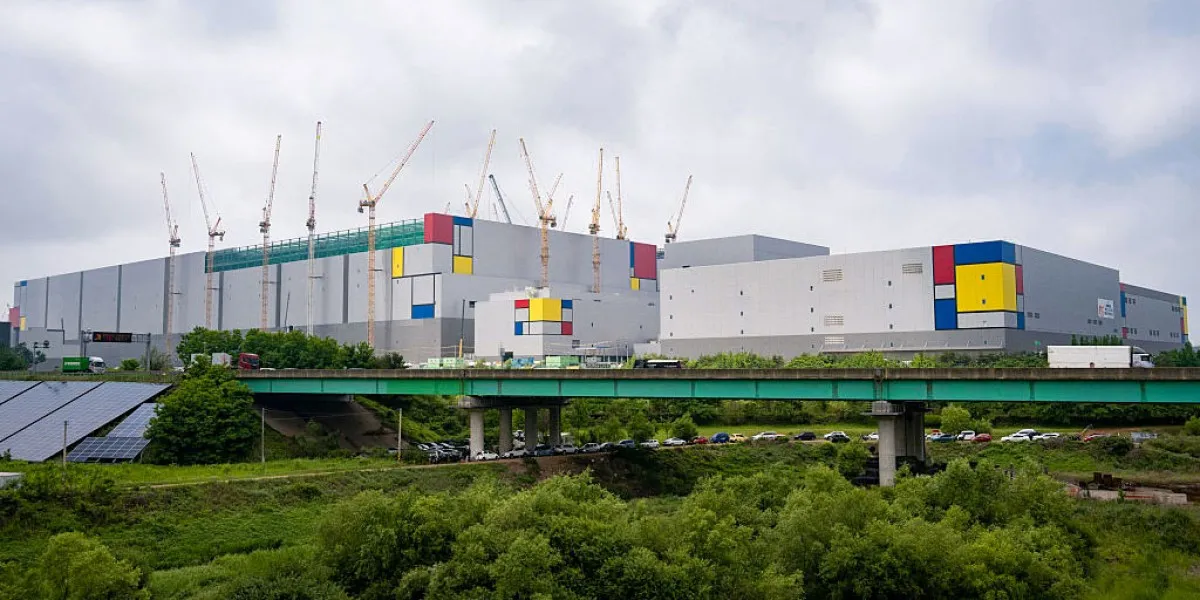
Construction of P5 stopped in 2024 during the memory downturn and was reported in January 2026 to be restarting. The fab is now planned as a triple fab with up to six cleanrooms, compared with four in P4. That design reportedly raises capacity by more than 1.5 times and requires the floor-area ratio to rise from 350% to 490%. [2] [4] [7]
Nvidia has qualified Samsung, SK Hynix and Micron as HBM4 suppliers for Vera Rubin. SK Hynix still leads, with an IDC-estimated 56.4% of HBM revenue in Q1 2026. Analysts estimate SK Hynix will get about 60–70% of Rubin allocation and Samsung about 25–30%. Nvidia has not disclosed the split. [6] [10]
Samsung is speeding up expansion. Groundbreaking for P5 Fab 2 moved to July 2026, more than six months early, and a separate HBM fab at Onyang costing 6 trillion won was set to start in September. Strong earnings support the spending: preliminary Q3 2026 operating profit reached a record 107.4 trillion won. [5] [7] [3]
HBM output directly limits how many AI accelerators can ship. New P5 capacity is not expected before about 2028–29, so supply likely stays tight through 2027.
Read the full assessment
The view that demand lasts through 2028 is Samsung's own forecast, and reported 2026 data-center cancellations add downside risk.
I've finished the research and am writing up the dossier now.
Executive brief
Samsung paused construction of its fifth Pyeongtaek fab during the 2024 memory slump. It has since restarted it and now plans the building as a three-storey "triple fab" about as large as fabs P3 and P4 combined (The Elec). MIT Technology Review describes the site as about the size of Central Park. Three fabs run around the clock and a fourth is coming online. Samsung is trying to win back high-bandwidth memory (HBM) leadership from SK Hynix (MIT Technology Review). The money supports the push: Samsung's Q3 2026 preliminary operating profit was 107.4 trillion won (Yahoo Finance).
What changed and event timeline
P5 construction halted
Work began in 2023 and stopped in 2024 because the memory market fell. Samsung E&A's contract later grew from 391.5 billion to 550 billion won ().
P5 restart reported
Structural work was due to resume in February 2026, with the fab going live in 2028. At that point The Elec said its final use was still undecided (;).
Expansion pulled forward
Groundbreaking for P5 Fab 2 moved to July 2026, more than six months early, with operations targeted for 2029. SK Hynix is following the same accelerated approach ().
Nvidia certifies three HBM4 suppliers
Jensen Huang said Samsung, SK Hynix and Micron all qualified for Vera Rubin. He also urged SK Hynix to raise output because supply is tight ().
Triple-fab redesign and yield gains reported
P5 would have up to six cleanrooms, compared with four in P4. HBM4 yield reportedly rose from below 60% to nearly 80% ().
Record quarter, slight miss
Operating profit was 107.4 trillion won, just below Bloomberg's 108.67 trillion consensus, and shares fell 2.4% ().
Capabilities and access
- Product: HBM4. Samsung began mass production in February 2026 (Yahoo Finance).
- Sites:
- P4 is targeted for full operation by the end of 2026 (Digitimes).
Read the full section
- Product: HBM4. Samsung began mass production in February 2026 (Yahoo Finance). It is qualified for Nvidia's Vera Rubin and reportedly also supplies HBM4 to AMD (KED Global).
- Sites:
- P4 is targeted for full operation by the end of 2026 (Digitimes).
- P5 is aimed mainly at advanced DRAM for HBM (Sammy Fans).
- A separate 6-trillion-won HBM fab at Onyang was set to break ground in September 2026 (TrendForce).
Technical analysis for researchers and developers
- Why memory is the constraint: GPUs for AI depend on stacks of memory chips packaged next to the processor (MIT Technology Review).
- Fab design: Going from P4's double-fab layout with four cleanrooms to P5's triple-fab with six requires a floor-area-ratio change from 350% to 490%.
- Yield: The reported HBM4 yield figures come from Korean press. No audited yield data exists, so the improvement cannot be checked independently.
Read the full section
- Why memory is the constraint: GPUs for AI depend on stacks of memory chips packaged next to the processor (MIT Technology Review). That makes HBM output a direct limit on how many accelerators can ship.
- Fab design: Going from P4's double-fab layout with four cleanrooms to P5's triple-fab with six requires a floor-area-ratio change from 350% to 490%. It is reported to raise capacity by more than 1.5 times (TrendForce).
- Yield: The reported HBM4 yield figures come from Korean press. No audited yield data exists, so the improvement cannot be checked independently.
Claims and evidence
- Demand will keep surging through 2028. This is Samsung's own forecast (MIT Technology Review). Neither is independent evidence.
- IDC puts its HBM revenue share at 56.4% in Q1 2026 (SK hynix F-1).
- Vera Rubin allocation: Analysts estimate roughly 60–70% for SK Hynix and 25–30% for Samsung. Nvidia has not disclosed the split (Yahoo Finance).
Read the full section
- Demand will keep surging through 2028. This is Samsung's own forecast (MIT Technology Review). SK Hynix makes a similar company claim that HBM4 demand exceeds its capacity for three years (KED Global). Neither is independent evidence.
- SK Hynix leads the market. IDC puts its HBM revenue share at 56.4% in Q1 2026 (SK hynix F-1).
- Vera Rubin allocation: Analysts estimate roughly 60–70% for SK Hynix and 25–30% for Samsung. Nvidia has not disclosed the split (Yahoo Finance).
- Q3 profit: This is a company preliminary estimate (Xinhua).
Context and prior work
SK Hynix spent years ahead of Samsung in the HBM that goes into Nvidia accelerators. Meanwhile TSMC dominated foundry work, which means making chips that other companies design (MIT Technology Review). Samsung has also invested in P4 for sixth-generation (1c) DRAM since at least 2024 (TrendForce). Pyeongtaek is the latest stage of a longer race to scale capacity, not a sudden shift in strategy.
Limitations, safety and contested findings
- P5 timeline conflicts: The Elec says P5 goes live in 2028 (The Elec). TrendForce cites a completion target of 2030 (TrendForce).
- Demand risk: About $260 billion of data-center projects were reportedly cancelled in 2026 (Yahoo Finance).
- Worker conditions: MIT Technology Review reports heat, crowded work zones and heavy safety messaging on site. That account comes from a single reporter's visit.
Read the full section
- P5 timeline conflicts: The Elec says P5 goes live in 2028 (The Elec). TrendForce cites a completion target of 2030 (TrendForce). The difference likely reflects phased build-out versus full completion.
- Demand risk: About $260 billion of data-center projects were reportedly cancelled in 2026 (Yahoo Finance). The 2024 halt shows Samsung will pause construction when demand drops.
- Worker conditions: MIT Technology Review reports heat, crowded work zones and heavy safety messaging on site. A safety officer interviewed earns 140,000 won (about $97) a day. That account comes from a single reporter's visit.
Business and practitioner implications
- Supply: Through 2027, HBM supply probably stays the bottleneck for accelerator availability. New P5 capacity is not expected before about 2028–29.
- Buyers: Three qualified HBM4 suppliers give Nvidia more room to negotiate.
- Capacity planners: Both Korean makers are building ahead of demand.
Read the full section
- Supply: Through 2027, HBM supply probably stays the bottleneck for accelerator availability. New P5 capacity is not expected before about 2028–29.
- Buyers: Three qualified HBM4 suppliers give Nvidia more room to negotiate. SK Hynix still has the largest share, so Samsung's yield progress matters to accelerator pricing.
- Capacity planners: Both Korean makers are building ahead of demand. If AI capex slows, the 2024 pattern of paused fabs and falling prices could return.
The source trail.
Sources (12)
A visit to Samsung’s massive new semiconductor hub
Article text retrieved; extracted text may omit tables or interactive elements.
technologyreview.com