
RoboticsMachines in the physical world
Former Nvidia robotics marketer Amulya Vishwanath, now a VC, says robotics is in a 'Lego era' and not yet at its ChatGPT moment
Amulya Vishwanath, who led Nvidia robotics product marketing for seven years and now runs Techable VC, argues robotics lacks a ChatGPT moment because actuators, hands, software and safety standards are still being rebuilt, countering startups betting on one general robot model.
From the TechCrunch AI article of October 16, 2026 and cited sources: Vishwanath says robotics is in a 'Lego era.' In her view, its basic building blocks, including actuators, robot hands, software and safety standards, are still changing. [1]
SOURCES[1] An Nvidia insider-turned-VC on why robotics hasn’t hit its… techcrunch.com
 AT Pulse research deskPublished · Updated · 4 min read · AI-assisted analysis
AI-assisted, not human-edited. Methodology Corrections Who owns this site
- What happened
- Vishwanath says robotics is in a 'Lego era.' In her view, its basic building blocks, including actuators, robot hands, software and safety standards, are still changing. [1]
- Original source
- TechCrunch AI article, independent perspective
- Brief by
- AT Pulse research desk AI-assisted; publisher and contact on the desk page
- When
- October 16, 2026 article published
- Covered
- Oct 17 edition
- Evidence
- 7 sources across 5 sites
- 1An Nvidia insider-turned-VC on why robotics hasn’t hit its…techcrunch.com
- 2TechCrunch: Physical AI is more than robots, says the…techcrunch.com
- 3TechCrunch: This startup thinks robotics is about to have…techcrunch.com
- 4Berkeley Research: Are we truly on the verge of the…vcresearch.berkeley.edu
- 5Unite.AI: Nvidia unveils full-stack robotics platformunite.ai
- 6Berkeley Haas: Former Nvidia exec Amulya Vishwanath…newsroom.haas.berkeley.edu
Reach: not measured yet
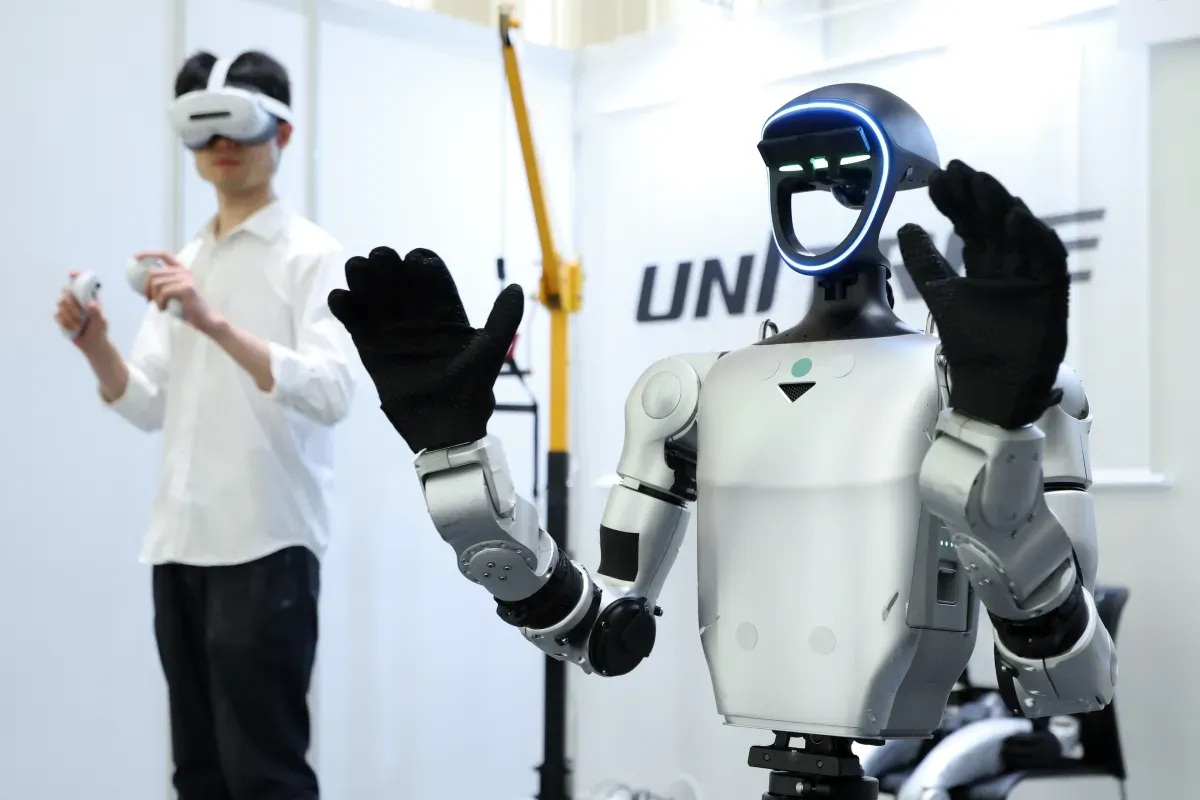
Vishwanath says robotics is in a 'Lego era.' In her view, its basic building blocks, including actuators, robot hands, software and safety standards, are still changing. Better pretraining alone cannot fix physical components or standards, so she doubts that a general robot foundation model is close. [1]
General Intuition takes the opposite view. It raised $320M at a $2.3B valuation on the bet that one model, pretrained on video-game footage paired with player controller inputs, can make much specialized robotics work redundant. The company reports that 8 minutes of real-world fine-tuning was enough to run a four-legged robot in a busy office. That figure has no independent replication or published evaluation protocol in the reviewed sources. [3]
Berkeley roboticist Ken Goldberg estimates that robots have roughly 100,000 years less training data than LLMs. This is a rough estimate, not a measurement. He argues for deploying working engineered systems first and collecting data from them in operation, which is closer to Vishwanath's incremental path than to scaling the way LLMs did. [4] [7]
Vishwanath defines physical AI broadly, covering molecules, materials and medicines as well as robots. Techable VC has made eight early-stage investments, including Trener Robotics, Syncere, AlphaZ and Andromeda Surgical. It targets problems such as worker shortages at family-run factories and surgeon burnout. [2] [6]
no reviewed source benchmarks foundation-model, simulation and engineering-first approaches against each other.
Read the full assessment
Implication: until one does, builders should treat hardware and safety work as necessary either way, while specialized robot software carries most risk if general models arrive.
Executive brief
Robotics doesn't have a ChatGPT moment yet because its basic parts are still being rebuilt. That is the argument of Amulya Vishwanath, who led product marketing for Nvidia's robotics platforms for seven years. She calls this the "Lego era": actuators, robot hands, software and safety standards are all still in flux (TechCrunch). Her view directly opposes General Intuition, a startup valued at $2.3B. Its CEO says one general foundation model will soon make much specialized robotics work redundant (TechCrunch). Vishwanath now runs Techable VC, which writes early checks in physical AI.
What changed and event timeline
Berkeley roboticist names the "data gap."
Ken Goldberg estimates robots lack about 100,000 years' worth of training data compared with LLMs. He argues for combining classic engineering with data collection ().
Nvidia pitches a full robotics stack
At CES, Nvidia released GR00T N1.6 (an open vision-language-action model for humanoid robots) and its Cosmos world models, which generate simulated training environments. Coverage framed the goal as becoming the "Android" of generalist robots ().
General Intuition bets on one model
The company raised $320M at a $2.3B valuation. It argues that a model trained on gameplay data makes collecting large amounts of real-world robot data unnecessary ().
Techable VC goes public
UC Berkeley Haas reported that Vishwanath's firm has made eight early-stage investments since its first close, in robotics, materials science and AI-enabled life sciences ().
The "Lego era" argument airs
On TechCrunch's Equity podcast, Vishwanath disputes the idea of an imminent general foundation model for robots and describes where she writes first checks (;).
Capabilities and access
- Techable VC: an early-stage fund; its size is not disclosed.
- Opposing model: General Intuition's foundation model, offered to other robotics companies rather than used in robots it builds itself. No public version name (TechCrunch).
- Platform layer: Nvidia's Isaac GR00T N1.6 and Cosmos models are open-source on GitHub (Unite.AI).
Read the full section
- Techable VC: an early-stage fund; its size is not disclosed. Named portfolio companies are Trener Robotics (industrial robot skills), Syncere (robotic lamps for chores), AlphaZ (construction, security and inspection robots) and Andromeda Surgical (Berkeley Haas).
- Opposing model: General Intuition's foundation model, offered to other robotics companies rather than used in robots it builds itself. No public version name (TechCrunch).
- Platform layer: Nvidia's Isaac GR00T N1.6 and Cosmos models are open-source on GitHub (Unite.AI).
Technical analysis for researchers and developers
The debate is about where the bottleneck sits: None of the reviewed sources includes a benchmark comparing these approaches.
Read the full section
The debate is about where the bottleneck sits:
- Data and pretraining camp: General Intuition trains on millions of hours of video game footage paired with the controller inputs players made. It reports that 8 minutes of real-world fine-tuning was enough to run a four-legged robot in an office with people moving around (TechCrunch).
- Simulation camp: Nvidia says it generated 780,000 synthetic trajectories in 11 hours, and that mixing synthetic and real data improved GR00T N1 by 40% (Unite.AI).
- Hardware camp: Vishwanath's "Lego era" points to physical parts (actuators, hands) and safety standards. Better pretraining does not fix those.
None of the reviewed sources includes a benchmark comparing these approaches.
Claims and evidence
- The "8 minutes of fine-tuning" result is company-reported. The reviewed sources contain no independent replication or published evaluation protocol (TechCrunch).
- The GR00T 40% improvement is Nvidia's own number, as relayed in trade coverage (Unite.AI).
- The 100,000-year data gap is a back-of-envelope estimate in peer-reviewed commentary (Science Robotics PDF). It is not a measured quantity.
Read the full section
- The "8 minutes of fine-tuning" result is company-reported. The reviewed sources contain no independent replication or published evaluation protocol (TechCrunch).
- The GR00T 40% improvement is Nvidia's own number, as relayed in trade coverage (Unite.AI).
- The 100,000-year data gap is a back-of-envelope estimate in peer-reviewed commentary (Science Robotics PDF). It is not a measured quantity.
- "Lego era" is an investor's framing. The reviewed sources give no quantitative support for it (TechCrunch).
Context and prior work
Goldberg's August 2025 Science Robotics papers argued that the "good old-fashioned engineering" route can close the data gap (Science Robotics PDF). His model is to deploy a working engineered system first, then collect operational data from it, as Waymo and Ambi Robotics did (Berkeley Research). Vishwanath's view lines up with that incremental path. De Witte's view mirrors how LLMs scaled (TechCrunch).
Limitations, safety and contested findings
- The disagreement is open. On the "foundation model" side are General Intuition and, through its platform strategy, Nvidia.
- Goldberg warns that overpromising risks a speculative investment bubble. He rejects timelines of 5–10 years for surgical or household robots (Berkeley Research).
- Vishwanath lists safety standards among the building blocks still being rebuilt (TechCrunch).
Read the full section
- The disagreement is open. On the "foundation model" side are General Intuition and, through its platform strategy, Nvidia. On the "components and engineering" side are Vishwanath and Goldberg.
- Goldberg warns that overpromising risks a speculative investment bubble. He rejects timelines of 5–10 years for surgical or household robots (Berkeley Research).
- Vishwanath lists safety standards among the building blocks still being rebuilt (TechCrunch).
- Vishwanath has a financial stake in the component-level thesis, and General Intuition has one in the foundation-model thesis.
Business and practitioner implications
- Investors: Vishwanath defines physical AI broadly as "a molecule, a material, a medicine," not just robots.
- Builders: if general models do arrive, specialized robot software is the layer most at risk (TechCrunch).
- Developers: Nvidia's open GR00T and Cosmos releases make it cheap to try simulation-heavy pipelines (Unite.AI).
Read the full section
- Investors: Vishwanath defines physical AI broadly as "a molecule, a material, a medicine," not just robots. She targets problems like worker shortages in family-run factories and surgeon burnout, and describes her Nvidia network as an advantage for due diligence and customer introductions (TechCrunch podcast).
- Builders: if general models do arrive, specialized robot software is the layer most at risk (TechCrunch). Hardware and safety work stays necessary under either thesis.
- Developers: Nvidia's open GR00T and Cosmos releases make it cheap to try simulation-heavy pipelines (Unite.AI).
The source trail.
Sources (7)
An Nvidia insider-turned-VC on why robotics hasn’t hit its ChatGPT moment, yet
Article text retrieved; extracted text may omit tables or interactive elements.
techcrunch.com