
CodingSoftware & developer tools
Simon Willison releases a browser LaTeX renderer, built with Claude Code, that stores the whole document in the URL
Simon Willison used Claude Code to build a free browser-based LaTeX viewer that keeps the entire document in the URL fragment. It borrows the link-as-document pattern from Aboard's Tiny Little Office, which launched a day earlier and documents its URL formats for AI agents.
From the Simon Willison article of October 15, 2026 and cited sources: The renderer keeps LaTeX source in the URL fragment, which browsers never send to a server. [1] [5]
SOURCES[1] Simon Willison: LaTeX renderer (2026-10-15) simonwillison.net[5] LaTeX renderer tool tools.simonwillison.net
 AT Pulse research deskPublished · Updated · 4 min read · AI-assisted analysis
AI-assisted, not human-edited. Methodology Corrections Who owns this site
- What happened
- The renderer keeps LaTeX source in the URL fragment, which browsers never send to a server. [1] [5]
- Original source
- Simon Willison article, independent perspective
- Brief by
- AT Pulse research desk AI-assisted; publisher and contact on the desk page
- When
- October 15, 2026 article published
- Covered
- Oct 17 edition
- Evidence
- 11 sources across 10 sites
- 1Simon Willison: LaTeX renderer (2026-10-15)simonwillison.net
- 2Aboard: Introducing TinyLittleOffice.comaboard.com
- 3Simon Willison: markdown-svg-renderer (2026-05-28)simonwillison.net
- 4Flaming Hydra issue 669flaminghydra.com
- 5LaTeX renderer tooltools.simonwillison.net
- 6Tiny Little Office llms.txttinylittleoffice.com
Reach: not measured yet
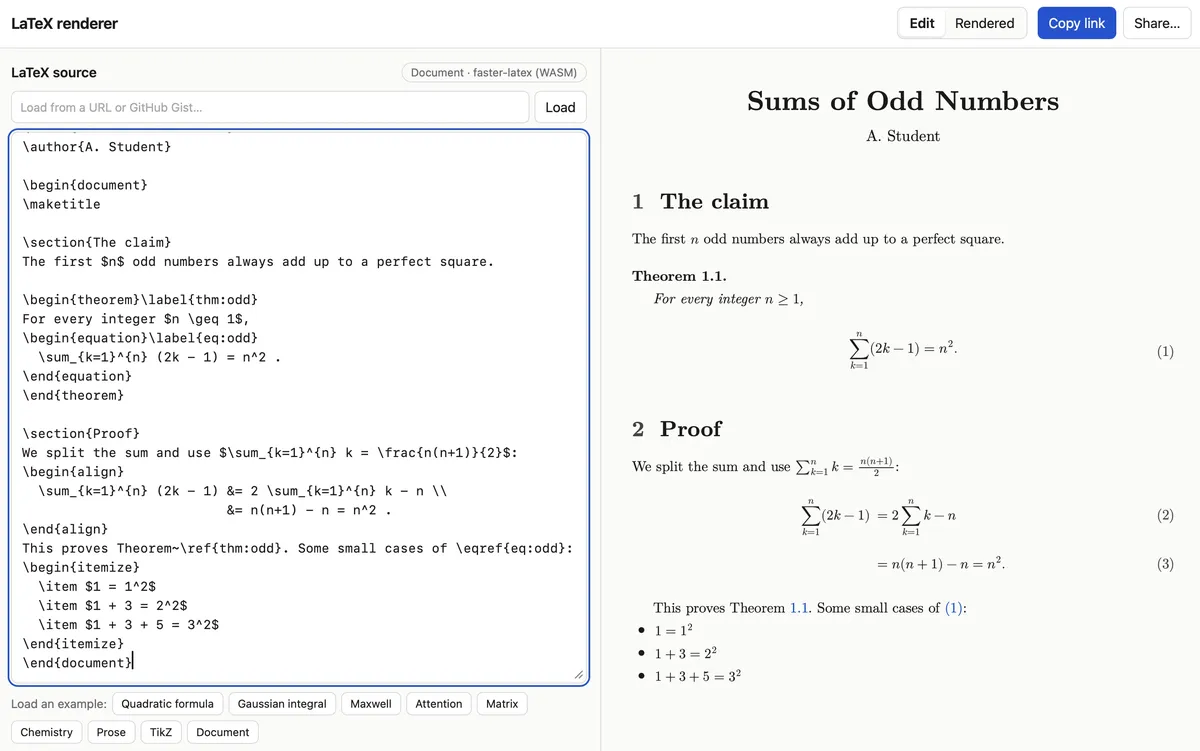
The renderer keeps LaTeX source in the URL fragment, which browsers never send to a server. MathJax typesets bare formulas, and a WebAssembly build of faster-latex handles prose and full documents. Content can load as raw text, as a compressed LaTeX-tuned form or from a remote file or Gist. Output exports to PNG, SVG or PDF. [1] [5]
Willison's own account shows a coding agent copied a day-old document pattern to a new format. The likely implication, still inferred, is more cheap, serverless documents that agents can read, with no access control beyond holding the link.
Executive brief
Simon Willison released a LaTeX renderer whose whole document lives in the link: the LaTeX source sits in the URL fragment (the part after "#"), not on a server. Claude Code built it from a handful of plain-English prompts. It copies the "the link is the document" idea that Paul Ford's Tiny Little Office launched a day earlier. That project also publishes an llms.txt file so AI agents can write documents straight into URLs. The tool is a small personal utility. Its wider point is that URL-encoded, agent-readable documents are becoming a design pattern. No independent coverage of the renderer itself turned up; only Tiny Little Office has outside reporting.
What changed and event timeline
Sandboxed Markdown/SVG tool ships
Willison's Markdown/SVG renderer runs content in a sandboxed iframe and loads from URLs or Gists. The LaTeX tool later reused both features.
Tiny Little Office launches
Aboard released an MIT-licensed suite of 10 browser apps that keep documents in the URL, with an optional encrypted short-link service.
More detail
LaTeX renderer published
Willison describes prompting Claude Code to build a fragment-based LaTeX viewer that also supports a compressed, LaTeX-tuned link format.
Capabilities and access
- Bare formulas are typeset by MathJax. Prose, sections, lists and full
\documentclassdocuments go to faster-latex, which runs as WebAssembly. - There are three ways to load content: raw text after
#, a compressed#~1…form, or?url=pointing at a file or Gist. - Exports PNG, SVG and PDF, plus a copy of the LaTeX source.
Read the full section
- Free at tools.simonwillison.net/latex. Bare formulas are typeset by MathJax. Prose, sections, lists and full
\documentclassdocuments go to faster-latex, which runs as WebAssembly. - There are three ways to load content: raw text after
#, a compressed#~1…form, or?url=pointing at a file or Gist. - Exports PNG, SVG and PDF, plus a copy of the LaTeX source.
- Built with Claude Code (Opus 5.5 Extra). Dependencies: Pako 2.1.0, MathJax 4.1.3, faster-latex 0.3.1 and DOMPurify 3.4.16 (post).
Technical analysis for researchers and developers
- Where the data lives: Browsers don't send the URL fragment to the server, so the page itself never stores the document.
- Compression: Willison asked for a custom compression dictionary tuned to LaTeX, presumably applied through Pako, a zlib library (post).
- Rendering pipeline: DOMPurify sanitizes the output and an iframe sandbox isolates it, a pattern taken from the earlier tool (May post).
Read the full section
- Where the data lives: Browsers don't send the URL fragment to the server, so the page itself never stores the document. Tiny Little Office relies on the same fact (Aboard).
- Compression: Willison asked for a custom compression dictionary tuned to LaTeX, presumably applied through Pako, a zlib library (post). The post publishes no compression ratios.
- Rendering pipeline: DOMPurify sanitizes the output and an iframe sandbox isolates it, a pattern taken from the earlier tool (May post).
- Reproducibility: The prompt sequence is published. The reviewed sources say nothing about how faster-latex works inside.
Claims and evidence
- The tool was built mostly by prompting Claude Code: this is Willison's own account, with the prompts shown (post).
- Tiny Little Office is agent-friendly: its llms.txt documents the URL formats, and its GitHub README offers a Claude skill.
- Short links are encrypted and the server never sees the key: this is Aboard's claim (announcement). The reviewed sources include no independent security audit.
Read the full section
- The tool was built mostly by prompting Claude Code: this is Willison's own account, with the prompts shown (post).
- Tiny Little Office is agent-friendly: its llms.txt documents the URL formats, and its GitHub README offers a Claude skill. Both come from Aboard.
- Short links are encrypted and the server never sees the key: this is Aboard's claim (announcement). The reviewed sources include no independent security audit.
- The tool is protected against XSS: the protections (sandbox plus DOMPurify) are documented, but nobody outside has tested them.
Context and prior work
- Running LaTeX in the browser via WebAssembly isn't new. SwiftLaTeX compiles the XeTeX and PdfTeX engines to WebAssembly, and TUG has documented TeX running in browsers (TUGboat). LaTeX.js converts LaTeX to HTML.
- Tiny Little Office comes from Paul Ford and Rich Ziade's company Aboard, with coverage in TechRadar.
- The LaTeX tool adds to Willison's collection of single-page tools in the simonw/tools repo.
Read the full section
- Running LaTeX in the browser via WebAssembly isn't new. SwiftLaTeX compiles the XeTeX and PdfTeX engines to WebAssembly, and TUG has documented TeX running in browsers (TUGboat). LaTeX.js converts LaTeX to HTML.
- Tiny Little Office comes from Paul Ford and Rich Ziade's company Aboard, with coverage in TechRadar.
- The LaTeX tool adds to Willison's collection of single-page tools in the simonw/tools repo.
Limitations, safety and contested findings
Read the full section
- Long documents make long URLs. Tiny Little Office advises keeping hand-written links under 2,000 characters (llms.txt) and admits long links get unwieldy in chat (Aboard).
- Tiny Little Office has no images, video or real-time collaboration, and its short links expire after one month (Aboard).
- Loading from
?url=means rendering content a third party controls. That is why Willison asked for sandboxing (post). - Anyone who has a link has the document (README).
Business and practitioner implications
- Easy for agents to target: A documented URL format plus llms.txt lets agents produce shareable documents without any API, account or storage (llms.txt).
- Low cost: There is little server state to run, and the privacy story is simple.
- Fast copying: A single developer reproduced the pattern for a new format within a day by prompting a coding agent (post).
Read the full section
- Easy for agents to target: A documented URL format plus llms.txt lets agents produce shareable documents without any API, account or storage (llms.txt).
- Low cost: There is little server state to run, and the privacy story is simple. In exchange, there is no access control beyond who holds the link.
- Fast copying: A single developer reproduced the pattern for a new format within a day by prompting a coding agent (post). Expect format-specific tools built on fragment links to multiply.
- Security before sharing: Teams adopting this should sanitize and sandbox untrusted fragment or URL content by default.