
InfrastructureCompute, chips & cloud
AI infrastructure bottlenecks are becoming a materials R&D problem
A Syensqo-sponsored MIT Technology Review Insights article argues that AI data centers and semiconductor systems now depend on advances in power, cooling, sealing, and specialty materials. Independent literature supports the broad infrastructure pressure, but Syensqo-specific performance claims remain vendor-reported.
 AT Pulse research deskSeptember 17, 2026 · 9 min read · AI-assisted analysis
AI data-center growth is stressing power delivery and thermal management, with technical literature pointing to higher-voltage, DC-distribution, and liquid-cooling approaches that raise new materials requirements. [10] [11]
The Syensqo-sponsored source frames specialty materials as enabling higher-voltage data centers, semiconductor-fab reliability, and immersion-cooling systems, but its company-specific commercial claims are not independently validated in the reviewed research. [1] [9]
The evidence supports a broad shift: AI infrastructure is not only constrained by chips and algorithms, but also by power architectures, cooling systems, seals, fluids, and manufacturable materials.
Read the full assessment
The implication for business and technical leaders is to treat materials choices as part of the compute roadmap. Agentic R&D systems may help prioritize candidates, but buying or deploying them should depend on lab validation, lifecycle analysis, reliability data, and reproducible workflows—not on the number of candidates screened.
Executive brief
On September 16, 2026, MIT Technology Review’s Business Lab published a Syensqo-sponsored interview/article arguing that AI infrastructure is becoming a materials problem as much as a compute or algorithm problem. The source is useful as a vendor-view snapshot, but it is not independent editorial reporting: the transcript states it was produced by MIT Technology Review Insights, its custom-content arm, in partnership with Syensqo. Separately, IEA-4E’s 2026 liquid-cooling report says liquid cooling can improve data-center energy efficiency but is constrained by standardization, upfront cost, reliability concerns, and retrofit difficulty.
Read the full section
On September 16, 2026, MIT Technology Review’s Business Lab published a Syensqo-sponsored interview/article arguing that AI infrastructure is becoming a materials problem as much as a compute or algorithm problem. The source is useful as a vendor-view snapshot, but it is not independent editorial reporting: the transcript states it was produced by MIT Technology Review Insights, its custom-content arm, in partnership with Syensqo.
The central thesis is plausible and partly corroborated by independent technical literature: AI data centers are pushing limits in power delivery, thermal management, reliability, and semiconductor manufacturing, while AI tools are increasingly used to search chemical and materials design spaces. A 2026 technical review of AI data-center power delivery similarly identifies rising power demand, current transients, and thermal stress as drivers for higher-voltage and DC-distribution architectures. Toward Next-Generation AI Data Centers: Power Delivery Architecture Shifts, Emerging Technologies, and Challenges Separately, IEA-4E’s 2026 liquid-cooling report says liquid cooling can improve data-center energy efficiency but is constrained by standardization, upfront cost, reliability concerns, and retrofit difficulty. Liquid Cooling in Data Centres - 4E Energy Efficient End-use Equipment
What is less independently established is the article’s Syensqo-specific performance narrative: that Syensqo’s materials, Microsoft Discovery workflows, and sustainability-screening approach are already compressing specific R&D cycles or enabling particular AI-infrastructure deployments at commercial scale. Syensqo and Microsoft say Syensqo is using Microsoft Discovery to screen millions of molecular candidates for heat-transfer fluids and predict properties such as thermal performance, dielectric strength, and safety, but public evidence found for this dossier is company-reported, not an independently reproduced evaluation. Syensqo and Microsoft scale AI-driven discovery and growth | Syensqo
What changed and event timeline
- Context
Prior context: AI infrastructure pressure
AI accelerators and dense server racks have increased attention on rack-level power, heat removal, packaging, and supply-chain inputs. This supports the source’s broad claim that higher voltage, energy density, and thermal requirements are changing material requirements.
More detail
A 2026 paper on next-generation AI data centers describes three power-architecture shifts: higher in-rack DC bus voltages, facility-level DC distribution, and eventual medium-voltage solid-state transformer interfaces.
Syensqo–Microsoft collaboration foundation
Syensqo says its 2026 work builds on a 2025 memorandum of understanding with Microsoft. The public Syensqo release frames the collaboration as covering R&I, sales, and commercial activities rather than only laboratory research.
Microsoft Discovery expanded preview
Microsoft described Discovery as an extensible R&D platform combining agentic orchestration, graph-based knowledge, advanced reasoning, and high-performance computing; the April blog still described it as in preview and warned that features and performance could change.
Microsoft says Discovery is generally available
In a July 22, 2026 Microsoft blog, Microsoft said Discovery was “now generally available” and included autonomous lab orchestration, AI models for science, agentic memory, data curation, and governance features.
MIT Technology Review Insights/Syensqo episode
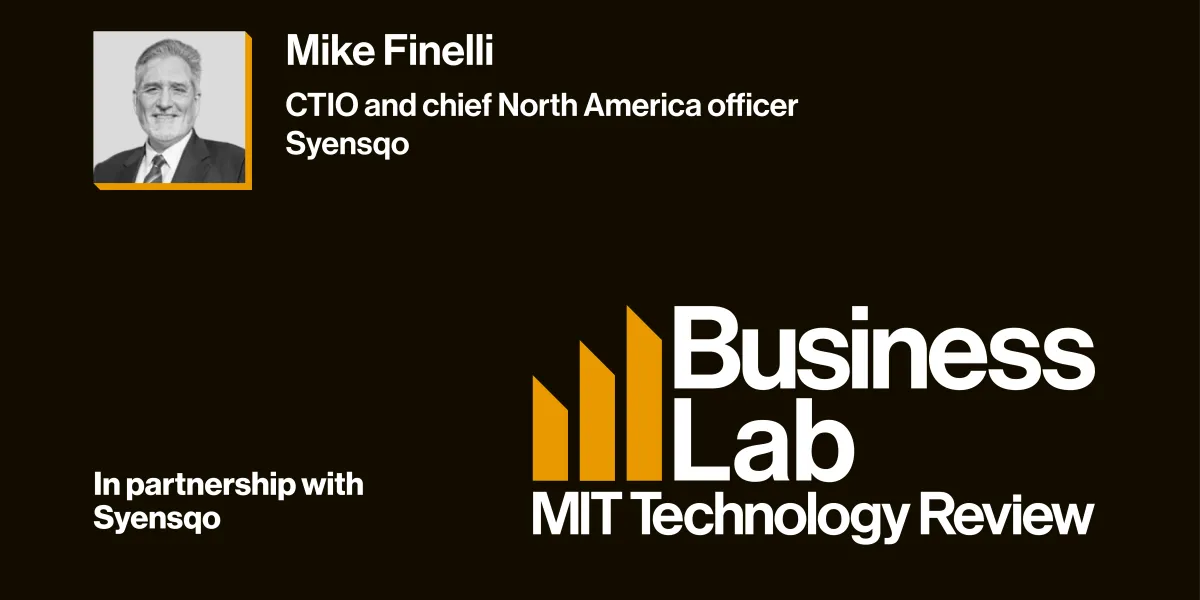
Mike Finelli, Syensqo’s chief technology and innovation officer and chief North America officer, argued that AI is pushing semiconductors and data centers to physical limits. Syensqo is developing materials for high-voltage data-center architectures, semiconductor fab sealing, and immersion-cooling fluids.
More detail
And AI agents are helping Syensqo triage molecular candidates before lab testing.
Capabilities and access
The Syensqo interview does not identify a specific foundation model, checkpoint, chemistry model, or version number. It refers generally to “AI agents” and “Microsoft Discovery.” Access appears to have evolved during 2026: Microsoft’s April 2026 Azure blog described expanded preview access, while a July 2026 Microsoft corporate blog described Microsoft Discovery as generally available.
Read the full section
The Syensqo interview does not identify a specific foundation model, checkpoint, chemistry model, or version number. It refers generally to “AI agents” and “Microsoft Discovery.” Public Microsoft documentation says Discovery agents are built on Foundry Agent Service and that Discovery Agent V2 redesigned the agent architecture with data-plane resources, workspace-level shared model deployments, per-message @AgentName routing, YAML export, immutable versioning, and project binding. Microsoft Discovery Agent Concepts | Microsoft Learn
Microsoft’s REST/API documentation presents Discovery as a modular platform containing workspaces, projects, investigations, agents, containerized tools, models, a “Bookshelf” knowledge base, and supercomputers for HPC workloads. It also says organizations can integrate their own AI models, package scientific software as containers, connect external and proprietary data sources, and define multi-agent workflows. Microsoft Discovery Overview | Microsoft Learn
Access appears to have evolved during 2026: Microsoft’s April 2026 Azure blog described expanded preview access, while a July 2026 Microsoft corporate blog described Microsoft Discovery as generally available. Microsoft Discovery: Advancing agentic R&D at scale | Microsoft Azure Blog For practitioners, that means claims about availability should be checked against current Azure tenant eligibility, licensing, and regional availability before planning deployment.
Technical analysis for researchers and developers
The documented architecture is an agent-orchestrated R&D platform, not a single materials model. Public Syensqo/Microsoft materials support the high-level version: Syensqo says it is screening millions of molecular candidates and predicting thermal performance, dielectric strength, and safety for next-generation heat-transfer fluids.
Read the full section
Architecture
The documented architecture is an agent-orchestrated R&D platform, not a single materials model. Discovery’s public architecture combines:
- natural-language interaction through a Copilot-style interface;
- agent teams for planning, retrieval, tool use, and analysis;
- HPC resources for simulations;
- containerized scientific tools;
- knowledge bases for internal and external literature; and
- enterprise security/governance controls. Microsoft Discovery Overview | Microsoft Learn
In the Syensqo use case, Finelli describes a pipeline with agents that: digitally synthesize molecular combinations, run or invoke physics-based simulations, predict properties including sustainability/toxicity-related attributes, rank candidates, and hand a reduced candidate list to laboratory scientists. Public Syensqo/Microsoft materials support the high-level version: Syensqo says it is screening millions of molecular candidates and predicting thermal performance, dielectric strength, and safety for next-generation heat-transfer fluids. Syensqo and Microsoft scale AI-driven discovery and growth | Syensqo
Evaluation and reproducibility
No public Syensqo benchmark, candidate set, wet-lab validation dataset, error bars, or reproducible workflow was found. That is the main technical gap. Developers should treat the Syensqo claims as a case-study assertion, not as a validated benchmark.
By contrast, the broader field has more reproducible examples. Microsoft’s MatterGen paper in Nature describes a diffusion-based generative model for inorganic materials design and says associated datasets/code artifacts are available via GitHub; it reports synthesis and measurement of at least one generated material as proof of concept. A generative model for inorganic materials design | Nature PNNL/Microsoft work on battery materials combined AI and cloud HPC to screen more than 32 million candidates and identify 18 promising solid-electrolyte candidates; this is a stronger public example because it appears in peer-reviewed/publication channels rather than only sponsored content. Accelerating Computational Materials Discovery with Machine Learning and Cloud High-Performance Computing: from Large-Scale Screening to Experimental Validation | Journal Article | PNNL
Still, materials-discovery evaluation is hard. A 2025 npj Computational Materials perspective notes that materials foundation models face limits in clean datasets, novelty, generalization, and benchmarks, especially because discovery requires extrapolating into underrepresented chemical spaces. Foundation models for materials discovery – current state and future directions | npj Computational Materials
Implementation implications
For developers, the practical implementation pattern is likely: connect ELNs/LIMS and historical test data; containerize physics or chemistry codes; build retrieval over internal literature, SDS/regulatory data, and patent corpora; enforce provenance; and keep humans in the loop for synthesis feasibility, safety, and manufacturability. Microsoft’s documentation supports this “bring your own tools/data/models” architecture. Microsoft Discovery Overview | Microsoft Learn
Claims and evidence
- AI infrastructure is stressing power delivery and thermal systems.
- Data centers are moving toward higher-voltage architectures.
- Liquid cooling can improve data-center efficiency.
Read the full section
| Claim | Evidence status |
| AI infrastructure is stressing power delivery and thermal systems. | Independently supported by 2026 power-delivery review and liquid-cooling literature. Toward Next-Generation AI Data Centers: Power Delivery Architecture Shifts, Emerging Technologies, and Challenges |
| Data centers are moving toward higher-voltage architectures. | Independently supported directionally; specific adoption rates not established here. Toward Next-Generation AI Data Centers: Power Delivery Architecture Shifts, Emerging Technologies, and Challenges |
| Liquid cooling can improve data-center efficiency. | Independently supported, with caveats on standardization, cost, reliability, and retrofit barriers. Liquid Cooling in Data Centres - 4E Energy Efficient End-use Equipment |
| Syensqo is using Microsoft Discovery to screen molecular candidates for heat-transfer fluids. | Vendor-reported by Syensqo/Microsoft; no independent reproduced evaluation found. Syensqo and Microsoft scale AI-driven discovery and growth | Syensqo |
| Microsoft Discovery provides multi-agent orchestration, HPC integration, tools, knowledge bases, and enterprise governance. | Official Microsoft documentation; not independent performance validation. Microsoft Discovery Overview | Microsoft Learn |
| AI materials discovery is maturing but remains limited by data quality, novelty, benchmark design, and experimental validation. | Supported by peer-reviewed/perspective literature. Foundation models for materials discovery – current state and future directions | npj Computational Materials |
Context and prior work
Syensqo’s argument fits into a broader shift from trial-and-error materials R&D toward predict-and-verify loops. Microsoft Research’s MatterGen represents a generative approach: generate candidate inorganic materials conditioned on target properties rather than merely screening existing structures. A generative model for inorganic materials design | Nature Nature’s 2025 coverage summarized broader skepticism about whether millions of AI-proposed materials are practically useful.
Read the full section
Syensqo’s argument fits into a broader shift from trial-and-error materials R&D toward predict-and-verify loops. Microsoft Research’s MatterGen represents a generative approach: generate candidate inorganic materials conditioned on target properties rather than merely screening existing structures. A generative model for inorganic materials design | Nature Google DeepMind’s GNoME and automated lab work also pushed the field toward large-scale computational candidate generation, but those efforts triggered criticism about novelty, duplicates, and the meaning of “new” materials. Nature’s 2025 coverage summarized broader skepticism about whether millions of AI-proposed materials are practically useful. AI is dreaming up millions of new materials. Are they any good? | Nature
For semiconductor manufacturing, the materials story is not only about chips themselves. Seals, polymers, fluids, and contamination-control materials can affect uptime and process yield. Literature on semiconductor sealing materials identifies fluoroelastomers and perfluoroelastomers as commonly used in wafer-processing equipment exposed to thermal, wet-chemical, and plasma environments. Perfluoroelastomer and fluoroelastomer seals for semiconductor wafer processing equipment - ScienceDirect That supports the plausibility of Finelli’s “and, and, and” framing: temperature, purity, plasma resistance, outgassing, electrical properties, and chemical compatibility accumulate into difficult multi-objective constraints.
Limitations, safety, and contested findings
The largest limitation is evidentiary: the core article is sponsored custom content, and the most commercially specific claims are made by Syensqo executives. Safety and sustainability claims also need scrutiny. Recent benchmarking work argues that materials-discovery models need prospective evaluation, not only retrospective stability metrics.
Read the full section
The largest limitation is evidentiary: the core article is sponsored custom content, and the most commercially specific claims are made by Syensqo executives. No independent lab validation of Syensqo’s Microsoft Discovery-generated candidates, no named coolant chemistry, no benchmark suite, no lifecycle assessment, and no deployment data from a hyperscaler or semiconductor fab were found in the reviewed sources.
Safety and sustainability claims also need scrutiny. “Lower environmental impact” depends on lifecycle boundaries, toxicity, persistence, GWP, manufacturing emissions, end-of-life handling, and regulatory exposure. Syensqo’s Sustainable Portfolio Management methodology considers manufacturing footprints and application-level social/environmental effects, and it references REACH, SVHC, and SIN-list considerations, but this remains Syensqo’s internal framework even if it is auditable and third-party reviewed. Sustainable Portfolio Management (SPM) tool | Syensqo
AI-generated materials introduce additional risks: hallucinated synthesis routes, overconfident property prediction, hidden training-data leakage, and poor out-of-distribution performance. Recent benchmarking work argues that materials-discovery models need prospective evaluation, not only retrospective stability metrics. A framework to evaluate machine learning crystal stability predictions | Nature Machine Intelligence
Business and practitioner implications
For AI infrastructure leaders, materials should be treated as part of the compute roadmap: power architecture, coolant choice, seals, connectors, insulation, and thermal interfaces can constrain density and reliability. Do not count “millions screened” as business value without downstream yield, reliability, safety, and cost evidence.
Read the full section
For AI infrastructure leaders, materials should be treated as part of the compute roadmap: power architecture, coolant choice, seals, connectors, insulation, and thermal interfaces can constrain density and reliability.
For R&D executives, the Syensqo case suggests a plausible operating model: use agentic systems to narrow candidate spaces, but budget for validation, regulatory review, and pilot manufacturing. Do not count “millions screened” as business value without downstream yield, reliability, safety, and cost evidence.
For developers, the defensible architecture is provenance-first: version models, datasets, prompts, simulation containers, and lab results; preserve failed experiments; and make candidate-ranking criteria inspectable.
For investors and business buyers, the near-term signal is not “AI discovers materials autonomously,” but “AI may improve prioritization in multi-constraint R&D.” The commercial moat will likely sit in proprietary test data, process knowledge, customer qualification cycles, and manufacturing scale—not just in access to generic agents.
Sources
Primary/source text: MIT Technology Review Insights / Syensqo transcript, published 2026-09-16.
Key live sources used: Syensqo–Microsoft collaboration release; Microsoft Discovery documentation and Azure blog; 2026 AI data-center power-delivery review; IEA-4E liquid-cooling report; Nature MatterGen paper; PNNL/Microsoft battery-materials publication page; materials-discovery benchmarking and foundation-model literature.
The source trail.
Sources (15)
Building the materials foundation for AI
Article text retrieved; extracted text may omit tables or interactive elements.
technologyreview.com