
PolicyLaw, regulation & governance
YouTube Music adds three-tier AI labels to songs but keeps AI tracks eligible for monetization
YouTube Music now tags songs as Fully Gen AI, Partly Gen AI or No Gen AI, using partner declarations and its own detection. Unlike Deezer and TIDAL, it does not restrict monetization of AI-generated tracks.
From the TechCrunch AI article of October 14, 2026 and cited sources: Music partners choose one of three tiers, and YouTube also runs its own detection tools. [1] [9]
SOURCES[1] TechCrunch: YouTube Music launches new labels as… techcrunch.com[9] AllHipHop: YouTube Music Adds AI Song Labels With Rules… allhiphop.com
 AT Pulse research deskPublished · Updated · 5 min read · AI-assisted analysis
AI-assisted, not human-edited. Methodology Corrections Who owns this site
- What happened
- Music partners choose one of three tiers, and YouTube also runs its own detection tools. [1] [9]
- Original source
- TechCrunch AI article, independent perspective
- Brief by
- AT Pulse research desk AI-assisted; publisher and contact on the desk page
- When
- October 14, 2026 article published
- Covered
- Oct 15 edition
- Evidence
- 9 sources across 8 sites
- 1TechCrunch: YouTube Music launches new labels as…techcrunch.com
- 2YouTube sticks new labels on AI-generated songstheverge.com
- 3RightsTech: Deezer says more than 50% of daily uploads are…rightstech.com
- 4YouTube Blog: Our approach to responsible AI innovationblog.youtube
- 5Interspace Music: AI disclosure just became a delivery fieldinterspacemusic.com
- 6MusicTech: Apple Music's new "Transparency Tags"musictech.com
Reach: not measured yet
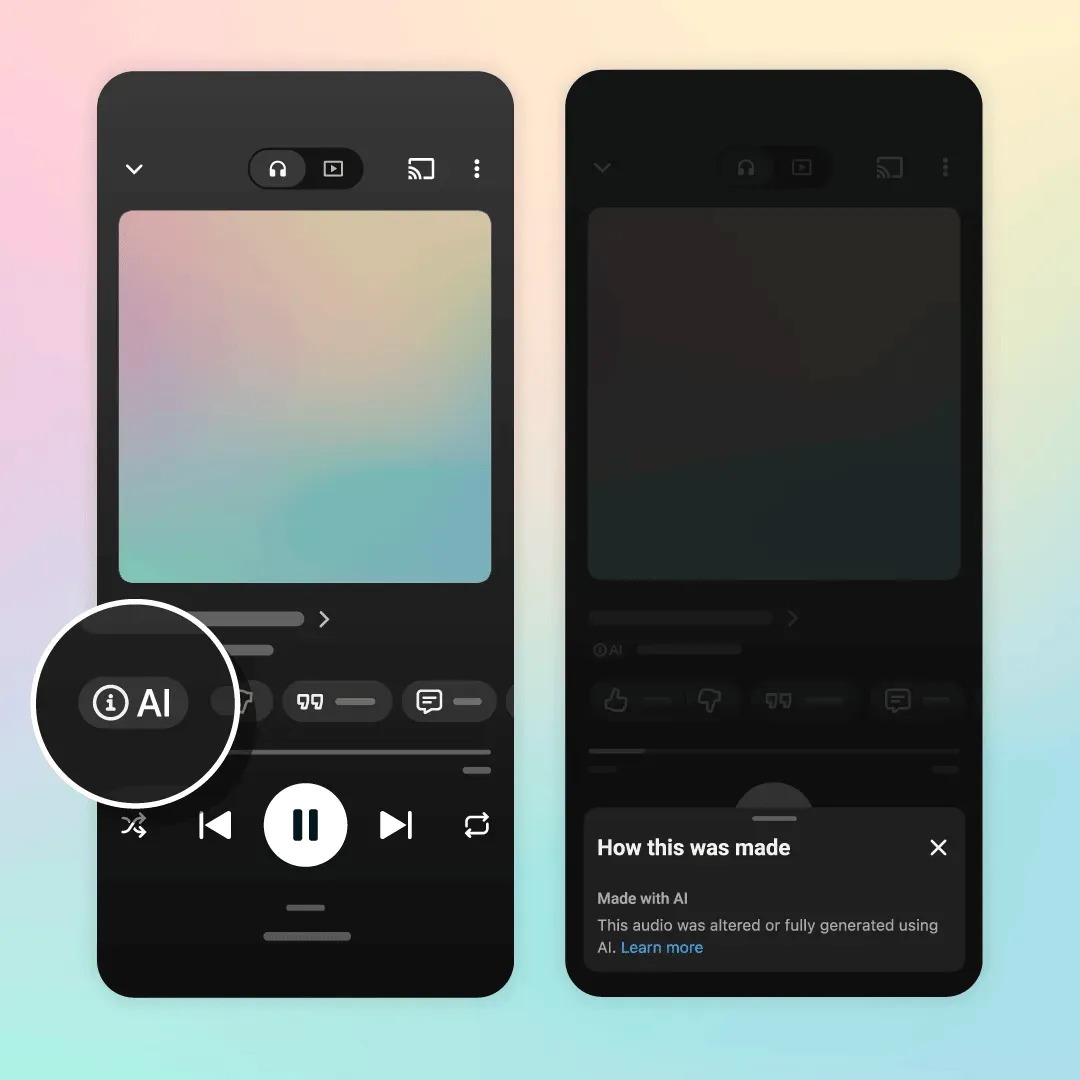
Music partners choose one of three tiers, and YouTube also runs its own detection tools. Fully Gen AI means AI produced everything, including beats and vocals. Partly Gen AI covers mixed work, such as an AI bassline under live vocals or AI help drafting verses or a melody. Auto-Tune fixes and AI mastering count as No Gen AI. Labels appear on the YouTube Music player page and in the main YouTube app, and tapping one explains what role AI played. [1] [9]
YouTube has chosen disclosure over restriction. Using AI does not stop a track from earning money. Deezer keeps AI music out of algorithmic recommendations and editorial playlists. TIDAL lets listeners hide fully AI-generated recordings and excludes them from royalties. [1]
The sources show platforms agreeing that AI use should be disclosed but splitting on taxonomy and payouts. As a result, distributors face extra metadata work, and AI-music creators may find YouTube more permissive than Deezer or TIDAL.
Read the full assessment
Label accuracy depends on detection that remains unevaluated.
Executive brief
YouTube Music has started labelling AI-generated songs, but AI use alone will not stop a track from earning money. That puts it at odds with Deezer and TIDAL, which restrict AI music, according to TechCrunch. The labels sort tracks into three tiers: Fully Gen AI, Partly Gen AI and No Gen AI. They draw on what music partners declare plus YouTube's own detection tools. The scale of the problem is large: Deezer reported in July that AI-generated tracks now make up more than half of its daily uploads, about 90,000 a day (RightsTech). YouTube is betting on disclosure rather than restriction.
What changed and event timeline
YouTube sets out its synthetic-media rules
Creators must disclose realistic altered content. Music partners in YouTube's AI experiments can request removal of AI tracks that imitate an artist's voice ().
Spotify adopts the DDEX disclosure standard
DDEX is the music industry's metadata standard body. Creators can flag AI use across vocals, instrumentation, composition, post-production and lyrics. Spotify's "AI Credits" appeared on mobile from April 16, 2026 ().
Apple announces Transparency Tags
They cover Artwork, Track, Composition and Music Video, but labels and distributors report them voluntarily ().
Deezer reports AI tracks at 44% of daily uploads
That is about 75,000 tracks a day, up from 10% in January 2025 (;).
AI passes human-made music in Deezer uploads
AI tracks are now more than 50% of daily uploads, about 90,000 a day, a level first reached in June ().
YouTube Music launches three-tier AI labels
The labels appear on the player page and in the main YouTube app. Tapping one explains what role AI played in the track ().
Capabilities and access
- Where labels show: the YouTube Music player page and the main YouTube app.
- Who declares: music partners pick one of the three tiers. YouTube also runs its own detection tools (TechCrunch).
- Not disclosed: the reviewed sources do not name the detection model, its version, accuracy, regional rollout or a launch schedule.
Read the full section
- Where labels show: the YouTube Music player page and the main YouTube app. Tapping a label gives details, such as whether AI was used for composition or vocals (TechCrunch).
- Who declares: music partners pick one of the three tiers. YouTube also runs its own detection tools (TechCrunch).
- Not disclosed: the reviewed sources do not name the detection model, its version, accuracy, regional rollout or a launch schedule.
Technical analysis for researchers and developers
- Fully Gen AI covers tracks where AI generated everything, including beats and vocals. Auto-Tune fixes and AI mastering count as No Gen AI (AllHipHop).
- YouTube's labels cover AI help with lyrics, melodies and videos. The IFPI and RIAA proposals covered sound recordings only (AllHipHop).
- YouTube uses 3 tiers, Spotify/DDEX uses 5 categories and Apple uses 4 elements.
Read the full section
- Tier definitions. Fully Gen AI covers tracks where AI generated everything, including beats and vocals. Partly Gen AI covers mixes such as an AI-generated bassline under live vocals, or AI help with verses or a melody before the artist records. Auto-Tune fixes and AI mastering count as No Gen AI (AllHipHop).
- Scope. YouTube's labels cover AI help with lyrics, melodies and videos. The IFPI and RIAA proposals covered sound recordings only (AllHipHop).
- Different taxonomies. YouTube uses 3 tiers, Spotify/DDEX uses 5 categories and Apple uses 4 elements. Anyone delivering metadata to several platforms will need to map between them.
- No evaluation. YouTube has published no detection benchmarks, false-positive rates or audit methods.
Claims and evidence
- AI use doesn't block monetization. This is YouTube's stated policy, as reported by TechCrunch.
- Only the vendor claims these exist. There is no independent assessment of how well they work.
- These are company-reported numbers from Deezer's own detector (RightsTech). They have not been independently replicated.
Read the full section
- AI use doesn't block monetization. This is YouTube's stated policy, as reported by TechCrunch.
- YouTube's detection tools. Only the vendor claims these exist. There is no independent assessment of how well they work.
- Deezer's upload figures. These are company-reported numbers from Deezer's own detector (RightsTech). They have not been independently replicated.
- Apple's timing. Sources disagree. TechCrunch says Apple's "Made With AI" labels arrive later this year. MusicTech reported in March that the tags already exist as optional metadata. Both could be true if the listener-facing labels lag behind the metadata fields.
Context and prior work
- The 2023 disclosure regime for synthetic video set the precedent, and the music labels use a similar approach (YouTube Blog).
- Stricter rivals.
- Deezer: labels AI music, keeps it out of algorithmic recommendations and editorial playlists, and withholds royalties from fraudulent streams.
Read the full section
- YouTube's earlier rules. The 2023 disclosure regime for synthetic video set the precedent, and the music labels use a similar approach (YouTube Blog).
- Stricter rivals.
- Deezer: labels AI music, keeps it out of algorithmic recommendations and editorial playlists, and withholds royalties from fraudulent streams.
- TIDAL: labels fully AI-generated recordings, lets listeners hide them and excludes them from royalties (TechCrunch).
- YouTube also makes AI music. Its Dream Track tool lets select creators generate tracks using AI versions of participating artists' voices.
Limitations, safety and contested findings
- Self-reporting is weak. Disclosure-based systems depend on what distributors choose to declare.
- It is not documented how YouTube resolves cases where its detection tools disagree with a partner's declaration (AllHipHop).
- Partly Gen AI includes AI brainstorming, while AI mastering counts as No Gen AI.
Read the full section
- Self-reporting is weak. Disclosure-based systems depend on what distributors choose to declare. MusicTech argues that Apple's optional tags alone are unlikely to keep up with the volume of AI uploads (MusicTech).
- Unclear backstop. It is not documented how YouTube resolves cases where its detection tools disagree with a partner's declaration (AllHipHop).
- Blurry line. Partly Gen AI includes AI brainstorming, while AI mastering counts as No Gen AI. Because of where that line sits, the same workflow could be labelled differently on different platforms.
Business and practitioner implications
- Distributors and labels: AI disclosure is becoming a standard delivery-metadata field.
- AI-music creators: YouTube is currently the most permissive major platform for earning money, compared with Deezer and TIDAL.
- Detection vendors: platforms combine their own detectors with partner declarations, but none have published accuracy figures. That leaves room for independent auditing.
Read the full section
- Distributors and labels: AI disclosure is becoming a standard delivery-metadata field. Pipelines need to output YouTube's 3 tiers, DDEX's 5 categories and Apple's 4 elements (Interspace Music).
- AI-music creators: YouTube is currently the most permissive major platform for earning money, compared with Deezer and TIDAL.
- Detection vendors: platforms combine their own detectors with partner declarations, but none have published accuracy figures. That leaves room for independent auditing.
The source trail.
Sources (9)
TechCrunch: YouTube Music launches new labels as AI-generated music floods streaming platforms
techcrunch.comYouTube sticks new labels on AI-generated songs
Related coverage; assess separately
theverge.com