
CodingSoftware & developer tools
Google Play lets users run private AI Studio–built Android apps without a developer account
Google Play now lets users launch Android apps they generate in Google AI Studio on their own phones using a standard Google account. The apps stay unlisted and creator-only, must follow Play policies, and are limited to adults in select markets.
From the TechCrunch AI article of October 13, 2026 and cited sources: The launch removes the main hurdle between generating an Android app and using it. [3] [1] [4]
SOURCES[3] Google Blog: Google Play updates, October 2026 blog.google[1] TechCrunch: Google Play now lets anyone build private… techcrunch.com[4] Android Developers: Build native Android apps in Google AI… developer.android.com
 AT Pulse research deskPublished · Updated · 5 min read · AI-assisted analysis
AI-assisted, not human-edited. Methodology Corrections Who owns this site
- What happened
- The launch removes the main hurdle between generating an Android app and using it. [3] [1] [4]
- Original source
- TechCrunch AI article, independent perspective
- Brief by
- AT Pulse research desk AI-assisted; publisher and contact on the desk page
- When
- October 13, 2026 article published
- Covered
- Oct 14 edition
- Evidence
- 9 sources across 8 sites
- 1TechCrunch: Google Play now lets anyone build private…techcrunch.com
- 2The Verge: Google makes it easier to launch your…theverge.com
- 3Google Blog: Google Play updates, October 2026blog.google
- 4Android Developers: Build native Android apps in Google AI…developer.android.com
- 5The Decoder: Google tests the app version of the…the-decoder.com
- 6Bitdefender: Developer verification for sideloaded appsbitdefender.com
RisingHow it’s measured
Hacker News · 15 likes · 9 comments
Reach blends public engagement (views, likes, comments, shares, stars) from the platforms where the story or its original source lives: YouTube, Hacker News, GitHub, Substack and similar. A video and the article written from its transcript share one score, taken from the video. Platforms with no data are left out rather than counted as zero, and the age of a story never lowers its score.
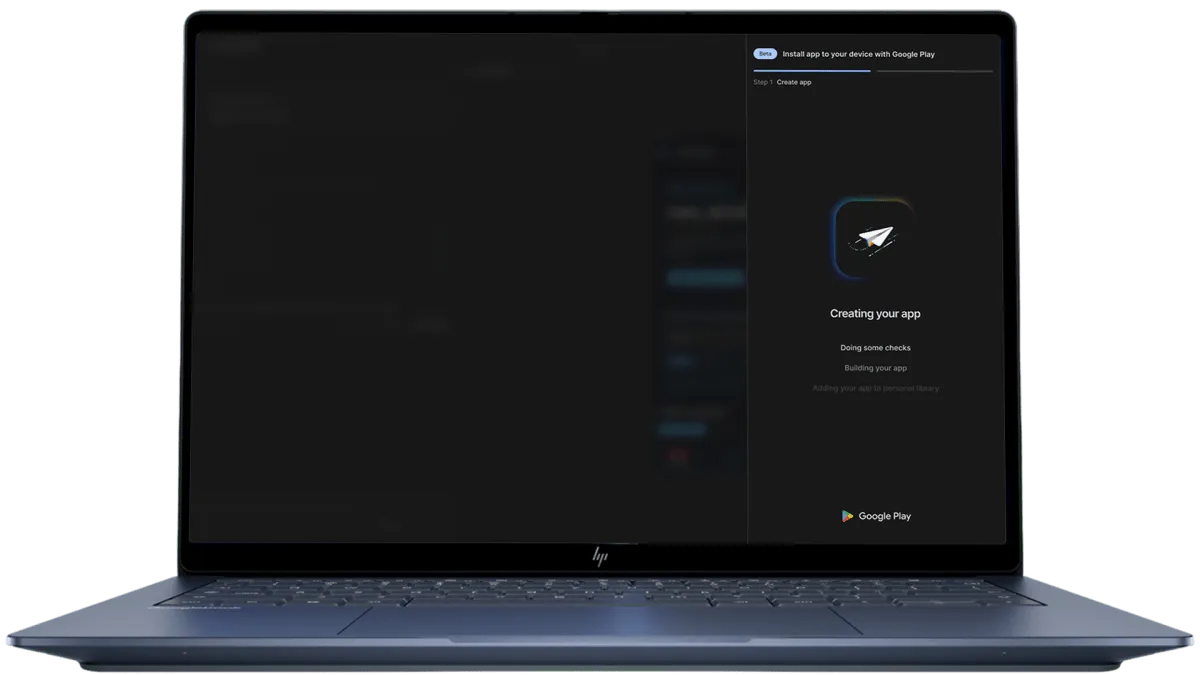
The launch removes the main hurdle between generating an Android app and using it. Until now, getting an AI Studio app onto a phone took a USB/ADB install, a Play internal test track that needs a developer account, or an export to Android Studio. Now the app runs through a private, account-scoped Play channel. Google has not documented how that channel works. [3] [1] [4]
AI Studio generates native Kotlin/Jetpack Compose apps. They can use the camera, GPS, accelerometer and Bluetooth, and can call the Gemini API. The first release covers solo personal utilities. Sharing with friends and family is promised for the coming months, and promoting an app to a public listing is not yet offered. [4] [1] [3]
The launch comes as Google tightens where Android apps can come from. Developer verification for apps on certified devices, including sideloaded ones, began in four countries in September 2026 and is due to expand globally from 2027. Personal apps give non-developers a sanctioned route that stays inside Play policy. [6] [1]
Analysts argue that free, custom-generated apps put pressure on makers of simple single-purpose apps such as trackers and checklists. Ready-made apps may still hold an advantage on security, reliability and compliance. [5]
What is established is that Play now delivers one-person software without a developer account.
Read the full assessment
The likely, but unproven, effects are pressure on simple utility apps and more informal app-making brought under Google's policy controls as sideloading tightens.
The searches are done and the dossier follows.
Executive brief
Starting October 13, 2026, an Android app you build with AI can run on your own phone through Google Play using an ordinary Google account. No developer account, no USB cable and no public listing are needed (Google). These "personal apps" are built in Google AI Studio. They don't appear in Play search and only their creator can use them. They still have to follow Play policies. The launch covers select markets including the U.S., for users 18 and over (TechCrunch). Play becomes a way to deliver one-person software, which also bears on Google's wider tightening of where Android apps can come from.
What changed and event timeline
AI Studio starts generating native Android apps
At I/O, Google added prompt-to-app generation of Kotlin/Jetpack Compose apps with a browser emulator. Getting an app onto a phone meant a USB/ADB install or a Play internal test track that needs a developer account ().
Analysts call it a "SaaSpocalypse" for apps
The Decoder argued that personal generated apps form a software layer below the marketplace, which puts pressure on makers of simple utility apps ().
Developer verification takes effect in four countries
Google's plan required apps on certified devices in Brazil, Indonesia, Singapore and Thailand to come from verified developers, including sideloaded apps. A global rollout follows from 2027 ().
Play launches private personal apps
Users can launch AI Studio–built apps through Play without a developer account. Google says sharing with friends and family comes "in the coming months" (;).
AI features added to Play discovery
Google also shipped app comparisons in Ask Play, Game Finder and wider Play-in-Gemini integration, and said Play in Gemini drove 6 million installs in two months ().
Capabilities and access
- Build: Google AI Studio's "Build an Android app" mode generates Kotlin with Jetpack Compose. The Gemini model that generates the code is not named.
- Run: Personal apps launch through Play on the creator's device and need only a standard account (Google).
- Eligibility: Select markets including the U.S., adults only.
Read the full section
- Build: Google AI Studio's "Build an Android app" mode generates Kotlin with Jetpack Compose. The apps can use the camera, GPS, accelerometer and Bluetooth, and can call the Gemini API (Android Developers). The Gemini model that generates the code is not named.
- Run: Personal apps launch through Play on the creator's device and need only a standard account (Google).
- Eligibility: Select markets including the U.S., adults only.
- Not yet available: Sharing with friends and family, and promoting an app to a public listing (TechCrunch).
Technical analysis for researchers and developers
- Before this launch: Getting an app onto a phone meant one of three things: an ADB install over USB, the Play internal testing track (Google creates the app record and packages the bundle automatically), or a ZIP/GitHub export handed off to Android Studio (Android Developers).
- Scope: Google says the first release targets personal utilities, hardware-based and AI-powered apps. Team work is pushed to Android Studio or GitHub.
- Evaluation: No public benchmark exists for code quality, security or crash rates of the generated apps.
Read the full section
- Before this launch: Getting an app onto a phone meant one of three things: an ADB install over USB, the Play internal testing track (Google creates the app record and packages the bundle automatically), or a ZIP/GitHub export handed off to Android Studio (Android Developers). Personal apps appear to swap the developer-account test track for an account-scoped private channel. Google has not documented how that channel works.
- Scope: Google says the first release targets personal utilities, hardware-based and AI-powered apps. Team work is pushed to Android Studio or GitHub. Firebase integration and tester management are listed as coming soon.
- Evaluation: No public benchmark exists for code quality, security or crash rates of the generated apps.
Claims and evidence
- Privacy: Google says the apps "stay private, secure, and separate" from the catalog (Google).
- Policy: Apps must comply with Play policies. Public release requires the standard Trust & Safety review (TechCrunch).
- Usage numbers: The 6 million Play-in-Gemini installs figure is reported by Google only (Android Developers).
Read the full section
- Privacy: Google says the apps "stay private, secure, and separate" from the catalog (Google). This is Google's own description and has not been tested independently.
- Policy: Apps must comply with Play policies. Public release requires the standard Trust & Safety review (TechCrunch). How compliance is enforced for private apps is not described.
- Usage numbers: The 6 million Play-in-Gemini installs figure is reported by Google only (Android Developers).
- Corroboration: Coverage by The Verge, Unite.AI and TechBriefly repeats Google's briefing. No hands-on independent testing was found.
Context and prior work
- Before this, many vibe coders stuck to web apps so they could avoid publishing on Play (TechCrunch).
- Apple has blocked vibe-coding apps such as Replit, citing Guideline 2.5.2.
- Google's developer-verification program ends anonymous sideloading. Personal apps give non-developers a sanctioned route instead.
Read the full section
- Before this, many vibe coders stuck to web apps so they could avoid publishing on Play (TechCrunch).
- Apple has blocked vibe-coding apps such as Replit, citing Guideline 2.5.2. Android's openness lets Google route generated apps through private or test channels instead (The Decoder).
- Google's developer-verification program ends anonymous sideloading. Hobbyists get a free limited account that covers up to 20 devices (Bitdefender). Personal apps give non-developers a sanctioned route instead.
Limitations, safety and contested findings
- Access is limited to adults, select markets and solo use for now (Google).
- The Decoder notes that ready-made apps still offer security, reliability and compliance that generated tools may lack (The Decoder).
- Google has not published a security review process for private apps, how Play Protect handles them, or how they interact with developer verification.
Read the full section
- Access is limited to adults, select markets and solo use for now (Google).
- The Decoder notes that ready-made apps still offer security, reliability and compliance that generated tools may lack (The Decoder).
- Google has not published a security review process for private apps, how Play Protect handles them, or how they interact with developer verification.
Business and practitioner implications
- Utility-app makers: Single-purpose apps such as trackers and checklists now compete with free, custom-generated versions (The Decoder).
- Google's position: Play is becoming the channel for hobbyist apps at the same time sideloading tightens.
- Developers: AI Studio fits prototyping. Production apps still go through Android Studio and GitHub and the full Play review.
Read the full section
- Utility-app makers: Single-purpose apps such as trackers and checklists now compete with free, custom-generated versions (The Decoder).
- Google's position: Play is becoming the channel for hobbyist apps at the same time sideloading tightens. That brings informal app creation inside Google's policy perimeter.
- Developers: AI Studio fits prototyping. Production apps still go through Android Studio and GitHub and the full Play review.
- Developer-relations teams: Watch the "share with trusted circle" release. It will decide whether personal apps reach families and small groups, such as the T-ball-league example in TechCrunch's report.