
ModelsArchitectures & capability
Facebook launches 'Your Algorithm,' using LLMs to turn typed requests into Feed and Reels ranking changes
Meta is rolling out Your Algorithm on Facebook Feed and Reels. Large language models interpret typed requests for more or less of a topic and blend them with engagement signals. Instagram and Threads already have similar controls.
From the TechCrunch AI article of October 13, 2026 and cited sources: Facebook users can now describe what they want in plain language, add and manage topics on a dedicated page, and mark posts Interested or Not interested from the three-dot menu. [3] [2] [1]
SOURCES[3] Meta: Your Algorithm, Your Words about.fb.com[2] Facebook will let you customize your feed algorithm using AI theverge.com[1] TechCrunch: Facebook is giving users more control over… techcrunch.com
 AT Pulse research deskPublished · Updated · 5 min read · AI-assisted analysis
AI-assisted, not human-edited. Methodology Corrections Who owns this site
- What happened
- Facebook users can now describe what they want in plain language, add and manage topics on a dedicated page, and mark posts Interested or Not interested from the three-dot menu. [3] [2] [1]
- Original source
- TechCrunch AI article, independent perspective
- Brief by
- AT Pulse research desk AI-assisted; publisher and contact on the desk page
- When
- October 13, 2026 article published
- Covered
- Oct 14 edition
- Evidence
- 9 sources across 6 sites
- 1TechCrunch: Facebook is giving users more control over…techcrunch.com
- 2Facebook will let you customize your feed algorithm using AItheverge.com
- 3Meta: Your Algorithm, Your Wordsabout.fb.com
- 4PPC Land: Facebook feed now takes typed requests as Meta…ppc.land
- 5TechCrunch: Instagram's new Your Algorithm tool (Dec 2025)techcrunch.com
- 6Meta: Control Your Threads Feed With New Dear Algo Featureabout.fb.com
Reach: not measured yet
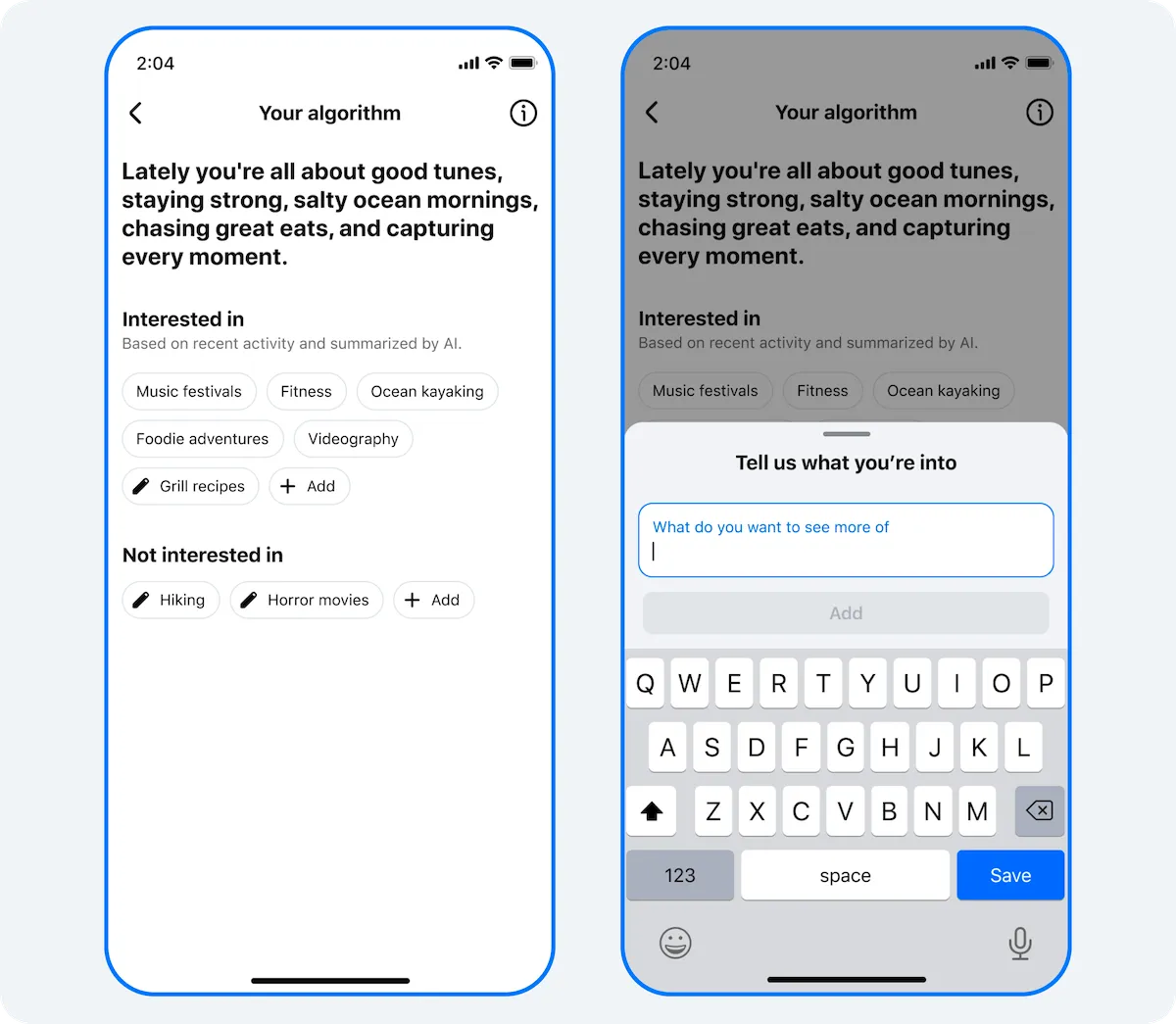
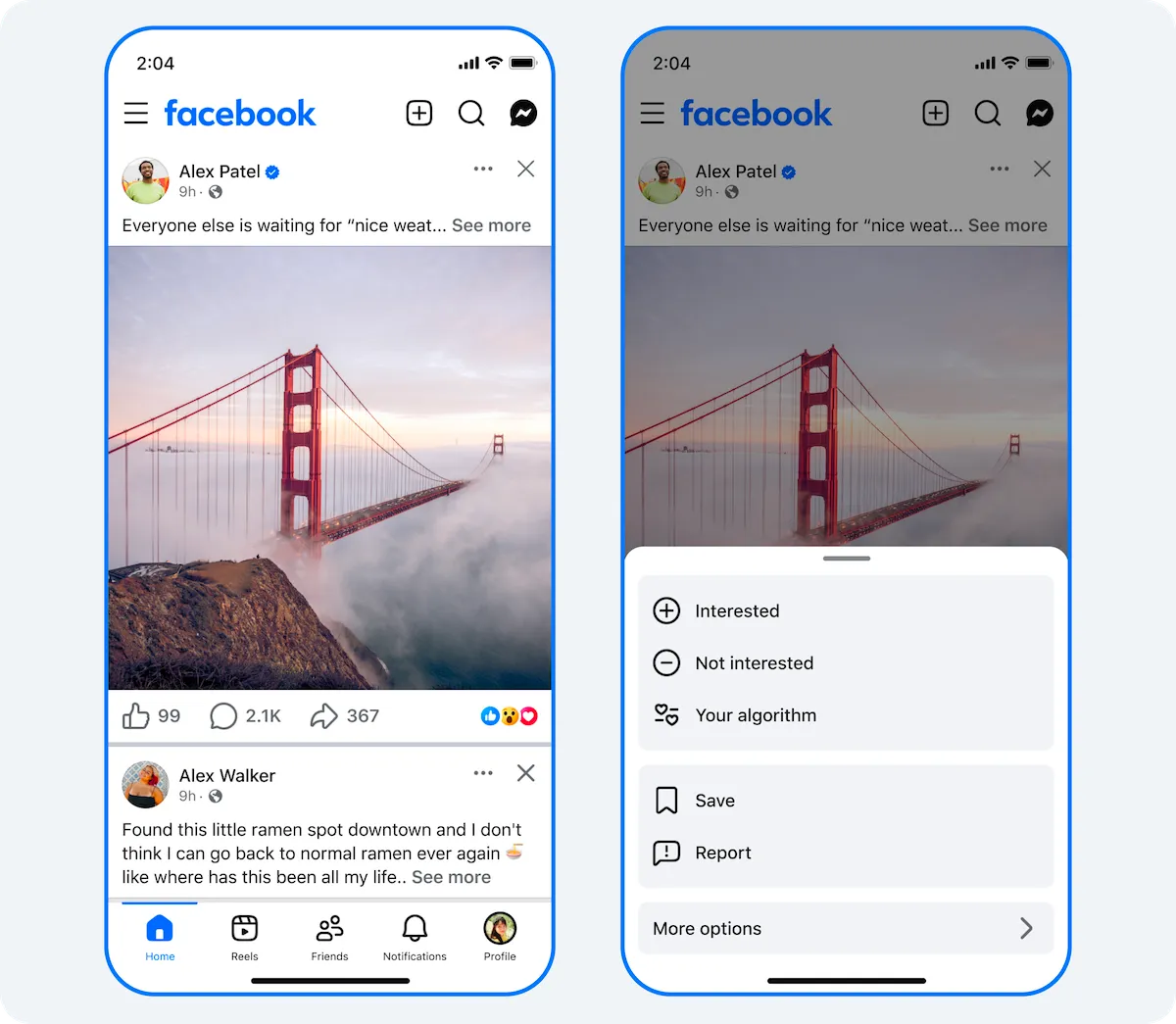
Facebook users can now describe what they want in plain language, add and manage topics on a dedicated page, and mark posts Interested or Not interested from the three-dot menu. Meta may ask follow-up questions after a choice. Meta says LLMs read the interests, context and intent in each request, combine them with signals like likes, comments and watch history, and adjust recommendations within the same session. [3] [2] [1]
The Facebook launch follows similar controls in Meta's other apps. Instagram Reels showed users AI-summarized interest topics in December 2025. Threads launched Dear Algo in February 2026, which lets users request more or less of a topic in a public post, with each request lasting three days. Instagram later added the controls to Explore and Feed, though sources disagree on the exact months. [5] [6] [7] [1] [8]
Meta explains the engineering in roughly one paragraph. It doesn't name the model or say whether typed text becomes topics, embeddings or ranking features. It also doesn't say how much a stated preference counts against behavior or how long it lasts. Meta's description of LLMs as a leap forward for ranking comes with no benchmarks, A/B results or adoption figures. [3] [4]
Meta's announcement doesn't say how typed preferences are stored or whether they shape ad targeting. In December 2025, Meta said conversations with Meta AI would personalize ads. Creators and advertisers can't see the preferences users state, so a share of distribution now depends on signals they cannot inspect. [4]
The reviewed sources show typed preference input spreading across Meta's apps and LinkedIn. One implication is that publishers' and advertisers' reach may depend on private user statements they can't see.
Read the full assessment
Recommender teams must decide how much stated preferences count against behavior and how long they last.
Executive brief
Meta says Facebook's Feed and Reels ranking now uses large language models to read typed requests such as "more of this, less of that," and that recommendations change within the same session. The feature, "Your Algorithm," began rolling out on October 13, 2026, after earlier versions on Instagram and Threads (TechCrunch). Meta has released no adoption figures, A/B results or quality measurements. It also hasn't said whether the typed preferences feed into ad targeting (PPC Land). Nobody outside Meta has evaluated the feature yet.
What changed and event timeline
Instagram Reels gets "Your Algorithm."
U.S. users could see the interest topics AI had summarized from their activity, then add, remove or share them, with a global English rollout announced as coming ().
Threads launches "Dear Algo."
Users write a public post starting "Dear Algo" to ask for more or less of a topic. The launch covered the U.S., UK, Australia and New Zealand (;).
Instagram expands the controls
TechCrunch says Feed and Explore were added in June (). SocialPilot dates Explore to April and Feed to June ().
Facebook adds "Your Algorithm."
Users can type preferences in plain language for Feed and Reels. The three-dot menu on posts now offers Interested / Not interested, and Meta may ask follow-up questions about the choice (;).
Capabilities and access
- Where it works: Facebook Feed and Reels.
- What users can do:
- add and manage topics
Read the full section
- Where it works: Facebook Feed and Reels. Users reach it from the three-dot menu on any post or from a dedicated "Your Algorithm" page (Meta).
- What users can do:
- add and manage topics
- describe what they want in their own words
- mark posts Interested or Not interested and answer follow-up questions
- Model: Meta doesn't name which LLM it uses.
- Availability: Meta calls it "rolling out" and gives no list of countries or languages, no EU timing and no detail on teen accounts (PPC Land). It had not reached Engadget's reviewer when that article was written (Engadget).
Technical analysis for researchers and developers
- What Meta documents: LLMs interpret the "interests, context, and intent" in a user's typed request.
- What it doesn't document:
- whether the LLM turns text into topics, embeddings or ranking features
Read the full section
- What Meta documents: LLMs interpret the "interests, context, and intent" in a user's typed request. Ranking then combines that with the engagement signals it already uses, which Meta describes as likes, comments, watch history and "thousands of other signals" (Meta).
- What it doesn't document:
- whether the LLM turns text into topics, embeddings or ranking features
- how much weight a stated preference gets against behavior
- how long a preference lasts (Threads' version expires after three days)
- Depth of disclosure: the engineering explanation is roughly one paragraph, with no paper cited. LinkedIn's March 2026 write-up of its LLM feed rebuild was far more detailed (PPC Land).
- Reproducibility: none. Meta has published no benchmarks or evaluations.
Claims and evidence
- LLMs are a "genuine leap forward" for ranking
- Recommendations adapt in real time, within a session
- Facebook gains the feature after Instagram — ,
Read the full section
| Claim | Source | Status |
| LLMs are a "genuine leap forward" for ranking | Meta | Meta's own claim, with no metrics behind it (PPC Land) |
| Recommendations adapt in real time, within a session | Meta | Not tested by anyone outside Meta |
| Facebook gains the feature after Instagram | TechCrunch, The Verge | Consistent across press reports |
| Exact dates of Instagram's expansion | TechCrunch vs. SocialPilot | The two sources disagree (see timeline) |
Context and prior work
- TikTok's "Manage Topics" (2024) offered generic topic categories. Instagram's version builds the topic list from each user's own activity (TechCrunch).
- Threads' Dear Algo was Meta's first public, prompt-style control (Meta).
- LinkedIn rebuilt its feed around LLMs in March 2026 (PPC Land).
Read the full section
- TikTok's "Manage Topics" (2024) offered generic topic categories. Instagram's version builds the topic list from each user's own activity (TechCrunch).
- Threads' Dear Algo was Meta's first public, prompt-style control (Meta).
- LinkedIn rebuilt its feed around LLMs in March 2026 (PPC Land).
- TechCrunch compares the shift to the way streaming services let viewers personalize recommendations (TechCrunch).
Limitations, safety and contested findings
- Known limits of the Instagram version: users couldn't prioritize posts from accounts they follow or reduce how many ads they see.
- Privacy: Meta's announcement says nothing about how typed preferences are stored or whether they're used for ads.
- Regulation: the launch comes as the EU has found Digital Services Act violations (PPC Land).
Read the full section
- Known limits of the Instagram version: users couldn't prioritize posts from accounts they follow or reduce how many ads they see. Engadget questions whether requests like "less AI-generated content" will work, given Facebook's spam problem (Engadget).
- Privacy: Meta's announcement says nothing about how typed preferences are stored or whether they're used for ads. In December 2025, Meta said conversations with Meta AI would personalize ads (PPC Land).
- Regulation: the launch comes as the EU has found Digital Services Act violations (PPC Land).
Business and practitioner implications
- Publishers and creators: distribution now depends partly on preferences users state privately, which creators and advertisers can't see (PPC Land).
- Recommender-system builders: natural-language preference input, alongside behavioral signals, is becoming a standard feature across Meta, LinkedIn and TikTok.
- Buyers and regulators: Meta has shown no evidence that these controls change what users actually see.
Read the full section
- Publishers and creators: distribution now depends partly on preferences users state privately, which creators and advertisers can't see (PPC Land). Expect reach to vary more, with no way to diagnose why.
- Recommender-system builders: natural-language preference input, alongside behavioral signals, is becoming a standard feature across Meta, LinkedIn and TikTok. How long a stated preference lasts, and how much it outweighs behavior, are the design choices that matter.
- Buyers and regulators: Meta has shown no evidence that these controls change what users actually see. They should be treated as unproven until Meta publishes data or an outside audit tests them.
The source trail.
Sources (9)
TechCrunch: Facebook is giving users more control over their algorithm
techcrunch.comFacebook will let you customize your feed algorithm using AI
Related coverage; assess separately
theverge.com