
RoboticsMachines in the physical world
Dyna Robotics unveils Dyna-2, a robot world-action model pretrained on over a million hours of human video
Dyna Robotics' Dyna-2 predicts future video and robot actions together. It was pretrained on more than a million hours of first-person human video. In Dyna's tests, adding more human video predictably improved robot performance, which reduces reliance on scarce robot training data.
From the Latent Space podcast episode of October 13, 2026 and cited sources: Dyna-2 is a mixture of transformers built from diffusion-transformer layers. [2] [1]
SOURCES[2] Dyna-2: A 1-Million-Hour Scaling Law for World-Action… dyna.co[1] Dyna-2: General Purpose Physical Agents with Hour-Long… latent.space
 AT Pulse research deskPublished · Updated · 5 min read · AI-assisted analysis
AI-assisted, not human-edited. Methodology Corrections Who owns this site
- Original source
- Latent Space podcast episode, independent perspective
- Brief by
- AT Pulse research desk AI-assisted; publisher and contact on the desk page
- Studies
- arXiv 2310.12931 (Oct 2023) [3] date from arXiv ID
- When
- October 13, 2026 podcast episode published
- Covered
- Oct 14 edition
- Evidence
- 8 sources across 8 sites; transcript sourced
- 1Dyna-2: General Purpose Physical Agents with Hour-Long…latent.space
- 2Dyna-2: A 1-Million-Hour Scaling Law for World-Action…dyna.co
- 3Eureka: Human-Level Reward Design via Coding Large…arxiv.org
- 4The Letter Two: Dyna Robotics secures $120 millionthelettertwo.com
- 5PR Newswire: DYNA Robotics unveils DYNA-2prnewswire.com
- 6Runtime Wire: Dyna Robotics turns napkin folding into a…runtimewire.com
RisingHow it’s measured
YouTube video · 22.9K views · 127 likes
Reach blends public engagement (views, likes, comments, shares, stars) from the platforms where the story or its original source lives: YouTube, Hacker News, GitHub, Substack and similar. A video and the article written from its transcript share one score, taken from the video. Platforms with no data are left out rather than counted as zero, and the age of a story never lowers its score.
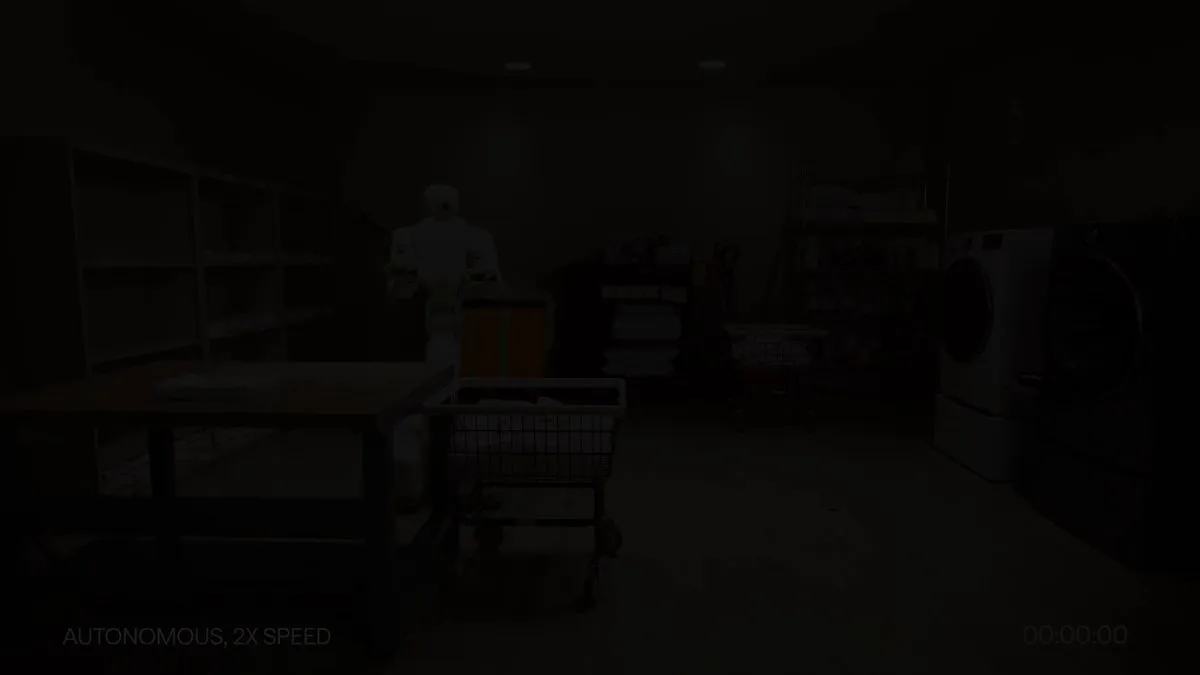
Dyna-2 is a mixture of transformers built from diffusion-transformer layers. It uses flow matching to generate future video and robot actions together, and treats the predicted video as a visual reasoning step before it acts. No robot data was used in pretraining. Action labels come from 3D hand poses estimated from human video. Error on held-out human video and zero-shot error on robot actions both fell as power laws as data grew. On-robot success rose from 20% to 53% across four data sizes. These results are company-reported and have not been reproduced by an outside group. [2] [1]
The method uses broad human video for general knowledge, then a small amount of robot data for each task. In the interview, a chopping task was trained from about 45 minutes of collected data. Ma also says the model quickly adapted to a new wheeled semi-humanoid with roughly 100 continuous action dimensions. The press release says five-finger bottle opening took 13 minutes of data. [1] [5]
Commercial use has moved past a single pilot. Din Tai Fung runs the robots for napkin folding at several US locations and is considering them for cutting food. A laundry job runs about an hour from start to finish. Ma puts the current fleet at tens of robots and aims for hundreds next year. [1] [6]
power-law data fits and a restaurant deployment across several sites.
Read the full assessment
Implication: if human video can replace most robot data, first-person and workplace-specific video becomes a strategic asset, and teaching robots new tasks could take less than an hour of demonstrations.
Executive brief
Dyna Robotics says its Dyna-2 robot model learned mostly from more than one million hours of first-person video of people doing everyday tasks, with no robot data in pretraining. The company also reports the first "scaling law" in which adding human video predictably improves how robots perform (Dyna). In a Latent Space interview, co-founder and chief scientist Jason Ma says Din Tai Fung restaurants have taken the robots across several US sites, and that a laundry job runs about an hour end to end (Latent Space).
Read the full section
Dyna Robotics says its Dyna-2 robot model learned mostly from more than one million hours of first-person video of people doing everyday tasks, with no robot data in pretraining. The company also reports the first "scaling law" in which adding human video predictably improves how robots perform (Dyna). If that holds, it would ease robotics' main shortage, which is robot training data. In a Latent Space interview, co-founder and chief scientist Jason Ma says Din Tai Fung restaurants have taken the robots across several US sites, and that a laundry job runs about an hour end to end (Latent Space). Dyna has not released weights or its dataset, and no outside group has reproduced the results.
What changed and event timeline
Eureka paper
Ma and NVIDIA co-authors used GPT-4 to write reward code for reinforcement learning. A simulated Shadow Hand learned to spin a pen, and the generated rewards beat human experts on 83% of 29 environments ().
$120M Series A
CRV, First Round and Robostrategy led the round. NVentures, Amazon's Industrial Innovation Fund, Samsung Next and LG Technology Ventures also invested ().
Dyna-2 announced
The press release claims the first human-to-robot scaling law, a 1.55× higher customer quality pass rate than Dyna-1, and task success rising from 20% to 80–90% in precision manufacturing ().
Din Tai Fung rollout reported
The report, based on Dyna's own posts, says Dyna-2 produces 1,590 table-ready napkins per shift and has passed the chain's return-on-investment threshold, moving a 2025 pilot toward a network-wide rollout ().
Latent Space interview
Ma describes how the model works, Dyna's in-house hardware, "tens" of robots deployed today with "hundreds" planned for next year, and a tactile-sensing risk to his own thesis ().
Capabilities and access
- Model: Dyna-2, a "world-action model". It predicts future video and robot actions together. Parameter count is not disclosed (Dyna).
- Robots tested: bimanual YAM arms with parallel-jaw grippers, 20-joint WUJI-2 hands, and a semi-humanoid prototype (Dyna).
- Semi-humanoid: a humanlike upper body with 4 degrees of freedom at the waist on a wheeled base.
Read the full section
- Model: Dyna-2, a "world-action model". It predicts future video and robot actions together. Parameter count is not disclosed (Dyna).
- Robots tested: bimanual YAM arms with parallel-jaw grippers, 20-joint WUJI-2 hands, and a semi-humanoid prototype (Dyna).
- Semi-humanoid: a humanlike upper body with 4 degrees of freedom at the waist on a wheeled base. It controls about 100 continuous action dimensions at 10–20 Hz (00:25:16, 00:45:14).
- Access: proprietary. There are no published weights or code. Dyna says an SDK is planned (00:46:37).
Technical analysis for researchers and developers
Read the full section
- Architecture: a mixture of transformers built from diffusion-transformer (DiT) layers. Video, action and joint-sensor data each get their own tokenizer, and video and actions are generated together with flow matching (Dyna). Ma calls predicting video first a visual "chain of thought" for choosing actions (00:01:39).
- Human data: action labels for the human video come from estimating 3D hand poses (Dyna).
- Reported fits:
- Error on held-out human video falls as a power law with data, with an exponent of −0.0184 (R² 0.919).
- Zero-shot error on robot actions falls with an exponent of −0.0713 (R² 0.884).
- On-robot success goes 20%→28%→45%→53% across four data-size steps (Dyna).
- Evaluation: offline metrics on 39 robot tasks, plus blind on-robot trials on 14 tasks across three robot types. Scaling of model size and compute is left for later work (Dyna).
- Deployment: Ma says on-device inference is required, with small models distilled from larger ones and an in-house inference stack (00:18:42–00:19:26).
Claims and evidence
Neither source defines the metric, so the two cannot be reconciled.
Read the full section
- Scaling law, a million hours, success rates: all from Dyna's own blog and press release, with no independent reproduction. One analysis calls "one million undocumented hours" a marketing number (Action Trajectories).
- Napkin quality figures differ by source:
- 87% zero-shot quality pass rate (PR Newswire)
- 93% of napkins meeting the standard (Sacra)
Neither source defines the metric, so the two cannot be reconciled.
- Success-rate figures differ by setting: "20% to 80–90%" in manufacturing versus 20%→53% in the blog's aggregate. These likely measure different tasks.
- Uniqueness of the Din Tai Fung expansion: Ma's own claim (00:37:11).
Context and prior work
- Name: taken from Richard Sutton's Dyna architecture, an agent that improves itself using a learned world model (01:09:11).
- Rival approaches: Ma contrasts world-action models with vision-language-action models (VLAs).
- Lineage: Eureka's LLM-designed rewards in simulation (arXiv). Ma says frontier models can now build synthetic environments well enough that simulation is worth revisiting (00:14:13).
Read the full section
- Name: taken from Richard Sutton's Dyna architecture, an agent that improves itself using a learned world model (01:09:11).
- Rival approaches: Ma contrasts world-action models with vision-language-action models (VLAs). He argues VLAs build in human bias by predicting abstract representations rather than raw video (00:54:31).
- Lineage: Eureka's LLM-designed rewards in simulation (arXiv). Ma says frontier models can now build synthetic environments well enough that simulation is worth revisiting (00:14:13).
Limitations, safety and contested findings
- Offline is not closed-loop: good offline prediction scores do not guarantee task success with the real robot acting.
- Hardware: dexterous hands still overheat and are not durable enough, and slow hardware slows evaluation (00:33:20).
- Safety: Ma chose wheels over legs because no one can yet guarantee a legged robot stays upright (00:25:16).
Read the full section
- Offline is not closed-loop: good offline prediction scores do not guarantee task success with the real robot acting. Gains are uneven from task to task, and robots still need task-specific demonstrations (Action Trajectories).
- Hardware: dexterous hands still overheat and are not durable enough, and slow hardware slows evaluation (00:33:20).
- Safety: Ma chose wheels over legs because no one can yet guarantee a legged robot stays upright (00:25:16).
- Self-identified risk: a model that also predicts touch could be far more data-efficient than one trained on video alone (00:56:28).
- Rollout test: whether performance holds across sites without custom engineering eating the savings (Runtime Wire).
Business and practitioner implications
- Data strategy: Dyna's recipe is human video for broad knowledge plus a small amount of robot data per task.
- Adaptation speed: new tasks took as little as about 45 minutes of collected data (00:30:11), and five-finger bottle opening took 13 minutes (PR Newswire).
- Commercial signal: a customer expanding across many sites, not a single pilot. Fleet scale is still small, with tens of robots deployed now (00:51:29).
Read the full section
- Data strategy: Dyna's recipe is human video for broad knowledge plus a small amount of robot data per task. That favours buyers of first-person video and makes per-workplace data (for example, hotel bedmaking) worth paying for (00:08:42, 00:12:43).
- Adaptation speed: new tasks took as little as about 45 minutes of collected data (00:30:11), and five-finger bottle opening took 13 minutes (PR Newswire).
- Commercial signal: a customer expanding across many sites, not a single pilot. Fleet scale is still small, with tens of robots deployed now (00:51:29).
The source trail.
Sources (8)
Dyna-2: General Purpose Physical Agents with Hour-Long Autonomy — Jason Ma, Dyna Robotics
Transcript retrieved via published_transcript; language en. Timestamped text, not direct audiovisual review. Source: https://latent.space/p/dyna. Automatic captions/transcription may contain errors.
latent.space