
ModelsArchitectures & capability
Google opens Gemini 4 Argon to paid API users at $2/$10 per million tokens until December, and llm-gemini 0.35 adds support
Google's Gemini 4 Argon, a sparse mixture-of-experts model with a 1M-token context window, opened to paid Gemini API users on 13 October at $2/$10 per million input/output tokens. Those rates double on 1 December. Simon Willison's llm-gemini 0.35 added support the same day.
From the Simon Willison article of October 13, 2026 and cited sources: Introductory pricing is $2 per million input tokens and $10 per million output tokens through 30 November. [2] [1]
SOURCES[2] Google Cloud blog: Gemini 4 Argon on Google Cloud cloud.google.com[1] Simon Willison: llm-gemini 0.35 simonwillison.net
 AT Pulse research deskPublished · Updated · 5 min read · AI-assisted analysis
AI-assisted, not human-edited. Methodology Corrections Who owns this site
- What happened
- Introductory pricing is $2 per million input tokens and $10 per million output tokens through 30 November. [2] [1]
- Original source
- Simon Willison article, independent perspective
- Brief by
- AT Pulse research desk AI-assisted; publisher and contact on the desk page
- When
- October 13, 2026 article published
- Covered
- Oct 14 edition
- Evidence
- 10 sources across 9 sites
- 1Simon Willison: llm-gemini 0.35simonwillison.net
- 2Google Cloud blog: Gemini 4 Argon on Google Cloudcloud.google.com
- 3Google: Gemini 4 Argon for developersblog.google
- 4Google: Gemini 4 Argon announcementblog.google
- 5Google DeepMind: Gemini 4 Argon model carddeepmind.google
- 6Gemini API docs: Gemini 4 Argonai.google.dev
Reach: not measured yet
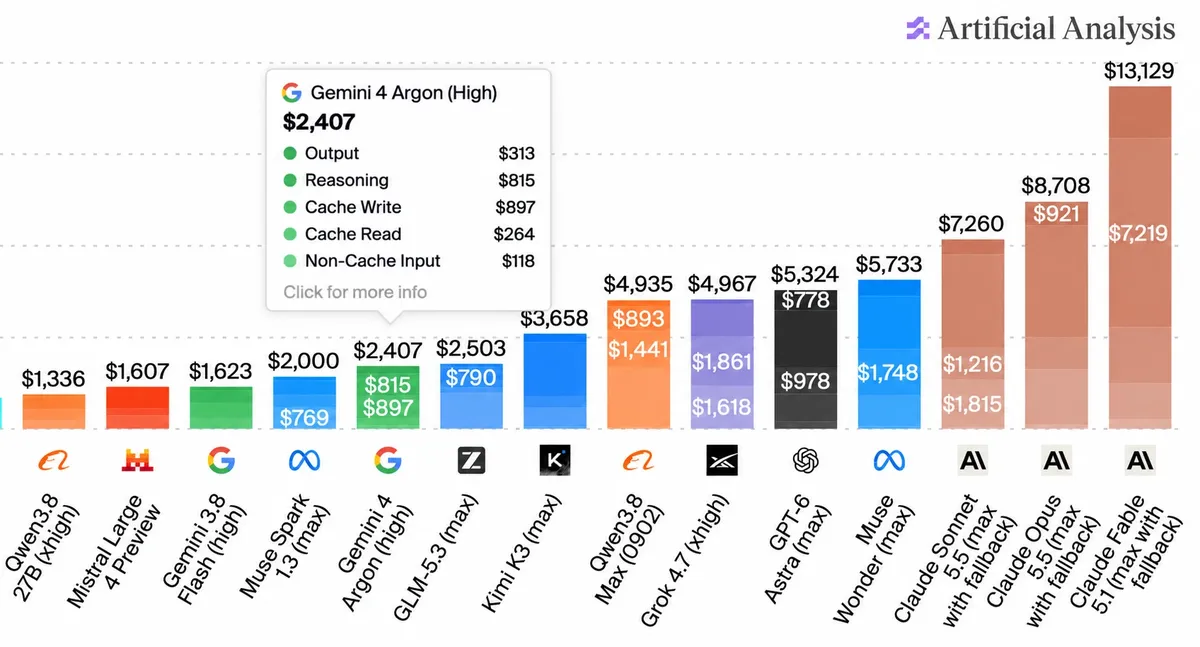
Introductory pricing is $2 per million input tokens and $10 per million output tokens through 30 November. Standard rates of $4 and $20 start on 1 December. At the launch rates, Willison puts Argon level with GPT-6 Sol, at half the price of Claude Opus 5.5 and at one-fifth the price of GPT-6 Astra. [2] [1]
Leaderboards disagree. Vals.ai ranks Argon first overall at 68.90%, but it scores only 4.83% on CUA-bench there. Artificial Analysis ranks it 8th of 216, and on that index its high setting produced 110M output tokens against an 85M median. That suggests real costs per task can run above what list prices imply. [8] [7]
The model takes text, image, video, audio and PDF input and returns text. It has a 1,048,576-token context window, and its long-decode option allows output close to 1M tokens. Only implicit caching is supported. Production use needs hard limits on output tokens and careful prompt structure to get the cache discount. [6]
The model card says Google cannot rule out that Argon reaches its critical capability levels for biology, cybersecurity or stealth and situational awareness. Google says its mitigations keep these risks below threshold. Separately, vetted cyber defenders in the Fairwind Program get the model without cyber guardrails. [5] [2]
pricing is documented, but the leaderboards disagree and Argon uses more output tokens than the median model. Implication: teams should measure cost per task in their own agent setups and plan for the December price doubling.
Executive brief
Google's Gemini 4 Argon is priced at $2 per million input tokens and $10 per million output tokens until 30 November 2026. On 1 December those rates double to $4 and $20 (Google Cloud blog). Google announced the model on 30 September. On 13 October it opened to paid Gemini API users and Google AI Ultra subscribers (Google developer blog). The same day, Simon Willison added it to his llm-gemini plugin (Willison). Vals.ai puts Argon first on its index, while Artificial Analysis ranks it 8th of 216 models.
Read the full section
Google's Gemini 4 Argon is priced at $2 per million input tokens and $10 per million output tokens until 30 November 2026. On 1 December those rates double to $4 and $20 (Google Cloud blog). Google announced the model on 30 September. On 13 October it opened to paid Gemini API users and Google AI Ultra subscribers (Google developer blog). The same day, Simon Willison added it to his llm-gemini plugin (Willison). Independent rankings disagree. Vals.ai puts Argon first on its index, while Artificial Analysis ranks it 8th of 216 models.
What changed and event timeline
Argon announced
Google introduced Argon as its frontier model and first gave access to vetted cyber defenders through its Fairwind Program ().
Broad availability
The model opened on the paid Gemini API tier, in AI Studio and Android Studio, and to AI Ultra subscribers in Antigravity, Google's agent-first coding platform (;).
Model card published
The card describes the architecture and the frontier-safety findings ().
Llm-gemini 0.35 released
The release adds the
gemini-4-argonmodel ID to Willison's LLM command-line tool (;).Price doubles
The introductory rates end on 30 November. Standard pricing of $4 input and $20 output then applies ().
Capabilities and access
- Model ID:
gemini-4-argon. - Context and output: 1,048,576-token context window. Output defaults to 65,536 tokens and can reach about 1M with the "long decode" feature (API docs).
- Inputs: text, image, video, audio and PDF. Output is text only.
Read the full section
- Model ID:
gemini-4-argon. - Context and output: 1,048,576-token context window. Output defaults to 65,536 tokens and can reach about 1M with the "long decode" feature (API docs).
- Inputs: text, image, video, audio and PDF. Output is text only.
- Reasoning effort: "thinking" levels of low, medium and high.
- Supported: function calling, structured outputs, code execution, file search, batch, flex and priority inference, and implicit caching.
- Not supported: Live API, image or audio generation, and explicit caching.
- Access tiers: paid API, AI Ultra, and Gemini for business (Cloud blog). Willison describes the subscription as a $100/month plan.
Technical analysis
- Architecture: a sparse mixture-of-experts transformer with native multimodal input, trained from scratch rather than adapted from an earlier model (model card).
- Post-training: instruction tuning plus reinforcement learning on multi-step reasoning tasks.
- Knowledge cutoff: March 2026.
Read the full section
- Architecture: a sparse mixture-of-experts transformer with native multimodal input, trained from scratch rather than adapted from an earlier model (model card).
- Post-training: instruction tuning plus reinforcement learning on multi-step reasoning tasks.
- Knowledge cutoff: March 2026.
- Evaluation: Google tested knowledge work, coding, ML engineering, long context, computer use and cybersecurity, and compared against GPT-6 Astra and Claude models. It does not publish the evaluation harnesses or prompts.
- Token usage: on the Artificial Analysis index, the high setting produced 110M output tokens, above the 85M median (Artificial Analysis).
- Implementation: the ability to output close to 1M tokens means production use needs hard budget caps.
Claims and evidence
- Google-reported scores: 77.9% on DeepSWE v1.1, 68% on CWE-bench v1, 91.7% on LVBench and 51.3% on AutomationBench (Google blog).
- Google-reported customer results: 35% more agentic code submissions and a 0.7% attack success rate on Gray Swan's prompt-injection benchmark (Cloud blog).
- Vals.ai (independent): 68.90% on the Vals Index, ranked first, at $15.68 per test (Vals.ai).
Read the full section
- Google-reported scores: 77.9% on DeepSWE v1.1, 68% on CWE-bench v1, 91.7% on LVBench and 51.3% on AutomationBench (Google blog).
- Google-reported customer results: 35% more agentic code submissions and a 0.7% attack success rate on Gray Swan's prompt-injection benchmark (Cloud blog).
- Vals.ai (independent): 68.90% on the Vals Index, ranked first, at $15.68 per test (Vals.ai).
- Artificial Analysis (independent): score of 53, ranked 8th of 216 (Artificial Analysis). Willison cites its total benchmark cost of $2,407 as close to GLM-5.3 and well below OpenAI, Anthropic and Meta's latest models (Willison).
- SVG drawings: Willison found the pelican SVGs excellent and says the "high" image cost 17.166 cents. This is anecdotal, not a benchmark.
Context and prior work
- Earlier plugin releases:
llm-gemini0.34 (2 September) addedgemini-3.8-flashwith the same low/medium/high thinking levels. - Price peers: at launch rates, Willison puts Argon level with GPT-6 Sol, at half the price of Claude Opus 5.5, and at one-fifth the price of Claude Fable 5.1 and GPT-6 Astra.
- Robotics: Google also presents Argon as a model for robotics work (Developers Blog).
Read the full section
- Earlier plugin releases:
llm-gemini0.34 (2 September) addedgemini-3.8-flashwith the same low/medium/high thinking levels. Version 0.33 added server-side tools for Search, URL context and code execution (releases). - Price peers: at launch rates, Willison puts Argon level with GPT-6 Sol, at half the price of Claude Opus 5.5, and at one-fifth the price of Claude Fable 5.1 and GPT-6 Astra.
- Robotics: Google also presents Argon as a model for robotics work (Developers Blog).
Limitations, safety and contested findings
- Frontier-safety findings: Google says it cannot rule out that Argon reaches its critical capability levels for biology or cybersecurity.
- Unguardrailed access: vetted defenders in the Fairwind Program get the model without cyber guardrails (Cloud blog).
- Weak spots: on Vals.ai it scores 4.83% on CUA-bench (7th of 8) and 87.43% on MedScribe (15th).
Read the full section
- Frontier-safety findings: Google says it cannot rule out that Argon reaches its critical capability levels for biology or cybersecurity. It also cannot rule out a stealth/situational-awareness threshold. Google says its mitigations bring these risks below threshold (model card).
- Unguardrailed access: vetted defenders in the Fairwind Program get the model without cyber guardrails (Cloud blog).
- Weak spots: on Vals.ai it scores 4.83% on CUA-bench (7th of 8) and 87.43% on MedScribe (15th). Long agentic tasks can cost up to $193.78 per test (Vals.ai).
- Rankings conflict: Vals ranks Argon first and Artificial Analysis ranks it eighth.
- Known failure modes: hallucinations, slowness and timeouts.
Business and practitioner implications
- Price change: budgets based on October rates will double after 30 November. Vals.ai already lists the $4/$20 rates.
- Real cost depends on token use: list prices mislead.
- Caching: cached input is 95% off, but only implicit caching is supported, so prompt structure affects the discount.
Read the full section
- Price change: budgets based on October rates will double after 30 November. Vals.ai already lists the $4/$20 rates.
- Real cost depends on token use: list prices mislead. Argon uses more output tokens than the median model, so test its total cost per task in your own agent setup.
- Caching: cached input is 95% off, but only implicit caching is supported, so prompt structure affects the discount.
- Security teams: a model scoring high on cyber benchmarks, plus unguardrailed access for vetted defenders, has value for defence and carries matching governance obligations.