
CodingSoftware & developer tools
Anthropic replaces Git with in-house Scion source control as daily merges pass 30,000
Anthropic built Scion, a centralized source-control system that runs on its servers, and Antique, a review tool with semantic approval rules. It did this after Claude-driven code output pushed monorepo merges from about 2,500 to more than 30,000 a day.
From the Simon Willison article of October 13, 2026 and cited sources: Coding agents moved Anthropic's bottleneck away from writing code. [2] [10]
SOURCES[2] Redesigning source control at Anthropic — Anthropic… anthropic.com[10] Anthropic's Scion Shows Why AI Agents Are Forcing a… dev.to
 AT Pulse research deskPublished · Updated · 5 min read · AI-assisted analysis
AI-assisted, not human-edited. Methodology Corrections Who owns this site
- Original source
- Simon Willison article, independent perspective
- Brief by
- AT Pulse research desk AI-assisted; publisher and contact on the desk page
- When
- October 13, 2026 article published
- Covered
- Oct 14 edition
- Evidence
- 10 sources across 9 sites
- 1Redesigning source control at Anthropic — Simon Willisonsimonwillison.net
- 2Redesigning source control at Anthropic — Anthropic…anthropic.com
- 3Anthropic Builds Scion to Replace Git at 30,000 Merges a…fourweekmba.com
- 4Hacker News discussionnews.ycombinator.com
- 5Anthropic replaces Git with custom source control system…cryptobriefing.com
- 6Anthropic Ditched Git and Built Scion — AlphaSignalalphasignal.ai
Reach: not measured yet
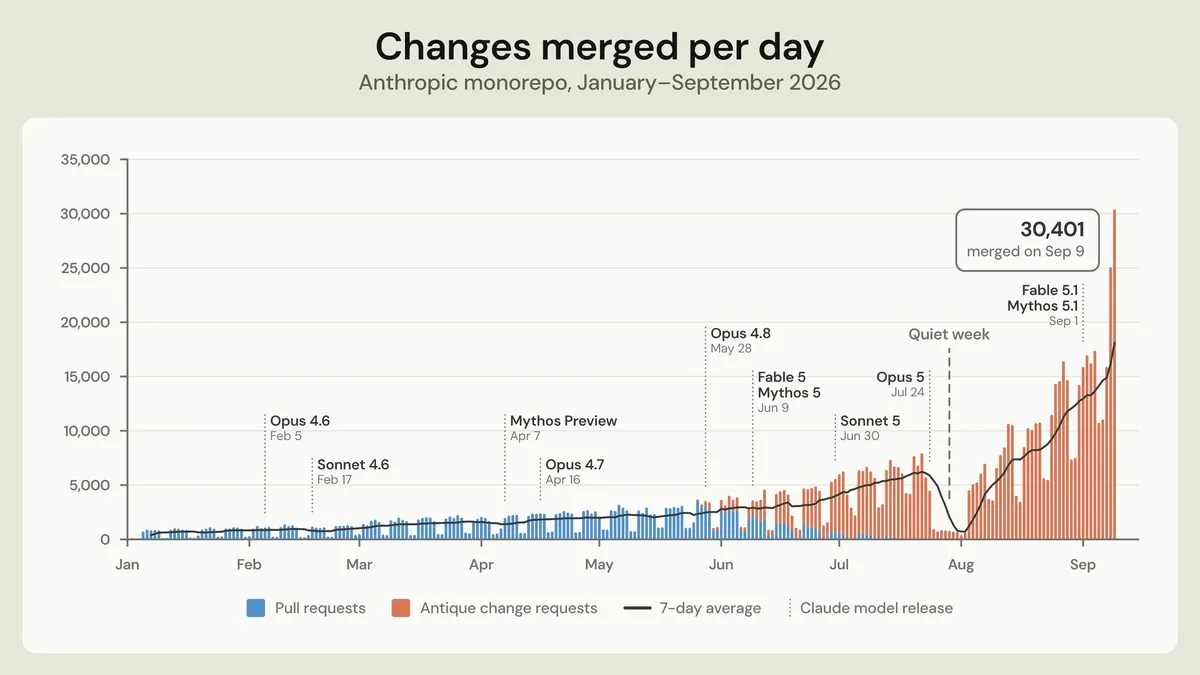
Coding agents moved Anthropic's bottleneck away from writing code. Between May and September 2026, merges into its main repository rose about twelvefold, with Claude writing most of the new code. That growth overwhelmed Git, and the strain spread to CI and review. [2] [10]
Scion replaces Git commits with changesets. Each one is a write-ahead-log entry that points to content-addressed file data. Commits, merges and history queries run on servers, clients fetch files on demand, and a three-tier cache serves requests. There is no global lock: Anthropic tests after merge and before deploy, and Claude resolves conflicts. The design borrows from Google's Piper and Meta's Sapling but is built mainly for agents rather than human engineers. [2] [7] [8]
Anthropic reports that Scion uses 200 times less CPU and memory than its old Git mirroring setup. It also reports checkouts about 100 times faster, which saved roughly a quarter of CI CPU. These are company-reported figures: no code or benchmarks have been released, and secondary coverage only repeats them. [2] [5] [6]
The engineer's job shifted from reading code line by line toward checking intent and design and rejecting Claude's proposals. Antique's semantic approval rules send human reviewers to riskier logic changes. Engineers also had to rein in Claude's adversarial reviews, which tended to over-engineer against hypothetical problems. [2]
The evidence is one company's account of a merge surge that broke Git. The implication is that teams scaling coding agents should plan for CI, review and merge capacity.
Read the full assessment
Few teams work at a scale where replacing Git, rather than tuning it, makes sense.
I've finished the research. Here is the dossier.
Executive brief
Anthropic says the volume of code merged into its main repository rose about twelvefold in four months. It went from about 2,500 merges a day in May 2026 to more than 30,000 a day in September, with Claude writing most of the new code (Anthropic Engineering). Git could not keep up, so seven engineers built Scion, a centralized source-control system, plus a code-review tool called Antique. They finished the migration in five months. The point for practitioners is that coding agents can move the bottleneck away from writing code and into source control, CI and review. All of the scale and performance figures come from Anthropic, and no one has checked them independently.
What changed and event timeline
Scion build and migration begins
The five-month effort ran from January to September 2026. The same seven-person team also built Antique and related systems ().
Baseline of about 2,500 merges a day
Anthropic gives this as its starting merge rate, before agent-driven code volume took off ().
More than 30,000 merges a day, and the migration is done
The move off Git finished while the merge rate grew roughly tenfold (;).
Anthropic publishes the design write-up
The post is by Nick G. and the source control team. It says Scion will not be open-sourced and is not meant to replace Git in general ().
Commentary and Hacker News debate
Simon Willison compares Scion to a reinvention of Subversion-style centralized control. The Hacker News thread reached about 800 points, and some commenters questioned the scale claims (;).
Capabilities and access
- Scion: internal source control for a single monorepo. Commits, merges and history queries run on servers.
- Approval rules can be semantic, for example telling comment-only edits apart from sensitive logic changes, so human reviewers focus on the riskier changes.
- Models: the post names Claude Mythos Preview and "Tag" as having driven the need for Scion and helped build it.
Read the full section
- Scion: internal source control for a single monorepo. Commits, merges and history queries run on servers. Clients fetch files on demand into a bounded local cache, and jobs can query the repo through APIs without keeping a local copy (Anthropic Engineering).
- Antique: internal code review. Approval rules can be semantic, for example telling comment-only edits apart from sensitive logic changes, so human reviewers focus on the riskier changes.
- Models: the post names Claude Mythos Preview and "Tag" as having driven the need for Scion and helped build it.
- Access: none. Neither system is open-source or available as a product.
Technical analysis for researchers and developers
- Scale: main-branch history is about 100 GB, and a compressed working copy is over 25 GB.
- Each is an entry in a write-ahead log that stores only the changed files plus pointers to content-addressed file data.
- Serving: three cache tiers: a local daemon, a regional cache, then the authoritative servers. No server holds a full copy of the repository.
Read the full section
- Scale: main-branch history is about 100 GB, and a compressed working copy is over 25 GB. CI runs about 25 million checkouts a day, which would mean more than 600 PB of Git traffic a day if each one fetched naively (Anthropic Engineering).
- Data model: "changesets" replace Git commits. Each is an entry in a write-ahead log that stores only the changed files plus pointers to content-addressed file data. There are no packfiles, no locks and no coordination between servers. Derived data such as blame and path history is computed and cached separately.
- Serving: three cache tiers: a local daemon, a regional cache, then the authoritative servers. All tiers answer the same requests, and Anthropic reports cache hit rates above 99%. No server holds a full copy of the repository.
- Merging: there is no global repository lock. Anthropic relies on testing after merge and before deploy, with Claude resolving conflicts automatically.
- Reproducibility: no code, benchmarks or test setup have been published.
Claims and evidence
All of these figures are reported by Anthropic only. Secondary coverage repeats them without new measurements (Crypto Briefing; AlphaSignal). Simon Willison links the rise in velocity to Fable/Mythos-class models, but he frames that as his own guess (Simon Willison).
Read the full section
- Infrastructure: Scion uses 200 times less CPU and memory than the previous Git mirroring setup (Anthropic Engineering).
- Checkouts: about 100 times faster, taking seconds instead of minutes, which saved about 25% of CI CPU.
- Ingestion pipeline: Claude rewrote the Git-to-Scion pipeline to use 20 times less memory and run 4 times faster.
All of these figures are reported by Anthropic only. Secondary coverage repeats them without new measurements (Crypto Briefing; AlphaSignal). Simon Willison links the rise in velocity to Fable/Mythos-class models, but he frames that as his own guess (Simon Willison).
Context and prior work
Anthropic says it learned from Google's Piper and Meta's Sapling. Piper is a centralized system built on Bigtable and later Spanner. In 2016 it held about 86 TB and 35 million commits, and engineers used it through cloud workspaces that store only modified files (CACM).
Read the full section
Anthropic says it learned from Google's Piper and Meta's Sapling. Piper is a centralized system built on Bigtable and later Spanner. In 2016 it held about 86 TB and 35 million commits, and engineers used it through cloud workspaces that store only modified files (CACM). Sapling began as an extension to Mercurial and was released as open source in 2022 as a client that works with Git (Meta Engineering). The difference with Scion is the main user: agents rather than human engineers.
Limitations, safety and contested findings
- No offline mode. On Hacker News, a Scion engineer said local commit buffering would mean copying server logic onto the client.
- Adversarial review by Claude tended to over-engineer in response to hypothetical concerns, so engineers had to rein it in (Anthropic Engineering).
- Some on Hacker News questioned the 30,000-a-day and 100 GB figures.
Read the full section
- No offline mode. On Hacker News, a Scion engineer said local commit buffering would mean copying server logic onto the client. It was not a priority because Claude, by far the heaviest user, is always online (HN comment).
- Over-engineering. Adversarial review by Claude tended to over-engineer in response to hypothetical concerns, so engineers had to rein it in (Anthropic Engineering).
- Skeptical commenters. Some on Hacker News questioned the 30,000-a-day and 100 GB figures. Others pointed to visible quality problems in Anthropic's products as a sign of technical debt at this pace (Hacker News).
Business and practitioner implications
- As agent output grows, measure capacity in CI, review queues and merge workflows, not just how fast code gets written (DEV Community).
- Anthropic says Scion only suits huge monorepos and needs tightly integrated review, search and CI.
- At Anthropic, engineers increasingly checked intent and design and turned down Claude's proposals, rather than reviewing code line by line.
Read the full section
- Watch the bottleneck move. As agent output grows, measure capacity in CI, review queues and merge workflows, not just how fast code gets written (DEV Community).
- Most teams shouldn't copy this. Anthropic says Scion only suits huge monorepos and needs tightly integrated review, search and CI. Its authors would rather see Git hosting platforms add server-side APIs and better sparse and shallow checkouts (Anthropic Engineering).
- The engineer's role changes. At Anthropic, engineers increasingly checked intent and design and turned down Claude's proposals, rather than reviewing code line by line.