
InfrastructureCompute, chips & cloud
Microsoft unveils Maia 300 and says its Maia chips will run most of its AI inference starting in 2027
Microsoft has unveiled Maia 300, its third-generation inference accelerator. The chip is built from chiplets on TSMC N2P. Microsoft says the Maia line will become its main platform for running AI in its products, with multi-gigawatt deployments starting in 2027. Nvidia and AMD still handle training.
From the The Verge · AI article of October 12, 2026 and cited sources: Microsoft says Maia, not Nvidia GPUs, will become the main inference system for its products, with a production rollout and multi-gigawatt scaling from 2027. [1] [7] [2]
SOURCES[1] Microsoft’s new AI chip makes it less reliant on Nvidia’s… theverge.com[7] CNBC – Microsoft will mainly use its Maia chips for AI… cnbc.com[2] UPI – Microsoft announces new AI chip Azure Maia 300 upi.com
 AT Pulse research deskPublished · Updated · 5 min read · AI-assisted analysis
AI-assisted, not human-edited. Methodology Corrections Who owns this site
- What happened
- Microsoft says Maia, not Nvidia GPUs, will become the main inference system for its products, with a production rollout and multi-gigawatt scaling from 2027. [1] [7] [2]
- Original source
- The Verge · AI article, independent perspective
- Brief by
- AT Pulse research desk AI-assisted; publisher and contact on the desk page
- When
- October 12, 2026 article published
- Covered
- Oct 13 edition
- Evidence
- 10 sources across 10 sites
- 1Microsoft’s new AI chip makes it less reliant on Nvidia’s…theverge.com
- 2UPI – Microsoft announces new AI chip Azure Maia 300upi.com
- 3The Standard – The Information report on Maia 300thestandard.com.hk
- 4The Register – Microsoft Maia 200theregister.com
- 5Crypto Briefing – TSMC capacity for 300,000 unitscryptobriefing.com
- 6Techzine – Hundreds of thousands of Maia 300 chipstechzine.eu
Reach: not measured yet
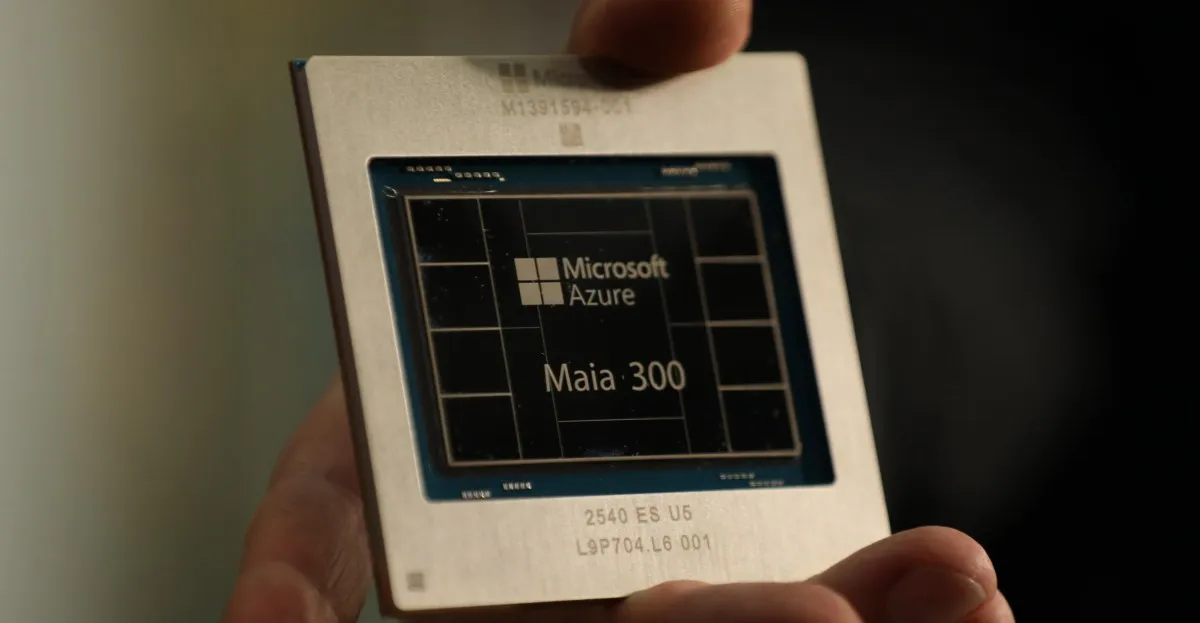
Microsoft says Maia, not Nvidia GPUs, will become the main inference system for its products, with a production rollout and multi-gigawatt scaling from 2027. Maia is built for inference only, so Microsoft still depends on Nvidia and AMD for training. The reviewed sources give no date for when outside Azure customers can rent Maia 300. [1] [7] [2]
Maia 300 has four 2nm compute chiplets, eight HBM4 stacks, and separate chiplets for device control and data movement. Reported figures: 288GB of memory, 18TB/s of bandwidth, up to 13.8 PFLOPS at FP4, and a 950W chip rating. It relies on SRAM caching and MXFP4-style compression, so models will need to run at low precision to get the most from it. [1] [8] [9]
Microsoft claims 40% more tokens per megawatt than leading GPU systems, without naming which ones, and up to 7x the throughput of a Maia 200 rack, where the Maia 300 rack holds roughly twice as many chips. Nobody outside Microsoft had tested the chip at announcement, and no benchmark methods have been published. SiliconANGLE estimates Maia 300 has about 20% less memory bandwidth than Nvidia's Rubin, with the same 288GB capacity. [1] [2] [9]
Maia 200 already runs Copilot, GitHub Copilot and Foundry. Moving more of its own inference onto Maia could cut Microsoft's serving costs and give it leverage on GPU prices. Nvidia stays central for training.
Read the full assessment
Data-center planners face racks drawing about 167kW.
Sources are gathered; writing the dossier now.
Executive brief
Microsoft says its own chip, not Nvidia's, will be the "primary AI inference system" for its products. It plans to scale the Azure Maia family to multi-gigawatt deployments starting in 2027 (The Verge). Maia 300 is the third-generation part. It is built from chiplets on TSMC N2P, and Microsoft claims it delivers 40% more tokens per megawatt than leading GPU systems. Nobody outside Microsoft had tested the chip when it was announced (UPI). Planned volume is also unclear. Earlier reports said Microsoft was seeking TSMC capacity for more than 300,000 chips, while some launch coverage says more than one million units in 2027.
What changed and event timeline
First Maia unveiled
Microsoft revealed its first in-house AI accelerator but then fell behind rivals in scaling production, according to The Information's reporting as carried by.
Maia 200 launches
An inference chip on TSMC N3 with 216GB of HBM3e, 7TB/s of bandwidth and a 750W rating. Microsoft claimed it was 30% cheaper than any other AI silicon on the market ().
Maia 300 volume reports
Unattributed reports said Microsoft was negotiating with TSMC for more than 300,000 Maia 300 chips for 2027 delivery, and claimed over 30% more tokens per dollar (;).
Maia 300 announced
Guthrie said Maia will become Microsoft's primary inference platform, with production rollout in 2027 (;).
Capabilities and access
- Model: Azure Maia 300, third generation. It is built for inference workloads: long-context reasoning, latency-sensitive chat and multi-step agentic tasks (The Verge).
- Reported specs: 288GB of HBM4, 18TB/s of bandwidth, up to 13.8 PFLOPS at FP4, and a 950W SoC rating (Notebookcheck).
- Access: production rollout starts in 2027. The reviewed sources give no date for external Azure customer instances.
Read the full section
- Model: Azure Maia 300, third generation. It is built for inference workloads: long-context reasoning, latency-sensitive chat and multi-step agentic tasks (The Verge).
- Reported specs: 288GB of HBM4, 18TB/s of bandwidth, up to 13.8 PFLOPS at FP4, and a 950W SoC rating (Notebookcheck).
- Access: production rollout starts in 2027. The reviewed sources give no date for external Azure customer instances.
Technical analysis for researchers and developers
- Chiplet split: four compute chiplets on 2nm, eight HBM4 stacks, a device-control chiplet for power and telemetry, and two data-movement chiplets (SiliconANGLE).
- Precision: SRAM caching cuts trips to HBM, and data is compressed in MXFP4 and similar low-precision formats (SiliconANGLE). Developers should plan for FP4/FP8 quantization.
- Scale-out: four chips per tray and 96 per liquid-cooled rack. Superpods hold 12,288 accelerators linked over custom Ethernet.
Read the full section
- Chiplet split: four compute chiplets on 2nm, eight HBM4 stacks, a device-control chiplet for power and telemetry, and two data-movement chiplets (SiliconANGLE). Microsoft says splitting compute, memory control and I/O frees more silicon for compute (The Verge).
- Precision: SRAM caching cuts trips to HBM, and data is compressed in MXFP4 and similar low-precision formats (SiliconANGLE). Developers should plan for FP4/FP8 quantization. On Maia 200, 16- and 32-bit math ran at a penalty (The Register).
- Scale-out: four chips per tray and 96 per liquid-cooled rack. Superpods hold 12,288 accelerators linked over custom Ethernet.
- Benchmarks: no public methodology has been published for the throughput claims.
Claims and evidence
- 40% more tokens per megawatt than leading GPU systems: Microsoft's claim. The baseline GPU system is not named (The Verge).
- Up to 7× rack-scale token throughput vs Maia 200: Microsoft's claim.
- Vs Maia 200, per chip: 2.5× memory bandwidth, 33% more capacity and about 2× HBM bandwidth per watt.
Read the full section
- 40% more tokens per megawatt than leading GPU systems: Microsoft's claim. The baseline GPU system is not named (The Verge).
- Up to 7× rack-scale token throughput vs Maia 200: Microsoft's claim. It compares a 96-chip rack with a Maia 200 rack holding roughly half as many chips (UPI).
- Vs Maia 200, per chip: 2.5× memory bandwidth, 33% more capacity and about 2× HBM bandwidth per watt. These are Microsoft figures, as quoted by UPI.
- Vs Nvidia Rubin: SiliconANGLE's analysis puts Maia 300 at about 20% less memory bandwidth than Rubin, with the same 288GB capacity (SiliconANGLE).
- Independent testing: none had been done as of the announcement (UPI).
Context and prior work
- Track record: Maia 200 already runs Microsoft Copilot, GitHub Copilot, Foundry and Microsoft's own models (The Verge).
- Rivals: Amazon (Trainium) and Google (TPU) build their own chips too. Microsoft did not compare Maia 200 against either (The Register).
- Model strategy: Mustafa Suleyman, CEO of Microsoft AI, ties Maia to co-designing silicon with Microsoft's own models (The Verge).
Read the full section
- Track record: Maia 200 already runs Microsoft Copilot, GitHub Copilot, Foundry and Microsoft's own models (The Verge). It used about two-thirds the power of comparable Blackwell parts and offered inference performance similar to Nvidia's B200 (The Register).
- Rivals: Amazon (Trainium) and Google (TPU) build their own chips too. Microsoft did not compare Maia 200 against either (The Register).
- Model strategy: Mustafa Suleyman, CEO of Microsoft AI, ties Maia to co-designing silicon with Microsoft's own models (The Verge).
Limitations, safety and contested findings
- Volume: reports conflict. Launch coverage cites more than one million units in 2027, with no named source (Analytics Insight).
- Inference only: Maia is an inference chip, so training still depends on Nvidia and AMD. Microsoft has not dropped Nvidia (UPI).
- Power: chip power rises from 750W to a reported 950W, and a 96-chip rack draws about 167kW (Analytics Insight).
Read the full section
- Volume: reports conflict. Launch coverage cites more than one million units in 2027, with no named source (Analytics Insight). Earlier reporting cited TSMC capacity talks for more than 300,000 units, with one million as an eventual goal that component supply could limit (Techzine).
- Inference only: Maia is an inference chip, so training still depends on Nvidia and AMD. Microsoft has not dropped Nvidia (UPI).
- Power: chip power rises from 750W to a reported 950W, and a 96-chip rack draws about 167kW (Analytics Insight).
Business and practitioner implications
- Bargaining power: if Maia carries Microsoft's own inference work, Microsoft gains leverage on GPU prices. Nvidia still gets training and third-party demand.
- Anthropic: The Information reported that Microsoft wants large customers such as Anthropic to adopt Maia (The Standard).
- Azure buyers: Copilot and Foundry costs may start to track Maia economics from 2027. Low-precision (FP4) inference is becoming the default to plan for.
Read the full section
- Bargaining power: if Maia carries Microsoft's own inference work, Microsoft gains leverage on GPU prices. Nvidia still gets training and third-party demand.
- Anthropic: The Information reported that Microsoft wants large customers such as Anthropic to adopt Maia (The Standard).
- Azure buyers: Copilot and Foundry costs may start to track Maia economics from 2027. Low-precision (FP4) inference is becoming the default to plan for.
- Data-center planners: racks at about 167kW mean liquid cooling and much higher power density.
- Capex: Microsoft's 2026 capital spending is reported to exceed $175B (Analytics Insight).
The source trail.
Sources (10)
Microsoft’s new AI chip makes it less reliant on Nvidia’s GPUs
Article text retrieved; extracted text may omit tables or interactive elements.
theverge.com