
ResearchPapers, evidence & method
Microsoft Research and UIUC release StudentSim, per-student simulators for training AI tutors
StudentSim fine-tunes a small open model on each learner's de-identified records so it mimics both their answers and how they revise after a hint, giving AI tutors a more realistic practice partner than a frontier LLM role-playing a student.
According to arXiv 2609.01591 (Sep 2026) [3]: StudentSim adds LoRA adapters to Qwen3-4B-Instruct and trains in two stages.
SOURCES[3] arXiv 2609.01591: StudentSim: Training LLM-based Student… arxiv.org
 AT Pulse research deskPublished · Updated · 4 min read · AI-assisted analysis
AI-assisted, not human-edited. Methodology Corrections Who owns this site
- What happened
- StudentSim adds LoRA adapters to Qwen3-4B-Instruct and trains in two stages. [1] [3] [6]
- Original source
- Microsoft Research article, company source
- Brief by
- AT Pulse research desk AI-assisted; publisher and contact on the desk page
- Studies
- arXiv 2609.01591 (Sep 2026) [3] date from arXiv ID
- When
- October 12, 2026 article published
- Covered
- Oct 13 edition
- Evidence
- 8 sources across 6 sites
- 1Microsoft Research Blog: Simulating student learning for…microsoft.com
- 2arXiv 2511.06078: Simulating Students with Large Language…arxiv.org
- 3arXiv 2609.01591: StudentSim: Training LLM-based Student…arxiv.org
- 4alphaXiv abstract pagealphaxiv.org
- 5GitHub: microsoft/StudentSimgithub.com
- 6alphaXiv: StudentSim (full-text rendering)alphaxiv.org
Reach: not measured yet
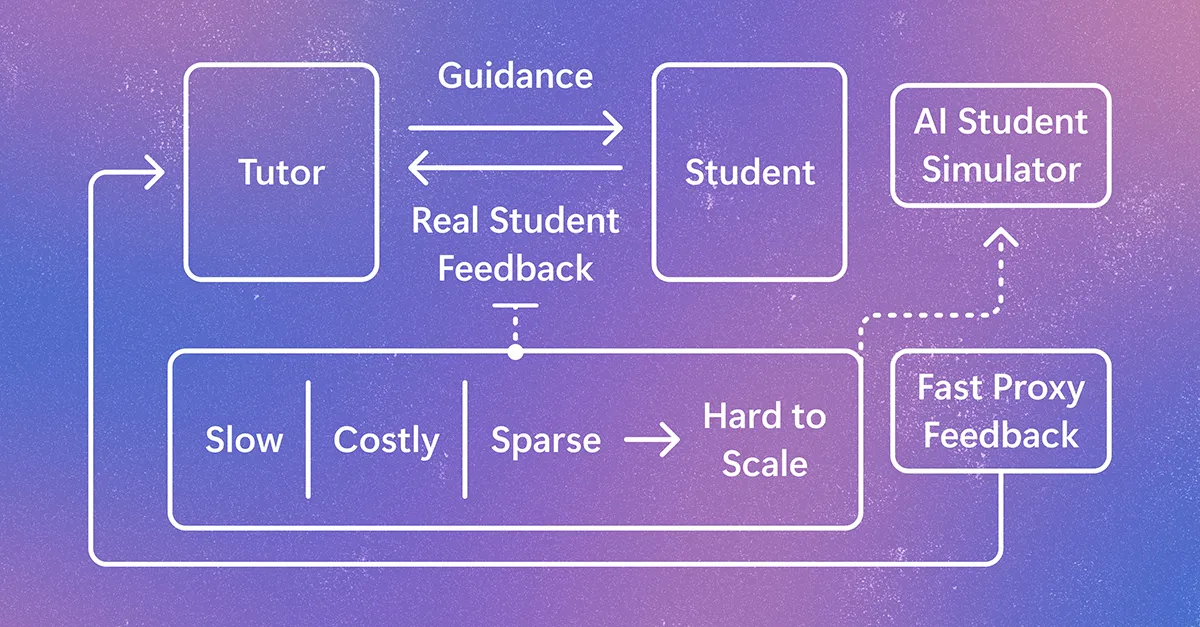
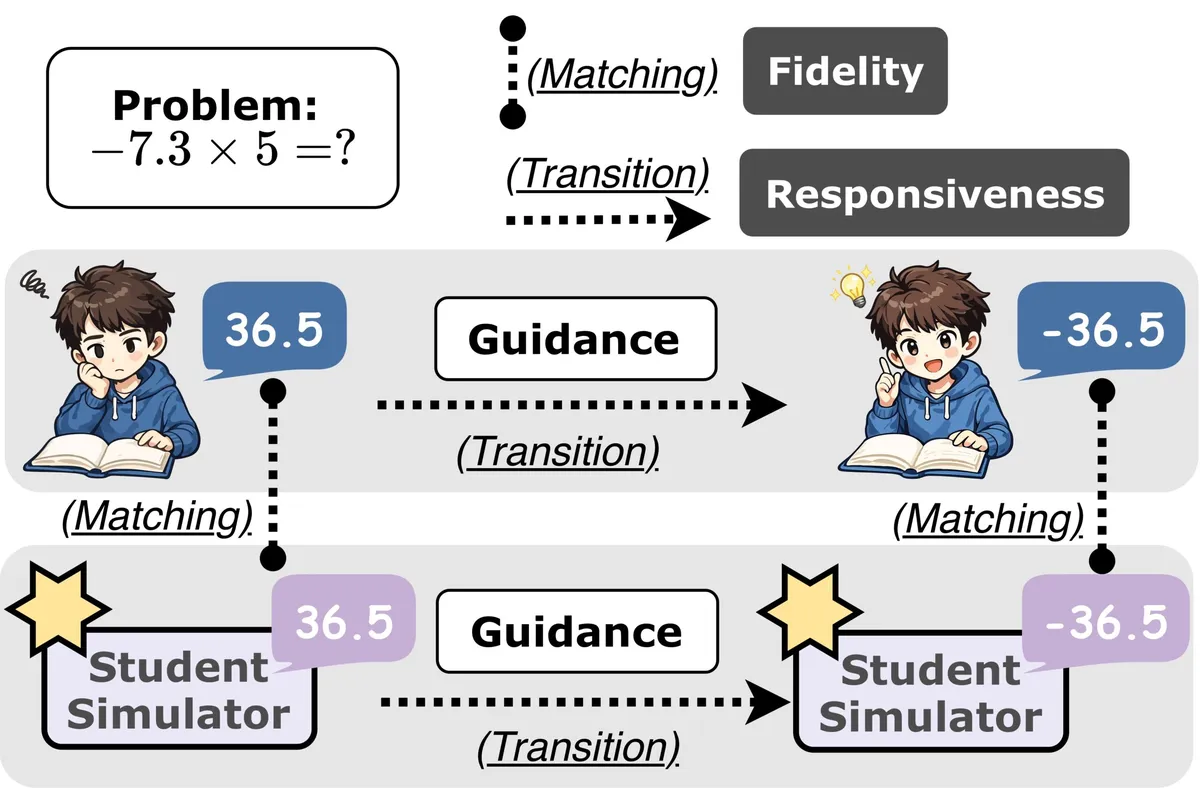
StudentSim adds LoRA adapters to Qwen3-4B-Instruct and trains in two stages. The first stage uses records pooled from many students to learn shared formats, common errors and typical revisions. The second stage specialises the model on one student's sparse records. The StudentSimEval benchmark covers 60 students across chess, English writing and maths. It scores behavioural fidelity, meaning how closely the simulator matches that student's held-out responses, and guidance responsiveness, meaning whether it updates its answer after tutoring. [1] [3] [6]
StudentSim beat GPT-5.4 prompted to act as a student in all three domains, but by very different margins. In chess the gap was wide (fidelity 0.515 vs 0.232). In writing (0.562 vs 0.514) and maths fidelity (0.638 vs 0.612) it was narrow. The responsiveness gains were larger in chess and maths than in writing. [1] [6]
A chess tutor was trained with reinforcement learning against a frozen StudentSim simulator. Expert raters scored it 90.5% accurate, compared with 71.6% for a tutor trained against GPT-5.4 acting as the student and 75.7% for a tutor with no reinforcement learning. So an unrealistic simulated student made the tutor slightly worse than skipping that training altogether. [1] [6]
The training and evaluation code is open source under the MIT license and includes per-student adapters and tutor checkpoints. To reuse the approach, teams need learner logs that record each response both before and after guidance. [5]
in chess, the choice of simulated student changed tutor quality, and using an LLM as the student did worse than no RL.
Read the full assessment
Implication: edtech teams using prompted LLMs as students may be optimising the wrong signal; realistic simulators could screen tutors before human trials.
Sources are checked; here is the dossier.
Executive brief
A chess tutor trained against simulated students got better than one trained against GPT-5.4 acting as a student. Expert raters scored the first tutor 90.5% accurate, compared with 71.6% for the GPT-5.4 version and 75.7% for a tutor with no reinforcement learning (Microsoft Research Blog). The system, StudentSim from Microsoft Research and UIUC, trains one simulator per real student from public, de-identified learning records. Each simulator copies how its student answers and how that student changes an answer after a hint. Microsoft describes it as a research tool. It is not a product and is not used in classrooms. No independent replication has appeared yet.
What changed and event timeline
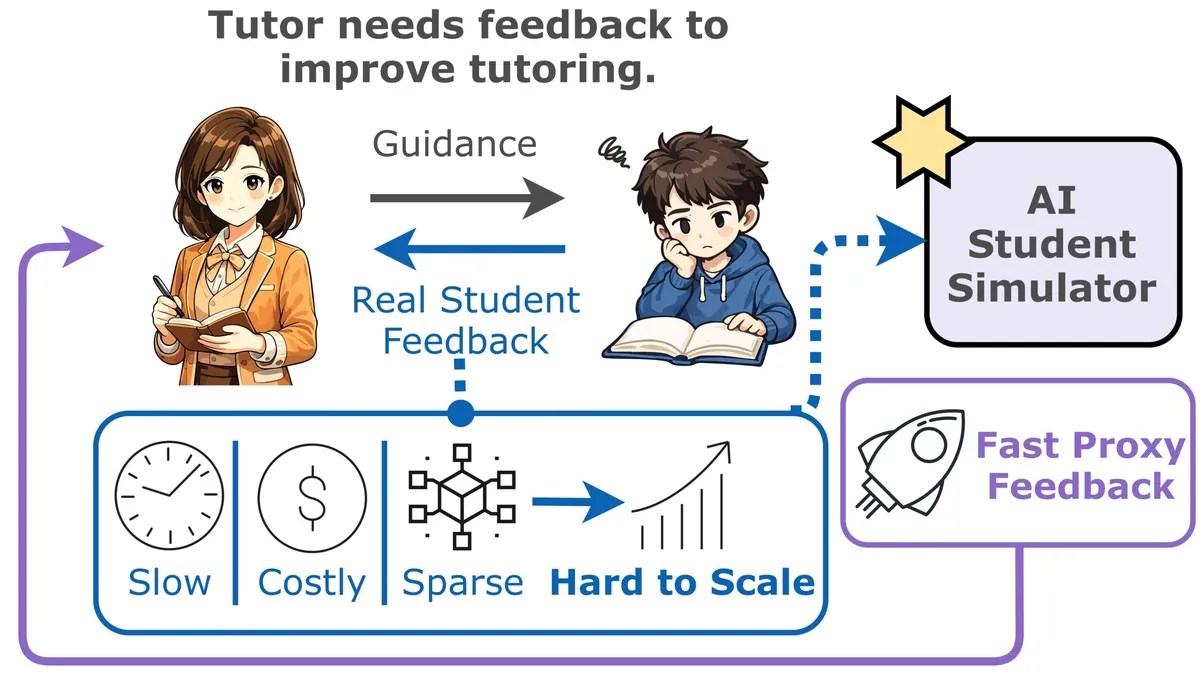
Review flags "too-smart" simulated students
A survey of LLM student simulation reports that prompted LLMs show narrow, idealised learner behaviour rather than real variation between students. This is the gap StudentSim targets ().
StudentSim paper submitted
It introduces two-stage per-student simulators and the StudentSimEval benchmark, which covers 60 students across chess, English writing and mathematics (;).
Microsoft blog and code
The blog post presents the research for a general audience. The training and evaluation code is public under the MIT license (;).
Capabilities and access
- Model: Qwen3-4B-Instruct with LoRA adapters (alphaXiv rendering of the paper).
- What it does in each domain: predicts a chess player's next move and how it changes after coaching.
- It includes the data preparation steps, a
studentsim-evalcommand, and per-student Stage-2 adapters and tutor checkpoints (GitHub).
Read the full section
- Model: Qwen3-4B-Instruct with LoRA adapters (alphaXiv rendering of the paper).
- What it does in each domain: predicts a chess player's next move and how it changes after coaching; writes essays with a learner's typical errors and predicts their corrections; predicts multiple-choice maths answers and whether they change after an explanation (blog).
- Repository: MIT license. It includes the data preparation steps, a
studentsim-evalcommand, and per-student Stage-2 adapters and tutor checkpoints (GitHub). - Data: chess data under CC0; writing data built from EFCAMDAT; maths data from FoundationalASSIST (GitHub).
Technical analysis
- Training: Stage 1 trains on records pooled from many students to learn shared formats, common errors and typical revisions.
- Metrics: behavioural fidelity (F) measures how closely the simulator matches that student's held-out responses.
- Tutor training: GRPO reinforcement learning with the simulator frozen.
Read the full section
- Training: Stage 1 trains on records pooled from many students to learn shared formats, common errors and typical revisions. Stage 2 specialises the model on one student's sparse records (blog).
- Metrics: behavioural fidelity (F) measures how closely the simulator matches that student's held-out responses. Guidance responsiveness (R) measures whether it updates its answer after tutor guidance. Both draw on Vygotsky's zone of proximal development, the gap between what a learner can do alone and with help (blog).
- Tutor training: GRPO reinforcement learning with the simulator frozen. The reward is the Stockfish score of the simulator's revised move minus the score of the student's original move (alphaXiv).
- Fair comparison: every method uses the same per-student training records and the same held-out evaluation records.
Claims and evidence
Writing and maths figures come from the alphaXiv rendering, not the arXiv abstract. All of these numbers are reported by the authors. Aggregator pages such as Emergent Mind and papers.cool repeat the abstract and do not corroborate it.
Read the full section
| Domain | StudentSim F / R | GPT-5.4 F / R | Other baseline F / R |
| Chess | 0.515 / 0.907 | 0.232 / 0.719 | Maia2: 0.454 / 0.272 |
| Writing | 0.562 / 0.642 | 0.514 / 0.595 | Untrained Qwen: 0.513 / 0.020 |
| Maths | 0.638 / 0.918 | 0.612 / 0.710 | Untrained Qwen: 0.492 / 0.613 |
Chess figures come from the blog. Writing and maths figures come from the alphaXiv rendering, not the arXiv abstract. All of these numbers are reported by the authors. Aggregator pages such as Emergent Mind and papers.cool repeat the abstract and do not corroborate it.
Context and prior work
- Knowledge tracing: classical methods such as Bayesian and Deep Knowledge Tracing model a student's state from their records.
- Maia2: predicts human chess moves well, but it is chess-only and cannot take coaching text.
- Prompted role-play: a 2025 review documents that LLMs asked to play students produce homogenised, overly capable learners (arXiv 2511.06078).
Read the full section
- Knowledge tracing: classical methods such as Bayesian and Deep Knowledge Tracing model a student's state from their records. They have no way to take natural-language tutor guidance as input (alphaXiv).
- Maia2: predicts human chess moves well, but it is chess-only and cannot take coaching text.
- Prompted role-play: a 2025 review documents that LLMs asked to play students produce homogenised, overly capable learners (arXiv 2511.06078). StudentSim instead trains on real records.
Limitations, safety and contested findings
- Uneven gains: the margins over GPT-5.4 are large in chess but small in writing (F 0.562 vs 0.514) and in maths fidelity (0.638 vs 0.612).
- Narrow human evaluation: the tutor test covered chess only, with 8 expert annotators producing 74 annotations (alphaXiv).
- No learning outcomes: the study measures nothing about real learning.
Read the full section
- Uneven gains: the margins over GPT-5.4 are large in chess but small in writing (F 0.562 vs 0.514) and in maths fidelity (0.638 vs 0.612).
- Narrow human evaluation: the tutor test covered chess only, with 8 expert annotators producing 74 annotations (alphaXiv). The authors call it a proof of concept.
- No learning outcomes: the study measures nothing about real learning. The authors say human studies are still essential for learning outcomes, safety, usability and classroom fit (blog).
- Short horizon: it models single-step revisions, not learning over longer periods.
- Privacy: it uses only public, de-identified datasets.
Business and practitioner implications
- Better proxy for edtech evaluation: prompting a frontier LLM to act as a student can give misleading reward signals.
- Low cost: a 4B model with LoRA adapters per student is cheap to fine-tune and run.
- Data dependence: the approach needs per-student history that records responses both before and after guidance. Most product telemetry does not capture that.
Read the full section
- Better proxy for edtech evaluation: prompting a frontier LLM to act as a student can give misleading reward signals. In chess, RL against GPT-5.4 as the student did slightly worse than no RL at all (71.6% vs 75.7%).
- Low cost: a 4B model with LoRA adapters per student is cheap to fine-tune and run. Teams with their own learner logs can adapt the open-source pipeline.
- Data dependence: the approach needs per-student history that records responses both before and after guidance. Most product telemetry does not capture that.
- Scope: treat simulator rewards as a filter before human studies, not a replacement for them.