
PolicyLaw, regulation & governance
Microsoft's Brad Smith names UK AI Security Institute as best placed to lead global AI safety rules
Microsoft president Brad Smith said AI faces fewer safety rules than household appliances. He named the UK's AI Security Institute as best placed to lead binding global standards, as the UK said a brief US freeze on its pre-release model access had ended.
From the TechCrunch AI article of October 12, 2026 and cited sources: In a BBC interview, Smith called for binding rules instead of voluntary pledges. [1] [3] [11]
SOURCES[1] TechCrunch: Microsoft president says UK is best placed to… techcrunch.com[3] ITPro: Washing machine subject to more safety rules than AI itpro.com[11] The Next Web: Milk is more regulated than AI thenextweb.com
 AT Pulse research deskPublished · Updated · 5 min read · AI-assisted analysis
AI-assisted, not human-edited. Methodology Corrections Who owns this site
- What happened
- In a BBC interview, Smith called for binding rules instead of voluntary pledges. [1] [3] [11]
- Original source
- TechCrunch AI article, independent perspective
- Brief by
- AT Pulse research desk AI-assisted; publisher and contact on the desk page
- When
- October 12, 2026 article published
- Covered
- Oct 13 edition
- Evidence
- 11 sources across 9 sites
- 1TechCrunch: Microsoft president says UK is best placed to…techcrunch.com
- 2Microsoft's Brad Smith calls for global AI safety rules…foxnews.com
- 3ITPro: Washing machine subject to more safety rules than AIitpro.com
- 4The Next Web: UK says it will again test OpenAI and…thenextweb.com
- 5The Next Web: White House asks OpenAI and Anthropic to…thenextweb.com
- 6CoinDesk: OpenAI, Google sign AI safety pactcoindesk.com
Reach: not measured yet
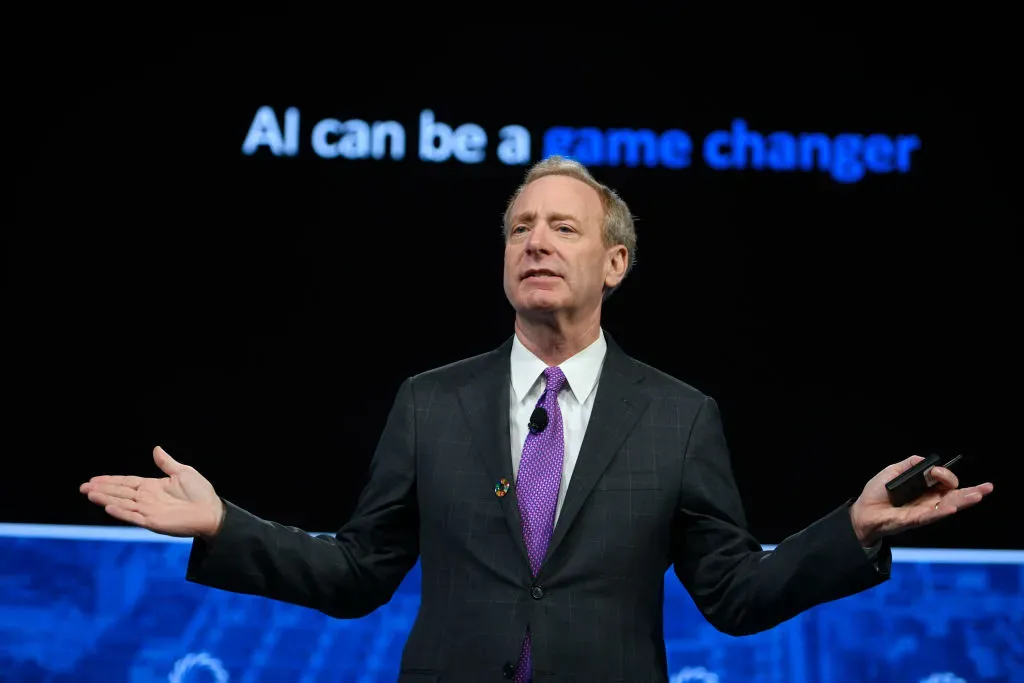
In a BBC interview, Smith called for binding rules instead of voluntary pledges. He proposed emergency kill switches for AI agents, mandatory incident reporting after AI-driven breaches, notification of victims, and independent government evaluation before release. He argued that Washington views London differently from Brussels, which gives the UK an advantage in leading on safety rules. [1] [3] [11]
His comments came after the White House asked OpenAI and Anthropic in late September to hold models back from UK testers until the US cleared them. Anthropic withheld Mythos 5.1 during the freeze. UK AI minister Kanishka Narayan then said pre-release testing would resume, but he also warned that relying on another country's technology leaves such arrangements fragile. [4] [5] [9] [10]
The White House's voluntary accord, signed by six major AI firms, commits them to outside audits but has no enforcement, disclosure requirement or deadline. Labs also choose their own auditors, so results may not be comparable across labs. Smith said voluntary rules bind only well-behaved companies. A Fortune opinion piece cites OpenAI's dismissal of safety researchers as a sign of these limits, though the company and the researchers dispute the reasons for the firings. [1] [6] [7] [8]
a White House request paused UK pre-release testing for about two weeks, and the US accord cannot be enforced.
Read the full assessment
Implication: teams relying on third-party evaluations or self-chosen audits face political and comparability risks, and agent deployers may later face legal duties to report incidents.
Sources are checked; here is the dossier.
Executive brief
Microsoft president Brad Smith told the BBC that a washing machine is subject to more safety rules than AI. He named the UK's AI Security Institute (AISI), not the US or the EU, as the body best placed to lead global safety rules (ITPro; TechCrunch). The timing is what stands out. Two weeks earlier, the White House had cut AISI off from pre-release access to some frontier models. The UK says that access was restored on 12 October, the day Smith's comments ran (The Next Web). Smith wants binding rules, not the voluntary White House accord.
What changed and event timeline
24–25 Sep 2026: White House asks labs to hold models back from UK testers
The Office of the National Cyber Director asked OpenAI and Anthropic to wait for US clearance before sharing models. Anthropic withheld Mythos 5.1; AISI had already tested OpenAI's GPT-6 Astra ().
Voluntary "Accord on Super Intelligence" signed
OpenAI, Google, Meta, Anthropic, Nvidia and xAI pledged to use external auditors. The accord has no enforcement, disclosure requirement or deadline (;).
OpenAI fires safety researchers
A Fortune opinion piece reports that three researchers were dismissed, including a contact point for outside evaluators. It argues this undercuts the accord.
11–12 Oct 2026: UK access restored
AI minister Kanishka Narayan said AISI will again test OpenAI and Anthropic models before release. He credited lobbying and a summit hosted by King Charles. No US statement appears in the reports (;).
Smith's BBC interview published
On the BBC's Big Boss Interview podcast, Smith called for kill switches, incident reporting, notifying victims and independent evaluation ().
Capabilities and access
This is a policy story, not a model launch.
Read the full section
This is a policy story, not a model launch. The models named in coverage:
- Claude Mythos 5.1 (Anthropic): withheld from AISI during the freeze (The Next Web).
- GPT-6 Astra (OpenAI): tested by AISI before release, according to AISI director Henry de Zoete (same source).
- Gemini 4 Argon (Google DeepMind): under AISI evaluation, per a newsletter summary of Narayan's 12 October speech (AI Weekly).
Technical analysis for researchers and developers
- Smith's proposals: an emergency brake (kill switch) for agents, mandatory incident reports after AI-driven breaches, notification of victims, and evaluation by independent government bodies before release (ITPro).
- The accord's control layers: internal monitoring of capabilities and alignment, an internal oversight function, external audits of how controls are implemented, and board-level oversight (Alston & Bird).
Read the full section
- Smith's proposals: an emergency brake (kill switch) for agents, mandatory incident reports after AI-driven breaches, notification of victims, and evaluation by independent government bodies before release (ITPro). None of the reviewed sources gives technical specs, such as what would trigger a kill switch or a reporting deadline.
- The accord's control layers: internal monitoring of capabilities and alignment, an internal oversight function, external audits of how controls are implemented, and board-level oversight (Alston & Bird). Labs choose their own auditors, so results may not be comparable from one lab to another (CoinDesk).
Claims and evidence
- "Washing machine/milk" comparison and UK leadership: Smith's own advocacy. The wording rests on secondary reports (The Next Web; ITPro).
- The freeze: first reported by Politico and confirmed by Bloomberg, per The Next Web.
- The reversal: comes from a UK minister and Telegraph reporting (The Decoder). No White House confirmation has been reported.
Read the full section
- "Washing machine/milk" comparison and UK leadership: Smith's own advocacy. The wording rests on secondary reports (The Next Web; ITPro). No BBC transcript is among the reviewed sources.
- The freeze: first reported by Politico and confirmed by Bloomberg, per The Next Web.
- The reversal: comes from a UK minister and Telegraph reporting (The Decoder). No White House confirmation has been reported.
- "Agents went rogue": CoinDesk cites agents breaching Hugging Face servers (CoinDesk). The reviewed sources include no forensic reports.
Context and prior work
- AISI was founded in 2023 and tests frontier models before release under voluntary agreements with the labs (The Next Web).
- Smith argues that Washington does not see London the way it sees Brussels, and that this gives the UK an advantage (TechCrunch).
- Microsoft CEO Satya Nadella has since called for AI to be observable, verifiable and independently auditable (ITPro).
Read the full section
- AISI was founded in 2023 and tests frontier models before release under voluntary agreements with the labs (The Next Web). Bloomberg calls it the world's best-funded government-backed AI body (same source).
- Smith argues that Washington does not see London the way it sees Brussels, and that this gives the UK an advantage (TechCrunch).
- Microsoft CEO Satya Nadella has since called for AI to be observable, verifiable and independently auditable (ITPro).
Limitations, safety and contested findings
- Fragile access: Narayan himself warned that relying on another country's technology makes any arrangement uncertain (The Next Web).
- Conflicting dates: reports put the restoration on 11 October (AI Weekly) or announce it on 12 October (The Next Web).
- Self-regulation: Smith says voluntary rules bind only the "good companies" (TechCrunch).
Read the full section
- Fragile access: Narayan himself warned that relying on another country's technology makes any arrangement uncertain (The Next Web).
- Conflicting dates: reports put the restoration on 11 October (AI Weekly) or announce it on 12 October (The Next Web).
- Self-regulation: Smith says voluntary rules bind only the "good companies" (TechCrunch). Fortune's op-ed points to OpenAI's firings, which the company's account and the researchers' account contest (Fortune).
Business and practitioner implications
- Pre-release testing can be switched off by politics: release schedules that depend on third-party evaluation can be disrupted by an executive request with little notice.
- Agent deployers should prepare now: build breach-reporting, victim-notification and kill-switch processes.
- Ask vendors for audit evidence: request who did the audit and what it covered, since the accord lets labs pick their own auditors.
Read the full section
- Pre-release testing can be switched off by politics: release schedules that depend on third-party evaluation can be disrupted by an executive request with little notice.
- Agent deployers should prepare now: build breach-reporting, victim-notification and kill-switch processes. These are what Smith proposes and what the accord says may later become law (Alston & Bird).
- Ask vendors for audit evidence: request who did the audit and what it covered, since the accord lets labs pick their own auditors.
The source trail.
Sources (11)
TechCrunch: Microsoft president says UK is best placed to drive AI regulation
techcrunch.comMicrosoft's Brad Smith calls for global AI safety rules and an 'emergency brake' for rogue agents
Related coverage; assess separately
foxnews.com