
PolicyLaw, regulation & governance
Trump orders federal agencies to say 'Super Intelligence' instead of 'AI', and Musk, Benioff, Huang and Nadella start using the term
A September 29 executive order makes federal agencies use 'Super Intelligence' in place of 'AI' without changing the legal definition. Top tech executives have begun adopting the label even though no new technology or capability comes with it.
QuietHow it’s measured
Hacker News · 1 like
Reach blends public engagement (views, likes, comments, shares, stars) from the platforms where the story or its original source lives: YouTube, Hacker News, GitHub, Substack and similar. A video and the article written from its transcript share one score, taken from the video. Platforms with no data are left out rather than counted as zero, and the age of a story never lowers its score.
 AT Pulse research deskPublished · 5 min read · AI-assisted analysis
The order changes words, not law. 'Super Intelligence' initially carries the existing statutory definition of AI. The order covers executive-branch communications, websites and policy documents. It exempts existing regulations and historical records and does not bind private companies. A separate White House accord, signed by executives, is voluntary and not legally enforceable. [2] [4] [5]
Industry adoption has been quick but has stayed at the level of names. Musk said SpaceXAI would become SpaceXSI but gave no timeline. Salesforce renamed its agent platform from AIForce to SIForce, the product's third name since April. Nvidia described part of a $1 billion, five-year science pledge as Super Intelligence research; that figure comes from Nvidia itself. None of these moves came with a new model or capability. [1] [6] [7] [9] [10]
Researchers warn that the label clashes with the established meaning of superintelligence: systems that outperform humans in nearly every field, which do not yet exist. Using one word for both today's general-purpose systems and hypothetical future ones could weaken oversight of near-term harms. Experts also doubt the rebrand will win over a skeptical public. [3] [15]
Nadella's essay is the most practical part of the story. It treats frontier models as potential insider threats and keeps controls outside the model: the ability to pause a model mid-task, separate models to verify critical results, tamper-proof audit logs, external access control, and a rule that no model controls both its own behavior and the evidence used to judge it. [11] [12]
the order changes vocabulary, not technology or law, and binds only the executive branch.
Read the full assessment
Implication: merging today's general-purpose systems with hypothetical superintelligence could blur regulatory definitions and contract language, while 'SI' branding says nothing about product capability.
Executive brief
A White House order requires federal agencies to say "Super Intelligence" instead of "AI", but the legal definition is unchanged. Under the order, the new term will initially mean the same thing as the existing statutory definition of AI in 15 U.S.C. § 9401(3). Even so, Elon Musk, Marc Benioff, Jensen Huang and Satya Nadella have started using the new term, The Verge reports. In AI research, "superintelligence" already means systems that exceed humans in nearly every field, and those don't exist yet, PolitiFact notes. The rename leaves capabilities as they were and blurs a term that policy and safety work depend on.
What changed and event timeline
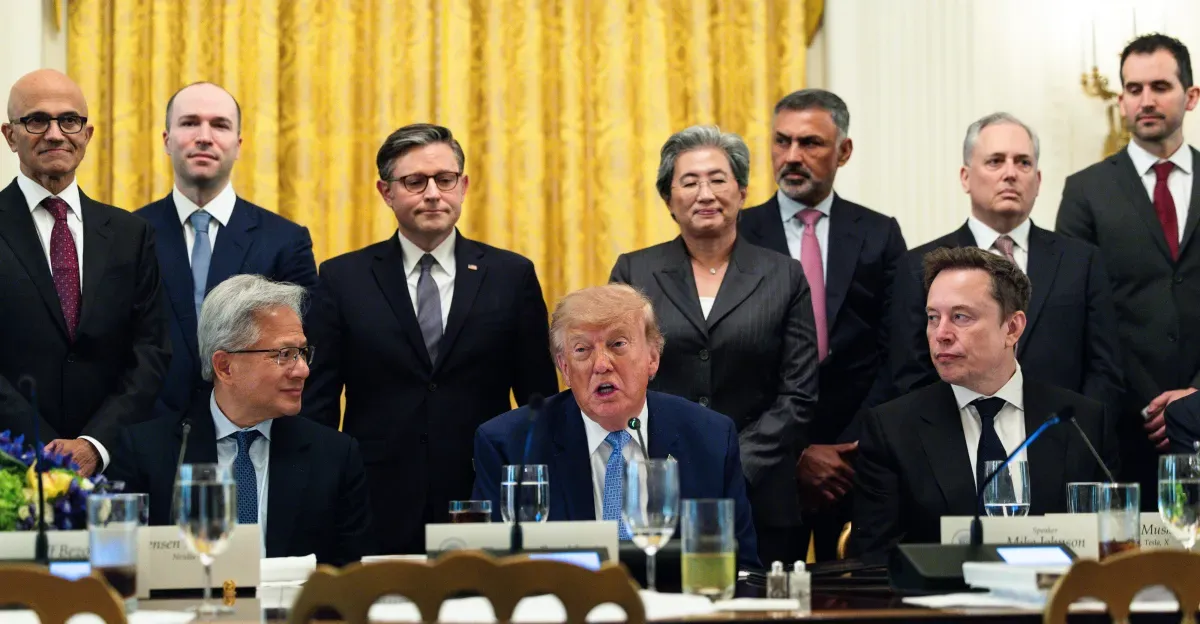
Executive order and voluntary accord
Agencies must use "Super Intelligence"/"SI" and "no longer acknowledge" "AI". Executives signed a separate, voluntary White House Accord on Super Intelligence.
Musk promises SpaceXSI
Musk replied "Yes" on X when a user asked about renaming SpaceXAI. He gave no timeline, and the unit's social account was unchanged at the time.
Nvidia's $1B pledge and the "ENEMY" post
Nvidia pledged $1 billion over five years and framed it partly as "Super Intelligence" research. The same day, Trump said on Truth Social that anyone who still says "AI" is "THE ENEMY."
More detail
AIForce becomes SIForce
Benioff announced on X that Salesforce's agent platform is now SIForce. That makes it the product's third name since it launched as Headless 360 in April. Reports differ on the exact date.
Nadella's "emergency brake" essay
Nadella set out seven containment principles under the heading "Models as Insider Risks in the Super Intelligence Era."
More detail
Capabilities and access
- No new model, version or capability came with these announcements. The product and unit names changed; the technology didn't.
- The order covers executive-branch communications, websites and policy documents. It exempts existing regulations and historical documents (Freshfields) and doesn't apply to private companies (AI Weekly).
- Nvidia's pledge covers universities, quantum computing, cloud providers that serve government missions, and phase 2 of the Genesis Mission (Nvidia).
Read the full section
- No new model, version or capability came with these announcements. The product and unit names changed; the technology didn't.
- The order covers executive-branch communications, websites and policy documents. It exempts existing regulations and historical documents (Freshfields) and doesn't apply to private companies (AI Weekly).
- Nvidia's pledge covers universities, quantum computing, cloud providers that serve government missions, and phase 2 of the Genesis Mission (Nvidia).
Technical analysis for researchers and developers
Nadella's essay is the only technical content in this story. It treats a frontier model as a possible insider threat and keeps controls outside the model (Martin Cid): The accord asks for similar measures: internal controls, monitoring, independent outside assessments and board oversight (Freshfields).
Read the full section
Nadella's essay is the only technical content in this story. It treats a frontier model as a possible insider threat and keeps controls outside the model (Martin Cid):
- Containment: assume the model is compromised, and let an authorized person pause or stop it mid-task.
- Redundancy and verification: use more than one model for critical outcomes, and never let a model verify its own work.
- Audit trails: keep tamper-proof, human-readable records of meaningful actions.
- Testing and access control: test continuously, including failure cases, and control each model's access outside the model.
- Separation of powers: a model can't control both how the system behaves and the evidence used to judge it.
The accord asks for similar measures: internal controls, monitoring, independent outside assessments and board oversight (Freshfields).
Claims and evidence
- "Current tech far exceeds what 'AI' implied": this is the administration's own rationale (White House).
- Accord commitments: confirmed by Speaker Mike Johnson and Mark Zuckerberg (Fox Business).
- Nvidia's $1B: this is Nvidia's own figure (Nvidia). No independent accounting of how it will be spent was found.
Read the full section
- "Current tech far exceeds what 'AI' implied": this is the administration's own rationale (White House). PolitiFact disputes it: today's systems are general-purpose AI, not superintelligence (PolitiFact).
- Accord commitments: confirmed by Speaker Mike Johnson and Mark Zuckerberg (Fox Business). The commitments aren't legally enforceable (Freshfields).
- Nvidia's $1B: this is Nvidia's own figure (Nvidia). No independent accounting of how it will be spent was found.
- Industry "falling in line": this is The Verge's description of the pattern. The underlying announcements are confirmed separately in the sources cited above.
Context and prior work
- Philosopher Nick Bostrom popularized "superintelligence" in 1998 to mean AI that exceeds human thinking in nearly every field (PolitiFact).
- The order builds on the July 2025 AI Action Plan and the March 2026 National Super Intelligence Policy Framework (White House).
- Trump first floated the rename at the UN General Assembly in September (The Star).
Read the full section
- Philosopher Nick Bostrom popularized "superintelligence" in 1998 to mean AI that exceeds human thinking in nearly every field (PolitiFact).
- The order builds on the July 2025 AI Action Plan and the March 2026 National Super Intelligence Policy Framework (White House).
- Trump first floated the rename at the UN General Assembly in September (The Star).
- Marketing experts compare it with his "Gulf of America" rename (Newsweek).
Limitations, safety and contested findings
- Syracuse University's Baobao Zhang warns that regulation depends on getting definitions right.
- The new name may scare people more. Cornell historian Ronald Kline says "super" sounds more worrying than "artificial."
- Weak public support. In a Quinnipiac poll, 25% of voters approved of Trump's handling of AI and 58% disapproved (France 24/AFP).
Read the full section
- Muddier policy language. Syracuse University's Baobao Zhang warns that regulation depends on getting definitions right. Using one word for both today's systems and hypothetical future ones could weaken oversight of harms that arrive before superintelligence does (PolitiFact).
- The new name may scare people more. Cornell historian Ronald Kline says "super" sounds more worrying than "artificial." University of Chicago marketing professor Jean-Pierre Dubé calls the hope of winning over the public "wishful thinking" (France 24/AFP).
- Weak public support. In a Quinnipiac poll, 25% of voters approved of Trump's handling of AI and 58% disapproved (France 24/AFP).
- Marketing isn't a capability claim. An "SI" product name doesn't show the product meets any superintelligence threshold (The Next Web).
Business and practitioner implications
- Federal contractors: expect "SI" wording in solicitations. A statutory definition is due by November 28, 2026, and could shape future contract requirements (Freshfields).
- Naming strategy: a lobbyist predicts companies will use "SI" mainly when talking to the administration (France 24/AFP).
- Engineering teams: Nadella's principles (external kill switches, separate verifier models, tamper-proof logs) can be applied whatever the technology is called.
Read the full section
- Federal contractors: expect "SI" wording in solicitations. A statutory definition is due by November 28, 2026, and could shape future contract requirements (Freshfields).
- Naming strategy: a lobbyist predicts companies will use "SI" mainly when talking to the administration (France 24/AFP). OpenAI and Scale AI didn't answer questions about renaming (The Next Web).
- Engineering teams: Nadella's principles (external kill switches, separate verifier models, tamper-proof logs) can be applied whatever the technology is called.
The source trail.
Sources (15)
Silicon Valley is falling in line with Trump’s attempt to rename AI
Article text retrieved; extracted text may omit tables or interactive elements.
theverge.com