
ResearchPapers, evidence & method
Nikon disqualifies Small World in Motion winner for using generative AI on microscopy video
Nikon withdrew first prize from Ning Xu's video of beating airway cilia after microscopists spotted structures that could not exist biologically. Xu says AI only post-processed real footage. The contest never clearly separated allowed processing from banned generative AI.
Reach: not measured yet
 AT Pulse research deskPublished · 4 min read · AI-assisted analysis
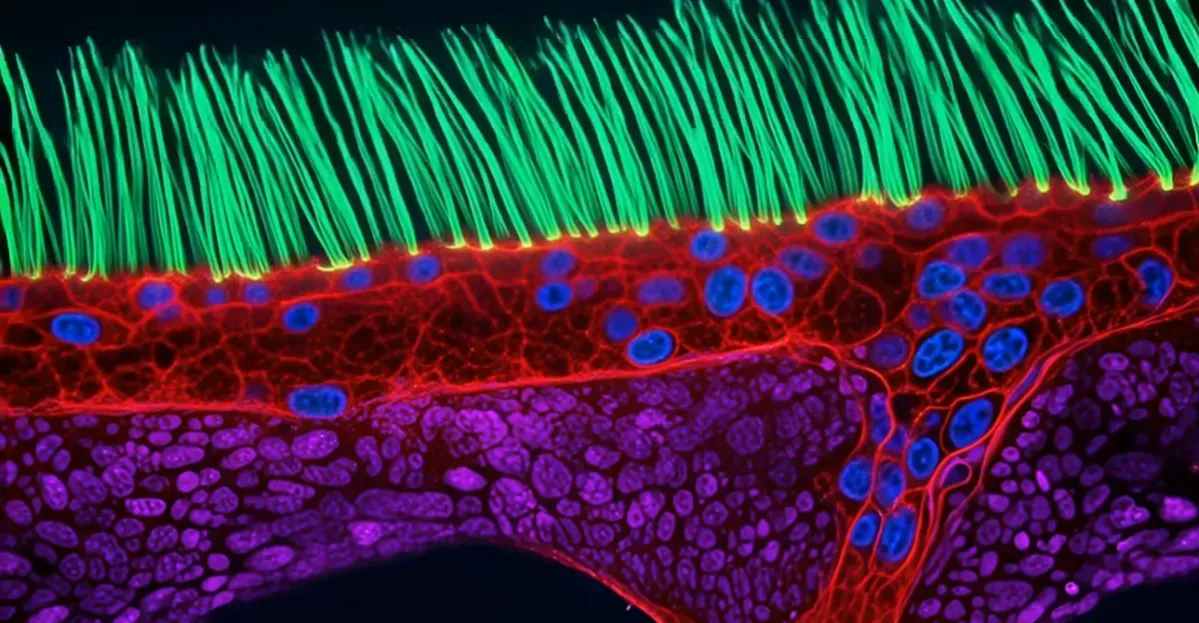
After a re-review, Nikon ruled that the winning entry, which showed cilia in tissue from a child with primary ciliary dyskinesia, broke its rules against generative AI. It removed the video and moved Nguyen Nam Nhat's second-place roundworm video up to first. [1] [3] [5]
Outside scientists caught the problem by checking the footage against known biology, not with automated detectors. They noted mitochondria-like structures where none belong and cilia of the wrong size appearing out of nowhere. One researcher also reported finding a SynthID watermark. [2]
Xu says an unsupervised neural network only separated and coloured features in reconstructed super-resolution images, and that the cilia and their motion are real. Nikon says the ruling is not a judgment of Xu's reputation or intent and that it will revisit its rules and evaluation procedures. [1] [6]
expert review against known biology exposed the problem, and no raw files or processing logs are public.
Read the full assessment
Implication: imaging teams, contests and journals may need documented pipelines, because an 'enhancement-only' label does not rule out added structures that were never measured.
Executive brief
Nikon withdrew first prize from its 2026 Small World in Motion microscopy video contest. The winning video, Ning Xu's footage of beating airway cilia, broke the contest's rules on generative AI (The Verge). Outside scientists flagged it first. They pointed to structures that appeared and vanished between frames, and one researcher reported finding a SynthID watermark (Gizmodo). Xu says the footage and the cilia motion are real and that AI was used only in post-processing. The case shows that "AI-assisted enhancement" of scientific imagery can fail both scientific and contest scrutiny.
What changed and event timeline
- Mid Sep 2026
Xu named winner
Nikon gave first place to Xu's video of cilia in tissue from a child with primary ciliary dyskinesia (PCD), a rare genetic disorder (;).
- Late Sep 2026
Microscopists object on LinkedIn
After the video was reposted, researchers including Edward Phelps (University of Florida) questioned whether its structures were biologically plausible. A PhD student reported finding a SynthID watermark ().
Nikon "re-reviewing."
Nikon said it was carefully re-reviewing the entry and that Xu was cooperating and had sent technical documentation ().
Disqualification
Nikon ruled that the video broke its generative-AI rules and removed it. Nguyen Nam Nhat's video of a roundworm and a Dileptus moved up from second to first (;).
Capabilities and access
- Tool: Xu describes an "unsupervised neural-network method" used to tell apart and display features in grayscale images reconstructed from super-resolution optical imaging (The Verge). No public source names the model, version or software.
- Watermark: The reported SynthID mark would point to a Google generative tool somewhere in the workflow (Gizmodo). That link is an inference: no reviewed source confirms which tool was used.
Technical analysis for researchers and developers
- Pipeline as described: optical acquisition, then super-resolution reconstruction to grayscale, then neural-network separation and colouring of features (The Verge).
- How it was caught: experts checked the video against known biology, not with automated detectors.
- Reproducibility: no raw acquisition files or processing log have been published. That leaves outsiders unable to separate measured signal from what the model added.
Read the full section
- Pipeline as described: optical acquisition, then super-resolution reconstruction to grayscale, then neural-network separation and colouring of features (The Verge). Xu says the AI did not create the cilia or their motion (DIYPhotography).
- How it was caught: experts checked the video against known biology, not with automated detectors. Phelps described purple structures that looked like mitochondria in a place where no such structure exists, and cilia of the wrong size appearing from nowhere (Gizmodo).
- Reproducibility: no raw acquisition files or processing log have been published. That leaves outsiders unable to separate measured signal from what the model added.
Claims and evidence
- Video broke the generative-AI rules: Nikon's own conclusion, reached after consulting its judges (Gizmodo). The judging materials are not public.
- AI was limited to post-processing: this is Xu's own account (The Verge). It conflicts with critics' observations that features appear that cannot exist biologically (Gizmodo).
- SynthID watermark detected: reported by one researcher. Nikon has not publicly confirmed it as a basis for the ruling.
Read the full section
- Video broke the generative-AI rules: Nikon's own conclusion, reached after consulting its judges (Gizmodo). The judging materials are not public.
- AI was limited to post-processing: this is Xu's own account (The Verge). It conflicts with critics' observations that features appear that cannot exist biologically (Gizmodo).
- SynthID watermark detected: reported by one researcher. Nikon has not publicly confirmed it as a basis for the ruling.
- Not a judgment of the entrant's reputation or intent: Nikon's statement (The Verge).
Context and prior work
- Nikon's rules ban using generative AI to produce content and require that entries be captured under a microscope (Gizmodo).
- Entries are judged on originality, informational content, technical proficiency and visual impact.
- Former judge Andrew Moore compared the result to old photographs restored with AI (Gizmodo).
Read the full section
- Nikon's rules ban using generative AI to produce content and require that entries be captured under a microscope (Gizmodo).
- Entries are judged on originality, informational content, technical proficiency and visual impact. One analysis argues these criteria reward exactly the visual polish AI provides (Martin Cid).
- Former judge Andrew Moore compared the result to old photographs restored with AI (Gizmodo).
Limitations, safety and contested findings
- The line between allowed "processing" and banned "generative AI" was never clearly defined. Nikon says it will "revisit rules and evaluation procedures" (DIYPhotography).
- The video presented a clinical condition (PCD).
- The dispute is still open: Xu maintains the motion is real, while Nikon ruled the entry non-compliant.
Read the full section
- The line between allowed "processing" and banned "generative AI" was never clearly defined. Nikon says it will "revisit rules and evaluation procedures" (DIYPhotography).
- The video presented a clinical condition (PCD). University of Queensland biologist Melanie White stressed that scientific images are data, and viewers must be able to trust they reflect the underlying measurement (Gizmodo).
- The dispute is still open: Xu maintains the motion is real, while Nikon ruled the entry non-compliant.
Business and practitioner implications
- Contest and journal operators: expect to require raw files and a log of every processing step before entries are scored on visual impact, as Martin Cid proposes.
- Imaging and ML teams: "unsupervised" or "enhancement-only" labels will not shield outputs that add structures that were never measured.
- Provenance tools: a watermark helped trigger scrutiny here, but expert review is what made the case.
Read the full section
- Contest and journal operators: expect to require raw files and a log of every processing step before entries are scored on visual impact, as Martin Cid proposes.
- Imaging and ML teams: "unsupervised" or "enhancement-only" labels will not shield outputs that add structures that were never measured. Disclose models, settings and before/after comparisons.
- Provenance tools: a watermark helped trigger scrutiny here, but expert review is what made the case.
- Vendors: a brand-run contest lost its headline winner after awarding a $3,000 prize, reported via BBC (Martin Cid).
The source trail.
Sources (7)
Nikon microscopic video competition winner disqualified for using generative AI
Article text retrieved; extracted text may omit tables or interactive elements.
theverge.com