
ResearchPapers, evidence & method
DeepMind's Pushmeet Kohli says AlphaFold 2 matched deposited protein structures but did not solve protein dynamics
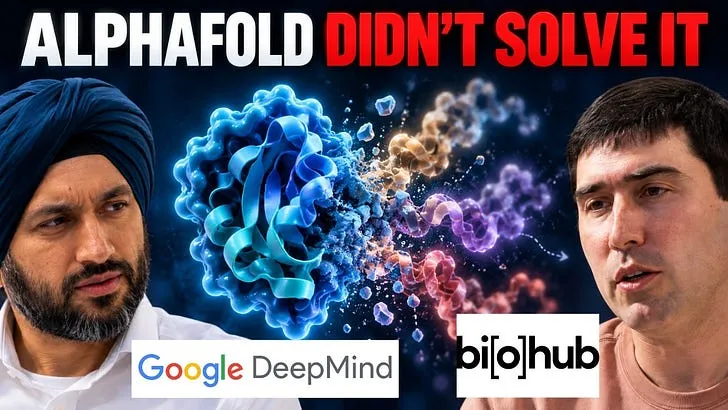
Google DeepMind's Pushmeet Kohli says AlphaFold 2 learned to reproduce single structures deposited in the Protein Data Bank, not the range of shapes proteins adopt. He and Biohub's Sal Candido argue progress now depends on better biological data, not model design.
RisingHow it’s measured
YouTube video · 4.8K views · 36 likes
Reach blends public engagement (views, likes, comments, shares, stars) from the platforms where the story or its original source lives: YouTube, Hacker News, GitHub, Substack and similar. A video and the article written from its transcript share one score, taken from the video. Platforms with no data are left out rather than counted as zero, and the age of a story never lowers its score.
 AT Pulse research deskPublished · 5 min read · AI-assisted analysis
AlphaFold 2 was trained to reproduce the one experimental structure deposited in the PDB for each protein. It does not recover the true ground state or the full set of shapes a protein takes in different contexts. Published studies confirm that it predicts a single static state, and its pLDDT confidence score only partly tracks how flexible a protein is. [1] [10] [11]
Both speakers frame data as the main constraint now. Built-in biological assumptions made AlphaFold 2 data-efficient, but Candido says they can hold models back as datasets grow. Kohli says DeepMind's virtual-cell work showed that the cell-by-gene data was not there yet. A $1.8 billion initiative from Biohub, DOE, NIH, Google DeepMind, Isomorphic Labs and Meta now aims to produce open, AI-ready biology data. [1] [2] [7]
Kohli argues that a well-calibrated confidence score matters more for trust than small accuracy gains or strict interpretability. He cites AlphaFold 2's usefulness as a predictor of disordered protein regions, which outside researchers found after the weights were released. Published benchmarks back this up: low pLDDT scores outperformed dedicated disorder predictors. [1] [8] [9]
Studies confirm AlphaFold 2 predicts one static state per protein. The implication: saying folding is 'solved' covers only matching deposited structures.
Read the full assessment
Dynamics, function and design remain open problems, and funding is shifting toward generating open data.
Executive brief
Pushmeet Kohli leads AI for Science at Google DeepMind. What it learned to do was reproduce the single structure that experimenters had deposited in the Protein Data Bank (PDB). Three days before the panel was published, Biohub, the US Department of Energy (DOE), the National Institutes of Health (NIH), Google DeepMind, Isomorphic Labs and Meta announced $1.8 billion to produce open biology data for AI (Biohub).
Read the full section
Pushmeet Kohli leads AI for Science at Google DeepMind. In this panel he says AlphaFold 2 did not solve how proteins actually behave. What it learned to do was reproduce the single structure that experimenters had deposited in the Protein Data Bank (PDB). It does not recover the full range of shapes a protein takes inside the body (transcript ~15:28). He and Sal Candido, who leads AI research at Biohub, argue that the bottleneck is now data, not model design. Three days before the panel was published, Biohub, the US Department of Energy (DOE), the National Institutes of Health (NIH), Google DeepMind, Isomorphic Labs and Meta announced $1.8 billion to produce open biology data for AI (Biohub).
What changed and event timeline
AlphaFold wins CASP14
DeepMind reported a median GDT score of 92.4 across targets. It also listed protein complexes and small-molecule interactions as unsolved ().
ESM3 launches
EvolutionaryScale released ESM3, a generative protein model that covers sequence, structure and function. The flagship version has 98 billion parameters (;).
EvolutionaryScale joins Biohub
The ESM team became part of Biohub, and Candido became its VP for AI research ().
Virtual Biology Initiative grows to $1.8B
The initiative launched in April 2026. The new funding mixes cash, data, compute and measurement tools for AI-ready datasets of cells (;).
Panel published
Latent Space released the session, moderated by Brandon Anderson. It covers whether data scaling follows a "bitter lesson," AlphaFold's limits, and trust versus interpretability ().
Capabilities and access
- Model: the discussion centres on AlphaFold 2, the 2020 version. DeepMind released its weights, and outside researchers then found new uses for it (~23:53).
- What it predicts: one static structure per protein, plus a per-residue confidence score called pLDDT (0–100) (DeepMind, 2021).
- No new model or release was announced in the session. The data initiative promises an "open resource" with shared standards (Biohub).
Read the full section
- Model: the discussion centres on AlphaFold 2, the 2020 version. DeepMind released its weights, and outside researchers then found new uses for it (~23:53).
- What it predicts: one static structure per protein, plus a per-residue confidence score called pLDDT (0–100) (DeepMind, 2021).
- No new model or release was announced in the session. The data initiative promises an "open resource" with shared standards (Biohub).
Technical analysis for researchers and developers
Read the full section
- Built-in biology vs. scale. Kohli says AlphaFold 2 encoded the idea that residues influence each other, which made it more data-efficient (~10:48). Candido says such built-in assumptions help most when data is small, and can hold a model back once data grows (~12:24).
- Noisy data can still help. Candido says training on metagenomic sequences, many of which are not real or complete proteins, still improved protein design (~02:32).
- Calibration matters most for trust. Kohli argues that a well-calibrated confidence score matters more than small accuracy gains (~23:53).
- Direction of work: model raw cryo-EM images instead of finished PDB structures (Kohli tried this; it "requires more work"). Candido says interpretability work finds information about function and motion inside protein language models (~17:54, ~22:18).
Claims and evidence
- AlphaFold 2 scored about 90 GDT (Kohli). DeepMind's own figure was a median of 92.4 (DeepMind).
- AlphaFold 2 turned out to be a strong disorder predictor. Independent work supports this.
- It predicts one state, not the range of shapes a protein takes. Independent studies support this (Yang et al., 2025).
Read the full section
- AlphaFold 2 scored about 90 GDT (Kohli). DeepMind's own figure was a median of 92.4 (DeepMind).
- AlphaFold 2 turned out to be a strong disorder predictor. Independent work supports this. Low pLDDT scores beat 11 dedicated disorder predictors on the DisProt-PDB benchmark (Fmax 0.784, AUC 0.905) (Wilson et al., 2022).
- It predicts one state, not the range of shapes a protein takes. Independent studies support this (Yang et al., 2025).
- The metagenomic-data benefit, and finding function and motion inside model internals, rest only on Candido's statements in the panel. No independent corroboration was found.
Context and prior work
- AlphaFold depended on decades of PDB data it did not create.
- Virtual cell work is data-limited. Kohli says DeepMind's attempts to model cells from cell-by-gene data showed that "the data was not there yet."
- The "BBI" in the transcript most likely refers to the Virtual Biology Initiative. The initiative's measurement plans include cryo-electron tomography and large-scale microscopy (Biohub).
Read the full section
- AlphaFold depended on decades of PDB data it did not create. Kohli says DeepMind lacked the means to enlarge the PDB, so it put its effort into modelling (~04:54).
- Virtual cell work is data-limited. Kohli says DeepMind's attempts to model cells from cell-by-gene data showed that "the data was not there yet."
- The "BBI" in the transcript most likely refers to the Virtual Biology Initiative. The initiative's measurement plans include cryo-electron tomography and large-scale microscopy (Biohub).
Limitations, safety and contested findings
- The panel is commentary from funders and builders. Both speakers' organisations are partners in the initiative being promoted (Biohub).
- The confidence score only partly tracks motion. pLDDT correlates inversely with protein dynamics but misses finer gradations, and flexible loops can come out as rigid predictions (bioRxiv).
- The risk of an uncharacterised model. Kohli warns that using such a model without knowing its strengths and limits can cause harm (~26:53).
Read the full section
- The panel is commentary from funders and builders. Both speakers' organisations are partners in the initiative being promoted (Biohub).
- The confidence score only partly tracks motion. pLDDT correlates inversely with protein dynamics but misses finer gradations, and flexible loops can come out as rigid predictions (bioRxiv).
- The risk of an uncharacterised model. Kohli warns that using such a model without knowing its strengths and limits can cause harm (~26:53).
- Contested point: Kohli says interpretability in the strict sense is not required; Candido gives it more weight.
- Clinical timelines: neither speaker gave a date for AI-driven gains in the clinic.
Business and practitioner implications
- Read "protein folding is solved" narrowly. It means matching deposited structures.
- Money is moving to data generation. The $1.8B commitment is for open, standardised biological data rather than new models (News-Medical).
- For drug discovery, Kohli says AI is already used at every stage. Large speed-ups depend on better models of how biology works (~28:08).
Read the full section
- Read "protein folding is solved" narrowly. It means matching deposited structures. Dynamics, function and design remain open, and that is where funding is still needed (~14:36).
- Money is moving to data generation. The $1.8B commitment is for open, standardised biological data rather than new models (News-Medical).
- For drug discovery, Kohli says AI is already used at every stage. Large speed-ups depend on better models of how biology works (~28:08).
- For teams: start from the problem, check confidence calibration before trusting outputs, and fail fast within your data and compute limits.