
CodingSoftware & developer tools
Simon Willison builds a newsletter archive for his blog by talking to Codex while cooking dinner
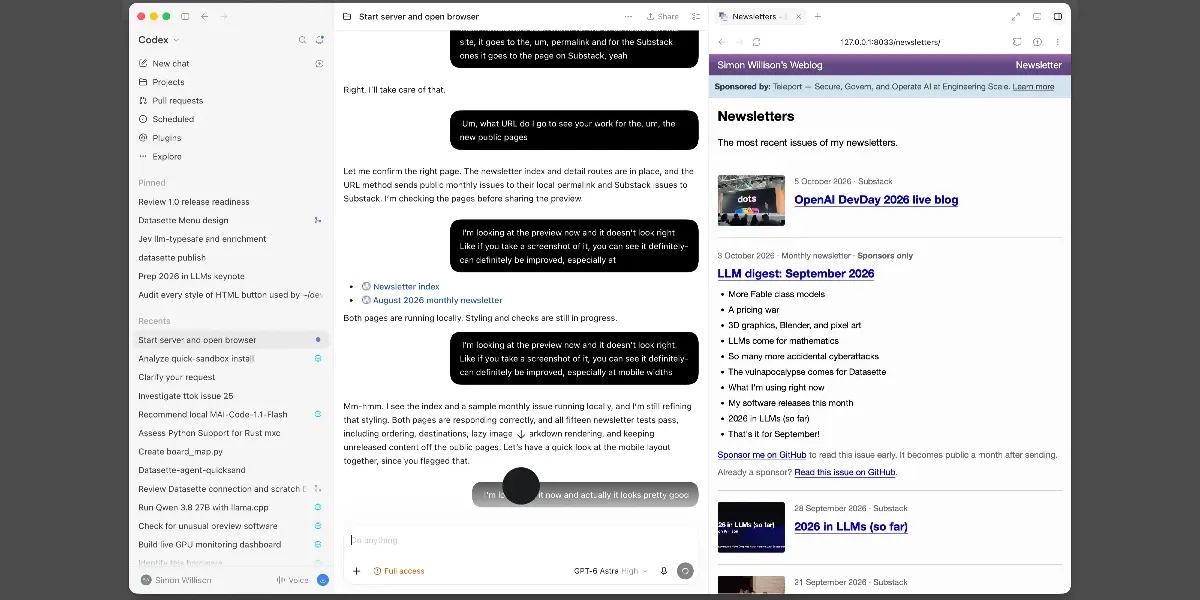
Simon Willison spent about 30 minutes directing Codex by voice with GPT-6 Astra to build a Newsletters section for his Django blog, then about 30 more minutes typing fixes. The result shipped, but voice proved weaker for detailed review.
QuietHow it’s measured
Hacker News · 10 likes
Reach blends public engagement (views, likes, comments, shares, stars) from the platforms where the story or its original source lives: YouTube, Hacker News, GitHub, Substack and similar. A video and the article written from its transcript share one score, taken from the video. Platforms with no data are left out rather than counted as zero, and the age of a story never lowers its score.
 AT Pulse research deskPublished · 5 min read · AI-assisted analysis
From the voice session came a data model, four importers (Substack RSS, Substack's undocumented archive endpoint, and two GitHub repositories), archive pages and search integration. The changes were merged as PR #719 with eight commits and are live on the blog. The full spoken transcript is public. [1] [3] [7]
Code review caught a real deployment flaw. The agent's importer ran git in a subprocess, which would not work on Heroku without extra build setup. It was replaced with token-authenticated GitHub API calls. A human still had to create the read-only token for the private repository. [3]
Willison concludes that voice is most useful for turning otherwise idle time into specification and scaffolding work. Typing stayed faster for pasting errors, giving examples and pointing at specific code. Talking to a computer is also impractical in a shared office. [1]
Practical limits apply. Voice use is metered separately from Codex task budgets, at roughly 15 to 30 minutes per five-hour window on Plus. There is no public GPT-Live API, and screen-context features work only on macOS. [8]
the public transcript and code show an agent turning rambling speech into working Django code, though for one developer and one feature. Implication: voice may let teams use idle time for scaffolding, while human review stays essential.
Executive brief
Simon Willison shipped a new Newsletters section for his Django blog on 9 October 2026. He built it almost entirely by talking to Codex for about half an hour while cooking dinner. The voice session produced a data model, four importers, archive pages and search integration. He then spent another half hour typing fixes after reviewing the code. His conclusion is that voice coding works well when you're doing something else at the same time, but it won't replace typing for detail work. The merged pull request and the live newsletters page are public, so anyone can check the result. No independent coverage of the experiment exists yet.
What changed and event timeline
Voice comes to the ChatGPT desktop app
OpenAI added GPT-Live voice to the macOS and Windows app, letting users direct agents in ChatGPT Work and Codex by speaking, on Plus, Pro, Business, Edu and Enterprise plans ().
GPT-6 Astra launches at DevDay
Sam Altman called Astra OpenAI's "most aligned" model and stressed computer use. Codex Ultrafast was also announced (;).
Voice session, review and merge
About 30 minutes of voice prompting, then about 30 minutes of typed revisions. PR #719 merged with 8 commits ().
Write-up published
Willison posted the account along with the full voice transcript as a Gist (;).
Capabilities and access
- Setup: the ChatGPT desktop app, Codex tab, "Start new voice chat", with the model set to GPT-6 Astra High, working on a local checkout with a dev server preview open in a browser (post).
- How voice is split from coding: voice runs on GPT-Live, and the coding model is chosen separately.
- Astra API pricing: $10 per million input tokens and $50 per million output tokens, with a staged rollout (Scalevise).
Read the full section
- Setup: the ChatGPT desktop app, Codex tab, "Start new voice chat", with the model set to GPT-6 Astra High, working on a local checkout with a dev server preview open in a browser (post). The reviewed sources don't explain what the "High" label means.
- How voice is split from coding: voice runs on GPT-Live, and the coding model is chosen separately. A July analysis said the desktop app coordinated tasks with GPT-5.6 Terra; that was written before Astra launched (Digital Applied).
- Astra API pricing: $10 per million input tokens and $50 per million output tokens, with a staged rollout (Scalevise).
Technical analysis for researchers and developers
- What was built: a standard Django feature: a new model, migration, admin configuration, views and templates.
- Importers:
- Substack RSS for recent issues.
Read the full section
- What was built: a standard Django feature: a new model, migration, admin configuration, views and templates. Newsletters were deliberately kept off tag pages and the homepage but shown on date archives. Only the unique monthly newsletters were added to search (post).
- Importers:
- Substack RSS for recent issues.
- Substack's undocumented
/api/v1/archiveendpoint for older ones. The agent ran a web search to work out how to paginate it and found Karen Spinner's write-up, which recommends offset paging withlimit=12. - Two GitHub repositories, one public and one private.
- Problem caught in review: the agent's importer ran
gitin a subprocess, which "won't work on Heroku" without extra build configuration. It was replaced with token-authenticated GitHub API calls (PR #719). - Reproducibility: the full transcript, including the speech disfluencies, and the commit history are public (Gist).
Claims and evidence
- Claim: an agent can turn rambling, self-correcting speech into a working spec. Evidence: the transcript excerpt and full Gist (Gist).
- Claim: the feature reached production. Evidence: the merged PR and the live index page.
- Claim: desktop voice can direct several agents at once. Willison's session used a single agent, so it doesn't test this.
Read the full section
- Claim: an agent can turn rambling, self-correcting speech into a working spec. Evidence: the transcript excerpt and full Gist (Gist). This is one person's experience on one feature.
- Claim: the feature reached production. Evidence: the merged PR and the live index page.
- Claim: desktop voice can direct several agents at once. Evidence: OpenAI's own description (OpenAI Community). Willison's session used a single agent, so it doesn't test this.
- Claim: Astra is OpenAI's "most aligned" model. Evidence: a statement from OpenAI's CEO at the launch event (live blog). No independent test confirms it.
Context and prior work
Read the full section
- Willison has long used ChatGPT voice on his phone while walking the dog, mostly for research and brainstorming. He says the desktop version is different because it adds a visual preview and lets him fall back to the keyboard (post).
- He earlier documented adding a content type to his blog through agent prompting in his agentic engineering guide (guide).
- OpenAI regularly uses voice-driven demos at DevDay (live blog).
Limitations, safety and contested findings
- Voice runs out at the detail stage. For pasting errors, giving examples and pointing at specific code, typing remained faster.
- The agent made a real deployment mistake. The
gitsubprocess choice was only caught in human review (PR #719). - Platform constraints:
Read the full section
- Voice runs out at the detail stage. For pasting errors, giving examples and pointing at specific code, typing remained faster. Talking to a computer is also impractical in a shared office (post).
- The agent made a real deployment mistake. The
gitsubprocess choice was only caught in human review (PR #719). - Platform constraints:
- Voice usage is metered separately from Codex task budgets; on Plus that's roughly 15–30 minutes per 5-hour window.
- There's no public GPT-Live API.
- Screen-context features work only on macOS.
- Credentials: a human still had to create the read-only token for the private repository (PR #719).
Business and practitioner implications
- Voice adds time, not speed. It turns otherwise idle time into specification and scaffolding work.
- In this case, review caught a problem that would have broken deployment.
- Expect a mixed workflow: voice for requirements, then typing for review and fixes.
Read the full section
- Voice adds time, not speed. It turns otherwise idle time into specification and scaffolding work; the change is in when work can happen, not in how fast it gets done.
- Keep code review in place. In this case, review caught a problem that would have broken deployment.
- Expect a mixed workflow: voice for requirements, then typing for review and fixes.
- Plan around the limits. On lower plans the voice metering caps sessions, and without a GPT-Live API, teams can't build their own voice integrations yet (Digital Applied).
- A cheaper model option: OpenAI positions GPT-6.1 Sol as close to Astra in capability at one-fifth of Astra's token prices (search listing for OpenAI's Sol announcement).
The source trail.
Sources (11)
A new feature for my blog, built using my voice — Simon Willison
simonwillison.netI built a new feature for my blog entirely by voice with Codex Desktop, while I was cooking dinner https://t.co/dQwOlgFeKT
Related coverage; assess separately
x.com