
ModelsArchitectures & capability
SimpliSafe’s new doorbell extends AI-filtered, human-monitored security to the front door
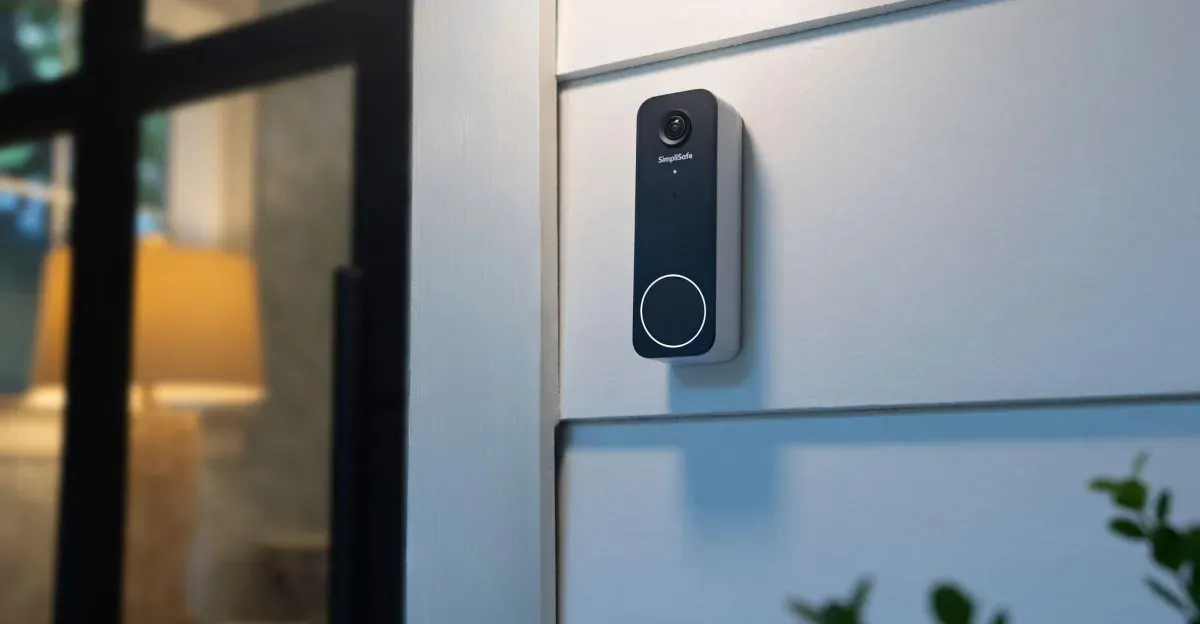
SimpliSafe’s Video Doorbell Series 2 pairs a wired 2K camera with Active Guard Outdoor Protection, routing qualifying events to remote agents who can view live video, speak, trigger deterrents and request dispatch. The model raises subscription, privacy and evaluation questions.
 AT Pulse research deskSeptember 16, 2026 · 11 min read · AI-assisted analysis
The Video Doorbell Series 2 is positioned less as a standalone camera than as an entry point into SimpliSafe’s monitored Active Guard service, with a $199.99 device tied to higher-value monthly plans. [1] [10]
The workflow is human-in-the-loop: AI and computer vision narrow events, while remote monitoring agents assess situations and may intervene through audio, sirens, homeowner contact or dispatch procedures. [1] [5] [6] [8]
the reviewed materials show a consumer security product using AI triage plus remote human review at a sensitive residential boundary, with documented agent access controls, biometric-adjacent processing and subscription pricing.
Read the full assessment
Implications: for AI teams, this is a case study in operationalizing computer vision through workflow design rather than full automation. For business leaders, it suggests recurring revenue but also higher governance obligations around access control, retention, escalation, bystander privacy and auditable performance.
Executive brief
On September 15, 2026, SimpliSafe launched the Video Doorbell Series 2, a wired 2K doorbell camera that extends its Active Guard Outdoor Protection service to the front door. The launch was reported by The Verge and separately announced by SimpliSafe via PR Newswire; no independent hands-on evaluation, benchmark, or third-party privacy/security audit specific to the new doorbell as of September 16, 2026 were found in the reviewed sources. This doorbell camera lets a human security guard watch your front door | The Verge For AI practitioners and business leaders, the product is best understood as a human-in-the-loop perimeter monitoring system: AI narrows the event stream; human agents make escalation decisions.
Read the full section
On September 15, 2026, SimpliSafe launched the Video Doorbell Series 2, a wired 2K doorbell camera that extends its Active Guard Outdoor Protection service to the front door. The core product shift is not merely higher-resolution video; it is the pairing of camera analytics with remote human monitoring agents who can view live video during qualifying events, speak through the device, sound deterrents, and potentially request emergency dispatch. The launch was reported by The Verge and separately announced by SimpliSafe via PR Newswire; no independent hands-on evaluation, benchmark, or third-party privacy/security audit specific to the new doorbell as of September 16, 2026 were found in the reviewed sources. This doorbell camera lets a human security guard watch your front door | The Verge
For AI practitioners and business leaders, the product is best understood as a human-in-the-loop perimeter monitoring system: AI narrows the event stream; human agents make escalation decisions. SimpliSafe describes the pipeline as involving on-device AI, cloud-based computer vision, and facial recognition / face matching; its support materials describe “familiar faces” matching, agent review, and intervention workflows. However, SimpliSafe has not published model cards, performance metrics, demographic error rates, latency distributions, false-alarm rates, or reproducible evaluation protocols for this service. This doorbell camera lets a human security guard watch your front door | The Verge
The main risk surface is not only computer vision error. It includes remote human access to private residential video, biometric processing, law-enforcement handoff, bystander privacy, and operational reliability. SimpliSafe says camera footage is encrypted, agents can access limited video only during an alarm or Active Guard engagement, and footage will not be shared with law enforcement unless legally required; its Active Guard privacy supplement says the service may collect facial features, facial embeddings, voice recordings, license plates, inferences, and other data, with Active Guard videos retained for up to 30 days unless legal or user-authorized exceptions apply. SimpliSafe
What changed and event timeline
SimpliSafe announced the Video Doorbell Series 2, priced at $199.99, with 2K resolution, head-to-toe field of view, dual-band Wi-Fi, two-way audio, and a siren.
More detail
SimpliSafe’s announcement says the product is available immediately through SimpliSafe and select retailers, and requires a SimpliSafe Base Station, Keypad, wired doorbell setup, chime, and compatible transformer.
- Same day
The Verge reported that the new doorbell brings SimpliSafe’s AI-powered proactive monitoring to the front door, using a mix of AI analysis and live agents to detect and respond to potential threats.
More detail
The article states the doorbell works with Active Guard Outdoor Protection, starting at $49.99 per month, and that an amber LED indicates a live agent while blue indicates homeowner live viewing.
- Prior deployment path
SimpliSafe’s Active Guard concept did not originate with this doorbell
The Verge reports Active Guard launched on SimpliSafe’s indoor camera in 2023, reached outdoor cameras in 2024, and is now being applied to the new doorbell.
More detail
TechCrunch’s 2024 coverage of Active Guard Outdoor Protection described the earlier outdoor-camera service as combining AI with human agents, with SimpliSafe telling TechCrunch that the human agent was intentionally retained so final decisions were not left to AI alone.
Capabilities and access
Known model/version: the device is the SimpliSafe Video Doorbell Series 2. No public firmware version, chipset, model-card identifier, CV model version, or facial-recognition vendor name in the reviewed materials were found in the reviewed sources.
Read the full section
Known model/version: the device is the SimpliSafe Video Doorbell Series 2. No public firmware version, chipset, model-card identifier, CV model version, or facial-recognition vendor name in the reviewed materials were found in the reviewed sources.
Documented hardware/service capabilities include:
- 2K video, 150-degree head-to-toe view, 10x zoom, two-way audio, dual-band Wi-Fi, smart alerts for people and packages, up to five seconds of pre-event capture, and a built-in siren, according to The Verge and SimpliSafe’s launch materials. This doorbell camera lets a human security guard watch your front door | The Verge
- Wired installation requirements: existing doorbell wiring, mechanical or digital chime, and a transformer rated 16–24VAC, 10–30VA; SimpliSafe’s support guide also notes an outdoor-rated plug-in adapter option for incompatible wiring setups. Video Doorbell Series 2 Overview and Installation Guide | SimpliSafe Support
- Plan dependency: Active Guard Outdoor Protection requires SimpliSafe’s Pro or Pro Plus plans, priced by SimpliSafe at $49.99/month and $79.99/month, respectively. SimpliSafe’s support pages distinguish Pro overnight coverage from Pro Plus 24/7 coverage. SimpliSafe® Launches Video Doorbell Series 2 to Help Stop Crime Before It Reaches Your Front Door
- Agent access: SimpliSafe’s terms say monitoring staff can remotely access live video or frames during security-related events when the camera is armed and within service hours; agents may speak, trigger sirens, use prerecorded audio, activate spotlights where applicable, listen to live audio, and take supported actions under operating procedures. SimpliSafe
- Face matching: SimpliSafe’s support page says Automatic Face Matching compares clips against the user’s “familiar faces” library and labels detected matches, which agents review; in Texas, Illinois, and Portland, Oregon, automatic face matching is disabled, while agents may manually review events. What is Automatic Face Matching for SimpliSafe® Active Guard Outdoor Protection? | SimpliSafe Support
Technical analysis for researchers and developers
The publicly documented architecture suggests a tiered event-processing system: For developers, the implementation lesson is that “AI security” here is not autonomous enforcement. Evaluation methodology is the largest gap. SimpliSafe has not published these metrics for the Video Doorbell Series 2 or Active Guard Outdoor Protection.
Read the full section
The publicly documented architecture suggests a tiered event-processing system:
- Device capture and local trigger layer. The doorbell captures video and audio and performs at least some on-device AI, according to The Verge. SimpliSafe’s materials do not disclose the exact models, hardware accelerators, frame rates used for inference, or whether local inference includes person detection, motion prefiltering, or face-quality assessment. This doorbell camera lets a human security guard watch your front door | The Verge
- Cloud CV / event classification layer. SimpliSafe and The Verge describe cloud-based computer vision. Support materials mention people/package detection, familiar face matching, and AI-reviewed events, but do not disclose training data, thresholds, calibration methods, or retraining cadence. This doorbell camera lets a human security guard watch your front door | The Verge
- Human-agent decision layer. Agents appear to be the operational decision point for engagement and escalation. SimpliSafe’s support documentation says if a person is detected and not matched to a familiar face, an agent assesses the situation and may initiate two-way audio, siren, spotlight, homeowner contact, or emergency dispatch request. How to use SimpliSafe® Active Guard Outdoor Protection | SimpliSafe Support
- Notification and evidence layer. SimpliSafe says notifications may be generated after review by an expert agent or advanced AI; the terms emphasize that emergency dispatch is limited and not guaranteed. How to use SimpliSafe® Active Guard Outdoor Protection | SimpliSafe Support
For developers, the implementation lesson is that “AI security” here is not autonomous enforcement. It is triage plus workflow orchestration: detect candidate events, suppress expected actors through familiar-face matching, route uncertain events to operators, and log interactions. That design can reduce fully automated decision risk, but it introduces new requirements: operator access control, event replay controls, audit trails, redaction/privacy zones, consent management, jurisdiction-specific biometric logic, and escalation governance. SimpliSafe documents some user-facing access constraints and jurisdictional face-matching restrictions, but no published audit-log design, independent access-control assessment, or operator-error evaluation were found in the reviewed sources. SimpliSafe
Evaluation methodology is the largest gap. A defensible system evaluation would need, at minimum, event-level precision/recall for people, packages, “lingering” behavior, familiar-face matches, nuisance motion, agent engagement accuracy, dispatch appropriateness, latency from detection to agent intervention, and subgroup analysis for face matching. SimpliSafe has not published these metrics for the Video Doorbell Series 2 or Active Guard Outdoor Protection. This matters because NIST’s face-recognition work has repeatedly shown that demographic differentials vary by algorithm, task, data, and application, and that false positives and false negatives have different real-world consequences. NIST Study Evaluates Effects of Race, Age, Sex on Face Recognition Software | NIST
Claims and evidence
- The Video Doorbell Series 2 launched September 15, 2026 at $199.99.
- It supports Active Guard Outdoor Protection with live agents.
- Active Guard uses AI plus human agents, including familiar-face matching.
Read the full section
| Material claim | Evidence status |
| The Video Doorbell Series 2 launched September 15, 2026 at $199.99. | Vendor-reported, also reported by The Verge. SimpliSafe® Launches Video Doorbell Series 2 to Help Stop Crime Before It Reaches Your Front Door |
| It supports Active Guard Outdoor Protection with live agents. | Vendor-reported, also reported by The Verge. SimpliSafe® Launches Video Doorbell Series 2 to Help Stop Crime Before It Reaches Your Front Door |
| Active Guard uses AI plus human agents, including familiar-face matching. | Vendor-reported in support/legal materials; older independent reporting describes the same high-level human-in-loop design. How to use SimpliSafe® Active Guard Outdoor Protection | SimpliSafe Support |
| Agents can access live video/audio during armed, qualifying events. | Vendor legal/support documentation. SimpliSafe |
| The service improves deterrence or emergency response accuracy. | Vendor claim; not independently verified in the sources found. SimpliSafe says agents can deter and request dispatch; no controlled effectiveness study was found. SimpliSafe® Launches Video Doorbell Series 2 to Help Stop Crime Before It Reaches Your Front Door |
| Face matching is safe, accurate, or fair across demographics. | Unknown / not substantiated for this product. NIST research shows face-recognition demographic effects vary by algorithm and deployment context. NIST Study Evaluates Effects of Race, Age, Sex on Face Recognition Software | NIST |
Context and prior work
The closest commercial analogue is Ring Virtual Security Guard, which also uses trained security professionals to monitor enrolled cameras when a person is detected, with two-way talk, siren activation, and possible emergency dispatch. Legacy DIY camera systems produced clips and alerts; newer systems route selected events to humans or automated assistants.
Read the full section
The closest commercial analogue is Ring Virtual Security Guard, which also uses trained security professionals to monitor enrolled cameras when a person is detected, with two-way talk, siren activation, and possible emergency dispatch. Ring lists the service at $99/month per location and says cameras are opted out by default, guards only access Live View during active event monitoring, and guards cannot download, save, share videos, or view event history. Ring Virtual Security Guard, a Real Time Professional Monitoring Service | Ring
The broader market pattern is a shift from passive recording to proactive intervention. Legacy DIY camera systems produced clips and alerts; newer systems route selected events to humans or automated assistants. This can be valuable where false alarms reduce police responsiveness or create municipal fines, but it also expands the surveillance boundary from household self-monitoring to outsourced observation of residential space.
Historical privacy failures in the smart-camera sector are relevant. The FTC’s Ring settlement alleged that Ring failed to restrict employee and contractor access to customer videos, used customer videos to train algorithms without consent, and failed to implement adequate security protections; the FTC later sent more than $5.6 million in refunds tied to that settlement. This is not evidence of wrongdoing by SimpliSafe, but it is a concrete precedent showing why remote employee/contractor access to home-camera footage requires rigorous technical and governance controls. FTC Sends Refunds to Ring Customers Stemming from 2023 Settlement over Charges the Company Failed to Block Employees and Hackers from Accessing Consumer Videos | Federal Trade Commission
Limitations, safety and contested findings
The most important limitation is lack of independent validation. Launch reporting and vendor documentation, plus older reporting on Active Guard were found in the reviewed sources, but no independent security audit, ML benchmark, field study, false-dispatch analysis, or civil-rights assessment for the Video Doorbell Series 2 Active Guard workflow.
Read the full section
The most important limitation is lack of independent validation. Launch reporting and vendor documentation, plus older reporting on Active Guard were found in the reviewed sources, but no independent security audit, ML benchmark, field study, false-dispatch analysis, or civil-rights assessment for the Video Doorbell Series 2 Active Guard workflow.
Safety concerns include:
- Bystander capture: front-door cameras often observe sidewalks, shared entrances, delivery workers, neighbors, and visitors who did not subscribe to the service. SimpliSafe tells users to avoid pointing cameras at high-traffic areas or neighboring property, and its terms place responsibility for field-of-view disputes on the subscriber. How to use SimpliSafe® Active Guard Outdoor Protection | SimpliSafe Support
- Biometric processing: SimpliSafe’s privacy supplement says Active Guard may process facial features, facial embeddings, face recognition outputs, voice recordings, license plates, and inferences such as whether someone is a frequent visitor or delivery person. SimpliSafe
- Not end-to-end encrypted: The Verge reports SimpliSafe says footage is encrypted at rest and in transit, but not end-to-end encrypted. SimpliSafe’s privacy page states it encrypts and protects feeds and recordings, but does not itself establish E2E encryption in the reviewed text. This doorbell camera lets a human security guard watch your front door | The Verge
- Dispatch uncertainty: SimpliSafe’s terms say there is no guarantee of service availability, uptime, or emergency dispatch for a particular event, and emergency dispatch is limited to specified conditions. SimpliSafe
Business and practitioner implications
For SimpliSafe, the launch creates a higher-value subscription path: a $199.99 device that can attach to recurring $49.99–$79.99/month monitoring plans. For security vendors, this reinforces a business model in which AI reduces monitoring labor by prefiltering events while human agents justify premium pricing and liability-sensitive decision-making. For buyers, the decision turns on threat model.
Read the full section
For SimpliSafe, the launch creates a higher-value subscription path: a $199.99 device that can attach to recurring $49.99–$79.99/month monitoring plans. For security vendors, this reinforces a business model in which AI reduces monitoring labor by prefiltering events while human agents justify premium pricing and liability-sensitive decision-making.
For enterprise AI teams building comparable systems, the implementation bar should include: event-gated access, least-privilege operator permissions, immutable access logs, explicit retention windows, biometric opt-outs, jurisdictional feature flags, abuse monitoring, and published evaluation metrics. Without those, “human-in-the-loop” can become a marketing phrase rather than a safety control.
For buyers, the decision turns on threat model. The service may be attractive for users who want monitored perimeter intervention, frequent package deliveries, or video-verified escalation. It is likely excessive for users who only need motion alerts and recordings. The privacy trade-off is real: the product’s value proposition depends on allowing outsiders—under defined conditions—to observe and interact with people at the front door.
Sources
- The Verge, Jennifer Pattison Tuohy, “This doorbell camera lets a human security guard watch your front door,” published September 15, 2026. This doorbell camera lets a human security guard watch your front door | The Verge
- SimpliSafe / PR Newswire launch announcement, September 15, 2026. SimpliSafe® Launches Video Doorbell Series 2 to Help Stop Crime Before It Reaches Your Front Door
- SimpliSafe Support: Video Doorbell Series 2 overview and installation guide. Video Doorbell Series 2 Overview and Installation Guide | SimpliSafe Support
Read the full section
- The Verge, Jennifer Pattison Tuohy, “This doorbell camera lets a human security guard watch your front door,” published September 15, 2026. This doorbell camera lets a human security guard watch your front door | The Verge
- SimpliSafe / PR Newswire launch announcement, September 15, 2026. SimpliSafe® Launches Video Doorbell Series 2 to Help Stop Crime Before It Reaches Your Front Door
- SimpliSafe Support: Video Doorbell Series 2 overview and installation guide. Video Doorbell Series 2 Overview and Installation Guide | SimpliSafe Support
- SimpliSafe Support: Active Guard Outdoor Protection usage and familiar-face workflow. How to use SimpliSafe® Active Guard Outdoor Protection | SimpliSafe Support
- SimpliSafe privacy page and Active Guard privacy supplement. SimpliSafe
- SimpliSafe Terms of Service, Outdoor Monitoring Services provisions. SimpliSafe
- TechCrunch, Brian Heater, October 15, 2024, prior Active Guard Outdoor Protection coverage. SimpliSafe’s new outdoor monitoring service combines AI with human agents | TechCrunch
- Ring Virtual Security Guard product page, for market comparison. Ring Virtual Security Guard, a Real Time Professional Monitoring Service | Ring
- FTC Ring settlement/refunds notice, for sector privacy precedent. FTC Sends Refunds to Ring Customers Stemming from 2023 Settlement over Charges the Company Failed to Block Employees and Hackers from Accessing Consumer Videos | Federal Trade Commission
- NIST face-recognition demographic effects summary, for technical risk context. NIST Study Evaluates Effects of Race, Age, Sex on Face Recognition Software | NIST