
SafetyRisk, alignment & guardrails
AVEVA's Arti Garg sets out a bounded path to letting AI control industrial setpoints
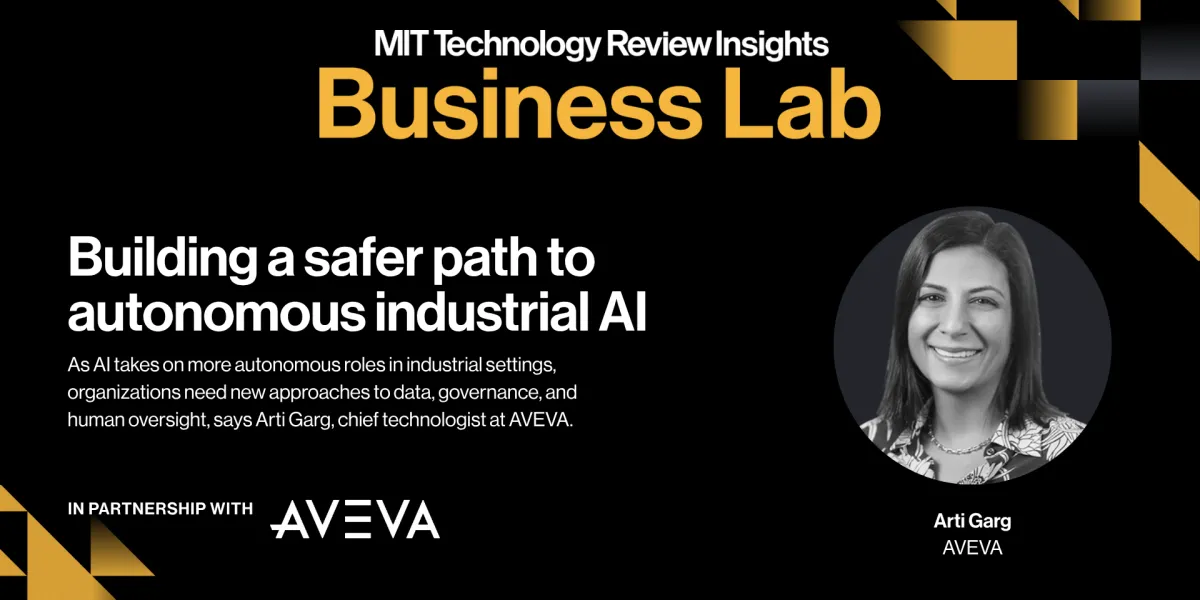
AVEVA chief technologist Arti Garg describes a staged path to industrial AI autonomy: setpoint recommendations first, then closed-loop control confined to fixed operating bands and limited areas, with humans shifting from operators to supervisors of physical systems.
Reach: not measured yet
 AT Pulse research deskPublished · 4 min read · AI-assisted analysis
Garg says AVEVA has run real-world pilots where AI adjusts equipment setpoints automatically instead of only recommending them. The safeguards are fixed operating bands and limits on which areas automation may act in. AVEVA calls the pilots successful but has named no customers and published no metrics. [1]
Her technical approach starts with data integration. Telemetry, service logs and design documents are linked, for example through graph databases, so AI can help diagnose faults in near real time. She also prefers smaller, purpose-built models, arguing they use less compute and behave more predictably, though the episode gives no data for this. [1]
AVEVA is a partner in Idaho National Laboratory's TAIGR programme, which tests AI-assisted grid management for risks. Those risks include plausible but wrong recommendations, adversarial manipulation of data or models, and the lack of any systematic way to assess AI risk in grid operations. [4] [5]
Independently, Garg chairs IEEE P7100 and AVEVA participates in INL's grid-AI testing.
Read the full assessment
The implication: bounded automation gives operators a concrete rollout order, though Garg acknowledges model drift and limited explainability remain unresolved for physical control.
Executive brief
AVEVA's chief technologist, Arti Garg, says the company has run successful real-world pilots in which AI adjusts setpoints on industrial equipment automatically, instead of only recommending them. AVEVA has not published any data from these pilots. She made the claim in a sponsored MIT Technology Review Business Lab episode, produced in partnership with AVEVA. The episode does not announce a product or model. It sets out AVEVA's governance position: AI should support people rather than replace them in critical decisions, and operating "bands" should limit what automation can change. Two of her points can be checked independently: she chairs IEEE P7100, and AVEVA takes part in Idaho National Laboratory's grid-AI testing.
What changed and event timeline
IEEE P7100 project approved
IEEE approved the project (its PAR) for a standard on measuring the environmental impact of AI systems, covering energy, CO2 and water for both training and inference.
Garg joins AVEVA
AVEVA named Garg, formerly head of technology strategy in HPE's CTO office, as chief technologist. Her remit focuses on generative AI for industrial uses.
INL launches TAIGR
Idaho National Laboratory started Testing for AI Grid Resilience (TAIGR), an effort to find risks in AI-assisted grid management. Partners include EEI, NERC, EPRI and AVEVA.
AVEVA presents grid-safety work
At AVEVA World in Milan, AVEVA's Alex Jenkins presented the company's work with INL on testing whether AI models are safe and resilient on the power grid. The public page lists no results.
Sponsored podcast published
In the episode, Garg describes AVEVA's three-part responsible-AI mandate, its setpoint-automation pilots and her P7100 work.
Capabilities and access
- The episode does not name or release any model or version.
- Garg mentions a proprietary AVEVA anomaly-detection model, and a system built with several customers that combines operational data with simulations to recommend setpoints (MIT TR).
- The episode gives no information on whether these are available, what they cost or how they perform.
Read the full section
- The episode does not name or release any model or version.
- Garg mentions a proprietary AVEVA anomaly-detection model, and a system built with several customers that combines operational data with simulations to recommend setpoints (MIT TR).
- The episode gives no information on whether these are available, what they cost or how they perform.
Technical analysis for researchers and developers
- Garg describes linking telemetry, service logs and design documents, for example with graph databases, so that AI can help diagnose faults in near real time (MIT TR).
- The proposed safeguards are fixed operating bands plus limits on which areas automation may act in. This moves the human from operator to supervisor.
- She argues that smaller, purpose-built models use less compute and are less likely to behave unpredictably. The episode offers no supporting data for this.
Read the full section
- Data integration first. Garg describes linking telemetry, service logs and design documents, for example with graph databases, so that AI can help diagnose faults in near real time (MIT TR).
- Bounded closed loop. The proposed safeguards are fixed operating bands plus limits on which areas automation may act in. This moves the human from operator to supervisor. Garg says the industry is still working out what the right guardrails are.
- Model sizing. She argues that smaller, purpose-built models use less compute and are less likely to behave unpredictably. The episode offers no supporting data for this.
- No architecture details, evaluation protocol or reproducible results are documented.
Claims and evidence
- Garg chairs P7100, and the working group launched about two years ago: this matches IEEE's records (IEEE WG; PAR).
- AVEVA works with INL on grid-AI resilience: this matches INL's TAIGR announcement and AVEVA's own materials (EurekAlert; AVEVA).
- The "successful" setpoint-automation pilots: this is a vendor statement in sponsored content, with no named customers or metrics (MIT TR).
Read the full section
- Garg chairs P7100, and the working group launched about two years ago: this matches IEEE's records (IEEE WG; PAR).
- AVEVA works with INL on grid-AI resilience: this matches INL's TAIGR announcement and AVEVA's own materials (EurekAlert; AVEVA).
- The "successful" setpoint-automation pilots: this is a vendor statement in sponsored content, with no named customers or metrics (MIT TR).
- A "78% increase" in industrial AI adoption over two years, and "almost half" of the industrial workforce retiring within five years: neither figure is sourced in the episode, and neither is corroborated in the reviewed sources.
Context and prior work
- AVEVA says it has worked on industrial AI for more than 20 years.
- TAIGR is modelled on the Department of Energy's CyTRICS programme, which tests the cybersecurity of industrial control systems.
- P7100 tries to separate compute used for AI from general-purpose data-centre compute when reporting environmental impact (IEEE WG).
Read the full section
- AVEVA says it has worked on industrial AI for more than 20 years. Garg describes the current shift as a move to foundation models, physical AI and agentic AI (MIT TR).
- TAIGR is modelled on the Department of Energy's CyTRICS programme, which tests the cybersecurity of industrial control systems. A related DOE-funded project, AMARANTH, builds a testbed for grid AI (EurekAlert).
- P7100 tries to separate compute used for AI from general-purpose data-centre compute when reporting environmental impact (IEEE WG).
Limitations, safety and contested findings
- INL's announcement names the main grid-AI risks: plausible but wrong recommendations ("hallucinations"), adversarial manipulation of data or models, and the lack of any systematic way to assess AI risk in grid operations (EurekAlert).
- Garg herself says newer models are not explainable in the traditional sense and can drift as they are retuned, which makes them risky to put in control of physical systems (MIT TR).
- The episode is sponsored and has no independent counterpoint.
Read the full section
- INL's announcement names the main grid-AI risks: plausible but wrong recommendations ("hallucinations"), adversarial manipulation of data or models, and the lack of any systematic way to assess AI risk in grid operations (EurekAlert).
- Garg herself says newer models are not explainable in the traditional sense and can drift as they are retuned, which makes them risky to put in control of physical systems (MIT TR).
- The episode is sponsored and has no independent counterpoint.
Business and practitioner implications
- Start with recommendations, then move to bounded automation. The pattern described is setpoint recommendations first, then closed-loop control within hard operating limits.
- Plan for environmental reporting. Once P7100 is finalised, it could become the basis for reporting and regulating AI's energy and water use.
- Use public test programmes.
Read the full section
- Start with recommendations, then move to bounded automation. The pattern described is setpoint recommendations first, then closed-loop control within hard operating limits. That gives a practical rollout order for operators.
- Plan for environmental reporting. Once P7100 is finalised, it could become the basis for reporting and regulating AI's energy and water use. It is still an active project, not a published standard (IEEE).
- Use public test programmes. Grid operators and their suppliers can bring their AI tools to INL's TAIGR testing rather than relying on vendor claims (EurekAlert).
The source trail.
Sources (6)
Building a safer path to autonomous industrial AI
Article text retrieved; extracted text may omit tables or interactive elements.
technologyreview.com