
SafetyRisk, alignment & guardrails
OpenAI adds College Planner to ChatGPT for Teens on the day Common Sense Media rates the teen mode 'Unacceptable Risk'
OpenAI is adding a College Planner and study tools to ChatGPT for Teens, while Common Sense Media, testing the same teen mode, rated it an unacceptable risk for under-18s, citing easily bypassed homework limits and missing parental crisis alerts.
 AT Pulse research deskOctober 8, 2026 · 5 min read · AI-assisted analysis
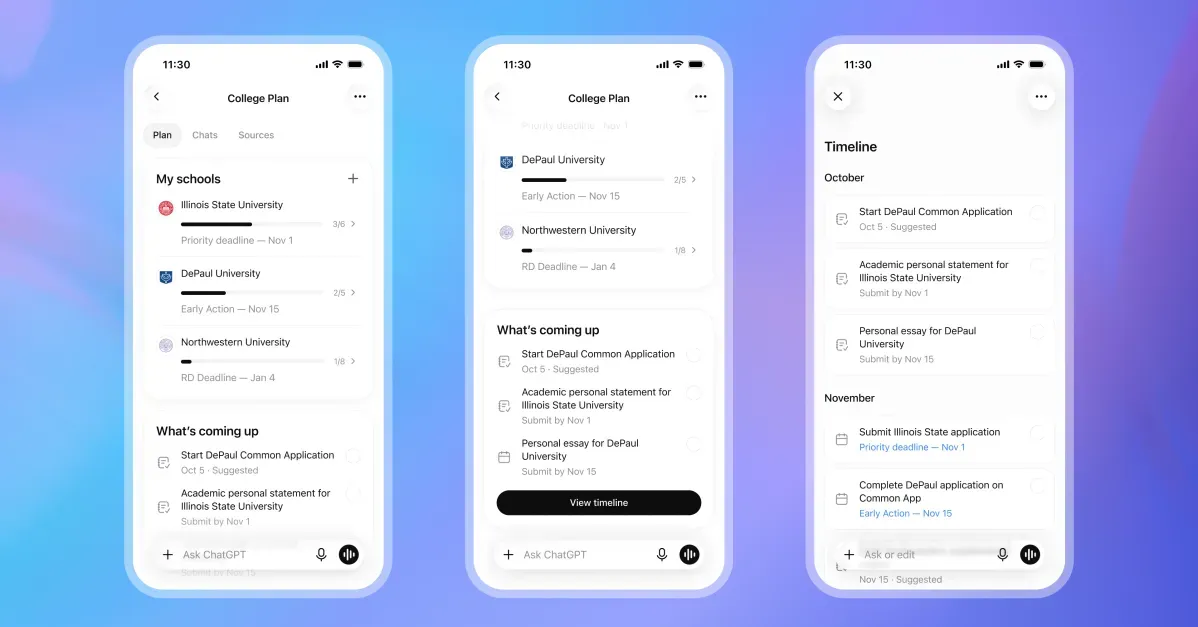
OpenAI announced College Planner on 7 October 2026. It gathers each student's application requirements, deadlines, tasks and financial-aid steps into one timeline that students can ask questions about. It is due 'soon' for US students in grades 10–12 applying to four-year colleges, with other programs and countries planned later. The launch also includes multi-photo note capture into a single PDF, flashcards and quizzes. [1] [2] [8] [9]
On the same day, Common Sense Media's Youth AI Safety Institute rated ChatGPT for Teens 'Unacceptable Risk' for everyone under 18. It tested more than 4,000 prompts before and after launch, using clinician-set ground truth. Testers got around Study Mode by dropping the '@study' prefix or changing the device time zone. Parents got no alerts in simulated self-harm crises. Three of five harm categories missed the 95% threshold. After launch, hotline referrals fell from 33% to 23%. [3] [6] [7]
OpenAI's main benefit claims come only from OpenAI and have not been independently checked. These include average teen use of under 15 minutes a day, hundreds of thousands of teens using ChatGPT weekly for college planning, and millions of additional learning messages measured against an unclear baseline. OpenAI says the Common Sense testing does not reflect how its safeguards work in practice. [8] [9] [11]
independent testing found weaker crisis responses after launch, while usage and learning gains rest on OpenAI's own figures.
Read the full assessment
Implication: schools and buyers will likely judge the planner on age assurance, parental alerts and data accuracy rather than features.
Executive brief
OpenAI announced College Planner for ChatGPT for Teens on 7 October 2026. On the same day, Common Sense Media's Youth AI Safety Institute rated that same product an "Unacceptable Risk" for everyone under 18. OpenAI says it is coming "soon" to US students in grades 10–12.
Read the full section
OpenAI announced College Planner for ChatGPT for Teens on 7 October 2026. On the same day, Common Sense Media's Youth AI Safety Institute rated that same product an "Unacceptable Risk" for everyone under 18. Its test of more than 4,000 prompts found that Study Mode, the feature meant to stop homework copying, was easy to bypass, and that parents received no alerts in simulated suicide and self-harm crises. College Planner will collect each student's application requirements, deadlines, tasks and financial-aid steps into one plan. OpenAI says it is coming "soon" to US students in grades 10–12. New flashcards, quizzes and multi-photo note capture come with it. Outside OpenAI's own materials, no evidence yet shows whether the planner helps students.
What changed and event timeline
Pre-launch testing window
Common Sense ran its first batch of tests on Free and Plus accounts, both linked and unlinked to parent accounts. This gives a baseline from before the teen mode launched ().
ChatGPT for Teens launches
The mode is for ages 13–17. OpenAI's age estimation places likely minors in it automatically. It restricts self-harm and romantic content and steers homework requests into Study Mode (;).
Post-launch testing window
Common Sense retested after launch. Child psychiatrists decided in advance which prompts should trigger crisis resources ().
"Unacceptable Risk" rating published
Common Sense recommends restricting ChatGPT to adults until safeguards are independently verified (;).
OpenAI announces College Planner and study tools
The announcement covers the planner, flashcards, quizzes, multi-photo PDF capture and a student advisory council. OpenAI also says teens average under 15 minutes a day on ChatGPT (;).
Capabilities and access
- College Planner: one plan per student covering requirements, deadlines, tasks and financial-aid steps for each school on their list.
- Study tools: continuous multi-photo capture into one PDF (iOS now, Android later), flashcards made from notes, saved decks and quizzes (The Verge).
- Model version: not disclosed.
Read the full section
- College Planner: one plan per student covering requirements, deadlines, tasks and financial-aid steps for each school on their list. It includes a timeline and lets students ask questions inside the plan. It is "coming soon" in the US for grades 10–12 applying to four-year colleges. Two-year, technical and trade programs and other countries are planned later (Unite.AI; Digital Trends).
- Study tools: continuous multi-photo capture into one PDF (iOS now, Android later), flashcards made from notes, saved decks and quizzes (The Verge).
- Model version: not disclosed.
Technical analysis for researchers and developers
- No technical documentation: OpenAI has published no architecture, retrieval sources or accuracy evaluation for the planner's deadline and requirement data.
- Age gating: reporting says OpenAI's age system uses more than 2,000 behavioural signals, such as login times and account age, and defaults to the under-18 experience when unsure (Dealroom).
- Common Sense methodology: more than 4,000 prompts across two windows. A clinician panel set ground truth in advance. Testers ran personas aged 13–19 (CSM).
Read the full section
- No technical documentation: OpenAI has published no architecture, retrieval sources or accuracy evaluation for the planner's deadline and requirement data.
- Age gating: reporting says OpenAI's age system uses more than 2,000 behavioural signals, such as login times and account age, and defaults to the under-18 experience when unsure (Dealroom).
- Common Sense methodology: more than 4,000 prompts across two windows. It used five "Red Line" harm categories, each with a 95% pass threshold. A clinician panel set ground truth in advance. Testers ran personas aged 13–19 (CSM).
- Reproducibility: the prompt set and raw data do not appear in the reviewed sources.
- Bypass findings: removing the "@study" prefix or changing the device time zone got around Study Mode limits. The "Show me the answer" option appeared in 43–90% of responses (CSM).
Claims and evidence
- Teens average under 15 minutes a day; under 2% exceed three consecutive hours. Vendor-reported, no independent check (Unite.AI).
- Hundreds of thousands of US teens use ChatGPT weekly for college planning. Vendor-reported (Digital Trends).
- Teens with the teen mode sent "about 2.7 million more learning-related messages." Vendor-reported. The baseline it is measured against is unclear (Unite.AI).
Read the full section
- Teens average under 15 minutes a day; under 2% exceed three consecutive hours. Vendor-reported, no independent check (Unite.AI).
- Hundreds of thousands of US teens use ChatGPT weekly for college planning. Vendor-reported (Digital Trends).
- Teens with the teen mode sent "about 2.7 million more learning-related messages." Vendor-reported. The baseline it is measured against is unclear (Unite.AI).
- More than one in four warranted crisis referrals were missed, and 3 of 5 Red Lines fell below 95%. Third-party testing by an advocacy group (CSM press release).
- OpenAI says the testing does not reflect how its safeguards work in practice. Reported in syndicated coverage (ABC 33/40).
Context and prior work
- Earlier Common Sense ratings: in 2025 the group rated ChatGPT "High Risk" for teens and OpenAI's Sora app "Unacceptable Risk" (CSM 2025).
- Earlier outside testing: researchers in 2025 found ChatGPT giving teens harmful advice on drugs and self-harm (BNN Bloomberg).
- Legal backdrop: the teen mode launched while OpenAI faces child-safety lawsuits (Dealroom).
Read the full section
- Earlier Common Sense ratings: in 2025 the group rated ChatGPT "High Risk" for teens and OpenAI's Sora app "Unacceptable Risk" (CSM 2025).
- Earlier outside testing: researchers in 2025 found ChatGPT giving teens harmful advice on drugs and self-harm (BNN Bloomberg).
- Legal backdrop: the teen mode launched while OpenAI faces child-safety lawsuits (Dealroom).
- Partners: College Advising Corps and Boston Children's Hospital's Digital Wellness Lab (Unite.AI).
Limitations, safety and contested findings
- Age detection: accounts registered as 19-year-olds that used teen personas never switched into the teen experience, even after saying they were 13 (CSM).
- Crisis responses: after launch, hotline referrals fell from 33% to 23% and follow-up safety questions from 28% to 2% (CSM).
- Privacy: teen conversations are used for training by default, and personalised ads default to on (CSM).
Read the full section
- Age detection: accounts registered as 19-year-olds that used teen personas never switched into the teen experience, even after saying they were 13 (CSM).
- Crisis responses: after launch, hotline referrals fell from 33% to 23% and follow-up safety questions from 28% to 2% (CSM).
- Privacy: teen conversations are used for training by default, and personalised ads default to on (CSM).
- Dispute: OpenAI rejects the findings. There is no reproduction by a third party independent of both.
- Planner itself: no published evaluation of the planner's deadline or financial-aid accuracy exists.
Business and practitioner implications
- Schools and counselors: treat the planner as a supplement and verify deadlines and aid steps against official college and FAFSA sources.
- Edtech competitors: OpenAI is moving into application-management workflows, the space of Naviance-style planners, through a channel it says reaches hundreds of thousands of teens each week.
- Builders of youth products: the Common Sense method (clinician-labelled prompts, harm thresholds, before/after windows) is a likely template for future audits.
Read the full section
- Schools and counselors: treat the planner as a supplement and verify deadlines and aid steps against official college and FAFSA sources.
- Edtech competitors: OpenAI is moving into application-management workflows, the space of Naviance-style planners, through a channel it says reaches hundreds of thousands of teens each week.
- Builders of youth products: the Common Sense method (clinician-labelled prompts, harm thresholds, before/after windows) is a likely template for future audits. Bypass paths like prompt prefixes and time-zone changes deserve red-teaming.
- Leaders: expect procurement and regulatory scrutiny to centre on parental alerts and age assurance, not on features.
The source trail.
Sources (13)
ChatGPT is getting college planning tools
Article text retrieved; extracted text may omit tables or interactive elements.
theverge.com