
ModelsArchitectures & capability
DeepMind's AlphaGenome Atlas Precomputes Predicted Effects for All 9 Billion Single-Letter Changes in the Human Genome
Google DeepMind has released a petabyte-scale set of AlphaGenome predictions covering every possible single-nucleotide variant in the human genome, along with a single impact score. Independent validation is still limited, and DeepMind says the resource is not validated for clinical use.
 AT Pulse research deskOctober 8, 2026 · 5 min read · AI-assisted analysis
The AlphaGenome Atlas contains precomputed predictions for about 9 billion possible single-letter DNA variants. It is roughly a petabyte in size, which DeepMind says is more than 30 times the AlphaFold Database. It also adds the AVI score, a single number per variant that combines AlphaGenome's predictions for non-coding DNA with AlphaMissense's predictions for coding DNA. Non-commercial users can reach the Atlas through a web portal and an API. Commercial access is planned through Google Cloud. [2] [6] [1]
The main technical advance is that AlphaGenome reads a 1-megabase stretch of DNA while still predicting at single base-pair resolution. Its predecessor, Enformer, had to give up some of one to get the other. The method passed peer review in Nature, and the paper reports that it matched or beat other models on 25 of 26 variant-effect benchmarks. DeepMind's own researchers wrote that paper, so the benchmark results are not independent. [4] [3] [1]
Independent evidence so far is thin and mixed. On a CRISPRi enhancer benchmark run by Cold Spring Harbor Laboratory (CSHL), the model had the highest correlations of the models tested but understated measured effect sizes, especially for distant regions. An outside genomics researcher called it the field's leading model but said it is slow, needs heavy compute, and that its AVI score is likely to be misread. Some reported discoveries, such as the DNM1 splice variant and extra UK Biobank associations, came from partners who co-authored the Atlas work. [9] [6]
Running the model yourself requires at least an H100-class GPU. The code is open source (Apache 2.0), but the weights are only available under non-commercial terms. Looking up precomputed results in the Atlas lets researchers skip that hardware requirement. For diagnostics and pharma companies, commercial use depends on Google Cloud licensing, and that service has no confirmed launch date. [7] [8] [2] [9]
researchers can look up predicted variant effects without running H100-class inference, and the method is peer-reviewed.
Read the full assessment
Implication: faster triage of non-coding variants in research and drug discovery, if AVI is used to rank variants and results are checked against lab assays.
Executive brief
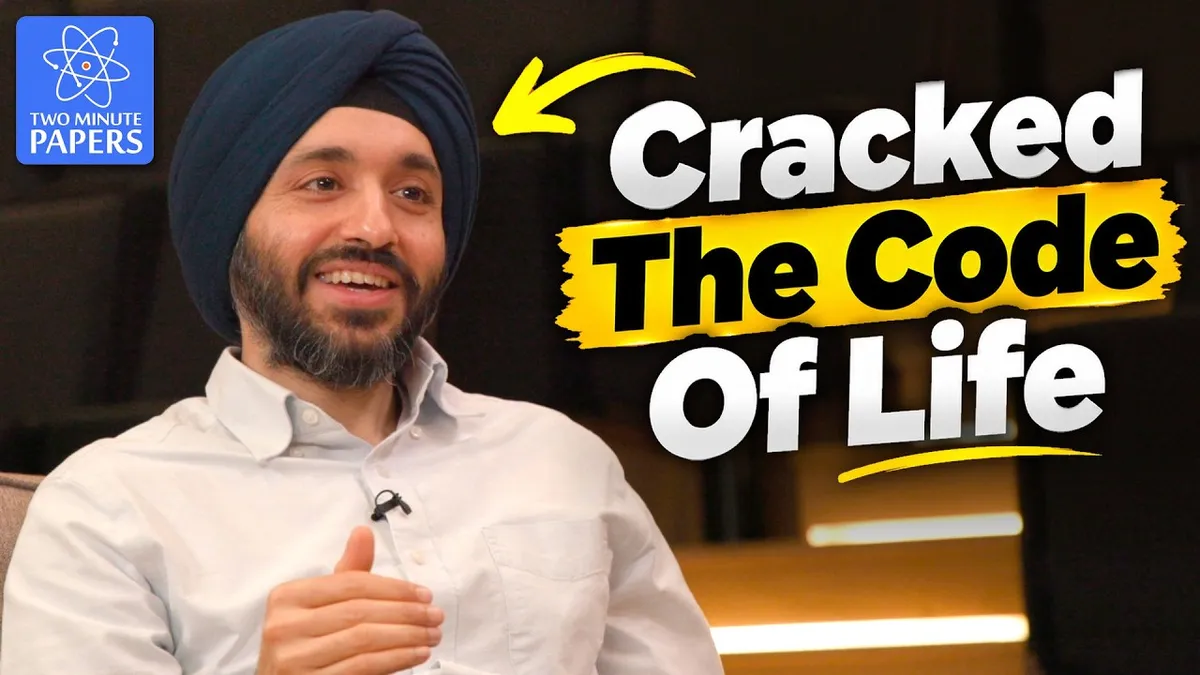
Google DeepMind has precomputed AlphaGenome's predictions for every one of the roughly 9 billion possible single-letter changes in the human genome. The resulting AlphaGenome Atlas is about 1 petabyte, which DeepMind says is more than 30 times the size of the AlphaFold Database (DeepMind). A 7 October interview by the Two Minute Papers channel with a DeepMind lead addressed as "Pushmeet" goes back over the model and the Atlas. The method has passed peer review in Nature, but independent testing is thin and shows mixed calibration. DeepMind also says the Atlas is not validated for clinical use.
What changed and event timeline
AlphaGenome previewed
DeepMind announced a DNA sequence model that reads 1 Mb of sequence and makes predictions at base-pair resolution, offered through a non-commercial API. At the time it claimed to match or beat other models on 24 of 26 variant-effect tasks ().
AlphaGenome Atlas launched
DeepMind released a no-code portal covering 9 billion single-nucleotide variants, along with a new single-number AVI impact score. Commercial access is planned through Google Cloud (;).
Interview published
The DeepMind interviewee describes the Atlas as a "dictionary" of variant effects and repeats the 30× comparison with AlphaFold DB (;).
Capabilities and access
- Model: AlphaGenome takes 1 Mb of DNA and predicts thousands of genomic tracks: expression, splicing, chromatin accessibility, histone marks, TF binding and contact maps (PubMed).
- Weights: JAX code is on GitHub under Apache 2.0. Running the model needs at least an H100.
- Atlas: A web portal, the API and a Google Antigravity skill are available for non-commercial use. Commercial use goes through Google Cloud (DeepMind).
Read the full section
- Model: AlphaGenome takes 1 Mb of DNA and predicts thousands of genomic tracks: expression, splicing, chromatin accessibility, histone marks, TF binding and contact maps (PubMed).
- Weights: JAX code is on GitHub under Apache 2.0. Weights ("all_folds") are on Kaggle and Hugging Face, gated behind non-commercial terms. Running the model needs at least an H100.
- Atlas: A web portal, the API and a Google Antigravity skill are available for non-commercial use. Commercial use goes through Google Cloud (DeepMind).
Technical analysis for researchers and developers
- Architecture: Convolutional layers detect local patterns, transformers pass information across the sequence, and modality-specific output heads make the predictions.
- Main advance over Enformer: It keeps long context and base-pair resolution at the same time instead of trading one for the other (video, 11:35).
- Human plus mouse training: The interviewee says training on both species pushes the model toward general mechanisms and improves generalization (08:08).
Read the full section
- Architecture: Convolutional layers detect local patterns, transformers pass information across the sequence, and modality-specific output heads make the predictions. Training data came from ENCODE, GTEx, 4D Nucleome and FANTOM5 (DeepMind blog).
- Main advance over Enformer: It keeps long context and base-pair resolution at the same time instead of trading one for the other (video, 11:35).
- Human plus mouse training: The interviewee says training on both species pushes the model toward general mechanisms and improves generalization (08:08).
- Building the Atlas: Distillation, GPU optimization and removing redundant computation cut compute by about 80× (IEEE Spectrum). The Atlas holds about 27,000 predictions per variant (search summary of Atlas coverage).
- Downstream heads: Simple lasso layers sit on top of the representations (24:02).
Claims and evidence
- Matches or beats other models on 25/26 variant-effect benchmarks ()
- Predicted and observed expression effect sizes correlate at about ρ≈0.5
- AVI is "best-in-class" on pathogenicity benchmarks
Read the full section
| Claim | Status |
| Matches or beats other models on 25/26 variant-effect benchmarks (PubMed) | Vendor-authored, peer-reviewed. The 2025 preview said 24/26 (blog) |
| Predicted and observed expression effect sizes correlate at about ρ≈0.5 | Stated by the interviewer, citing the paper (17:56); not checked against the paper |
| AVI is "best-in-class" on pathogenicity benchmarks | Vendor-reported; no metrics in the announcement (DeepMind) |
| Broad Institute DNM1 splice variant found; 22% more non-coding associations in UK Biobank | Collaborators who co-authored the Atlas work, so not independent (Implicator) |
| Highest correlations on a CRISPRi enhancer benchmark | Independent (CSHL), as reported by Implicator |
Context and prior work
- Enformer: DeepMind's earlier model, which used a shorter context window and coarser bins (video, 11:38).
- AlphaMissense: The AVI score combines AlphaGenome's non-coding predictions with AlphaMissense's coding predictions (Spectrum).
- AlphaFold DB as the template: The Atlas follows the same move of precomputing everything once.
Read the full section
- Enformer: DeepMind's earlier model, which used a shorter context window and coarser bins (video, 11:38).
- AlphaMissense: The AVI score combines AlphaGenome's non-coding predictions with AlphaMissense's coding predictions (Spectrum).
- AlphaFold DB as the template: The Atlas follows the same move of precomputing everything once. DeepMind says AlphaFold DB covers more than 250 million structures and has 4 million+ users (16:54).
- Generative DNA models: DeepMind presents AlphaGenome as a way to evaluate genomes generated by models such as Evo (20:58).
Limitations, safety and contested findings
- Not for clinical use: DeepMind says the Atlas is not validated or approved for any clinical use (DeepMind).
- Calibration: In the CSHL benchmark, the model understated measured effect sizes, more so for distant regions.
- Independent expert view: Carl de Boer (UBC) calls AlphaGenome the field's leading model but says it is slow and compute-heavy, and that the AVI score is likely to be misread (Spectrum).
Read the full section
- Not for clinical use: DeepMind says the Atlas is not validated or approved for any clinical use (DeepMind).
- Calibration: In the CSHL benchmark, the model understated measured effect sizes, more so for distant regions. That test was run only in K562 cells (Implicator).
- Independent expert view: Carl de Boer (UBC) calls AlphaGenome the field's leading model but says it is slow and compute-heavy, and that the AVI score is likely to be misread (Spectrum).
- Scope: The model misses enhancers outside its 1 Mb window and scores only one variant at a time (Spectrum). The interviewee agrees that connecting molecular effects to disease still needs research (05:46).
Business and practitioner implications
- Lower barrier to entry: Researchers can triage variants through the portal lookup instead of running inference on H100-class hardware.
- Licensing: Commercial users such as diagnostics, pharma and target discovery need Google Cloud licensing, and its launch date has not been confirmed (Implicator).
- Treat AVI as a ranking signal: Use it to prioritize variants, not to diagnose.
Read the full section
- Lower barrier to entry: Researchers can triage variants through the portal lookup instead of running inference on H100-class hardware.
- Licensing: Commercial users such as diagnostics, pharma and target discovery need Google Cloud licensing, and its launch date has not been confirmed (Implicator).
- Treat AVI as a ranking signal: Use it to prioritize variants, not to diagnose. Check results against your own assays and cell types, since the independent calibration results come from K562 only.
The source trail.
Sources (9)
DeepMind's New AI Just Cracked The Code Of Life
Transcript retrieved via youtube_auto_captions; language en. Timestamped text, not direct audiovisual review. Source: https://www.youtube.com/watch?v=Wkaw03p3BrM. Automatic captions/transcription may contain errors.
www.youtube.com