
ModelsArchitectures & capability
OpenAI makes interactive charts, forms and tools the default in ChatGPT answers with GPT-6
OpenAI made interactive answers the ChatGPT default: GPT-6 now mixes text with charts, forms, buttons and small tools like calculators, rolling out to paid tiers with Sol and free tiers with Luna. Independent evidence on whether the interfaces help users remains absent.
 AT Pulse research deskOctober 8, 2026 · 5 min read · AI-assisted analysis
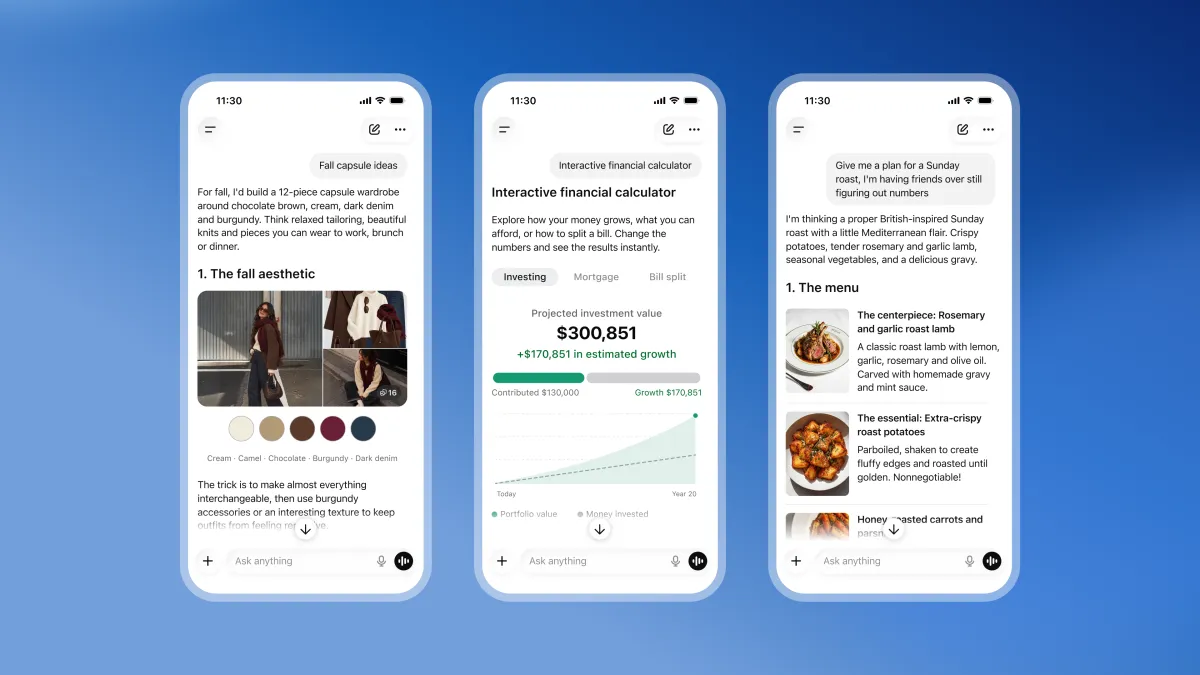
Intelligent UI is on by default for every ChatGPT tier, not offered as an opt-in. It arrived with GPT-6 Sol for Plus, Pro, Business and Enterprise users on October 7, 2026. GPT-6 Luna brought it to Free and Go users the next day. Answers can include charts, forms, tappable buttons, calculators, bill splitters, maps and simple games. The model decides which format fits each question, and users can turn the amount of visuals down. OpenAI says the goal is to make complex topics easier to learn. [1] [2] [5] [8]
OpenAI says the system uses a library of native, streamable components plus a compiler, so the interface appears gradually as the answer streams. Google's generative UI works differently: its model writes HTML, CSS and JavaScript for each prompt. OpenAI's approach suggests the model picks and fills pre-built components, which likely trades flexibility for consistency, but this is an inference. OpenAI has published no schema or evaluation, and the feature has no dedicated API, so developers cannot build on it or reproduce it. [5] [8] [9]
Most of the performance evidence comes from OpenAI. The claim that interactive answers aid learning has no independent support in the reviewed sources. The only independent benchmark measures the underlying models, not the interface: Artificial Analysis scores Luna (max) at 37 and Sol (max) at 48. That gap suggests free users may get lower-quality generated interfaces than paid users. OpenAI's own charts also show Sol trailing GPT-5.6 Sol on some agentic benchmarks. [1] [6] [10]
OpenAI ships this by default to a user base it puts above 1.2 billion weekly users, with no Intelligent UI API. Implication: rival chat products and single-purpose tool sites may face pressure to offer comparable interactive answers.
Sources are gathered; writing the dossier now.
Executive brief
OpenAI has made interactive interfaces part of the default ChatGPT answer. Its new "Intelligent UI" mixes text with charts, forms, buttons and small tools like calculators, and it shipped as the default for every tier at once, not as an opt-in experiment. ChatGPT has more than 1.2 billion weekly users, according to OpenAI. The feature launched together with GPT‑6 in ChatGPT. Paid users get GPT‑6 Sol and Free/Go users get GPT‑6 Luna (TestingCatalog). OpenAI says the aim is to make complex topics easier to learn (TechCrunch). None of the reviewed sources includes an independent evaluation of the interface itself.
What changed and event timeline
GPT‑6 Astra released
Astra is OpenAI's frontier GPT‑6 variant. It came out 19 days before Sol and Luna, and OpenAI's charts show it ahead of Sol on AutomationBench ().
Sol and Luna reach the API
Sol costs $2/$10 and Luna $0.10/$0.50 per million input/output tokens. That is about half of GPT‑5.6 promotional pricing. Both have a 1.05M-token context window (;).
Intelligent UI launches for paid tiers
GPT‑6 Sol with Intelligent UI rolls out globally to Plus, Pro, Business and Enterprise users. In a press demo, OpenAI generated diagrams explaining airplane-wing lift (;).
Free and Go tiers follow
GPT‑6 Luna with Intelligent UI reaches the free and low-cost Go tiers. OpenAI did not explain why paid users went first ().
Capabilities and access
- Models: GPT‑6 Sol (Plus, Pro, Business, Enterprise) and GPT‑6 Luna (Free, Go), both tuned for everyday chat.
- Output types: graphics, tappable buttons, forms, charts, calculators, bill splitters, maps and simple games (OpenAI).
- Controls: users can turn the amount of visuals down, the same way they adjust other personality settings (TechCrunch).
Read the full section
- Models: GPT‑6 Sol (Plus, Pro, Business, Enterprise) and GPT‑6 Luna (Free, Go), both tuned for everyday chat. The Work and Codex models did not change (TestingCatalog).
- Output types: graphics, tappable buttons, forms, charts, calculators, bill splitters, maps and simple games (OpenAI).
- Controls: users can turn the amount of visuals down, the same way they adjust other personality settings (TechCrunch).
- Not supported: Astra's Pro reasoning setting. There is also no dedicated Intelligent UI API; it is described as a ChatGPT product feature (Tech Insider).
Technical analysis for researchers and developers
- How it is built: OpenAI describes "a library of native, streamable components and a compiler."
- Contrast with Google: Google's dynamic view has the model write HTML, CSS and JavaScript per prompt (Google Research).
- Who decides the format: the model chooses the format based on the question (Tech Insider).
Read the full section
- How it is built: OpenAI describes "a library of native, streamable components and a compiler." The interface renders progressively instead of waiting for the full answer (TestingCatalog).
- Contrast with Google: Google's dynamic view has the model write HTML, CSS and JavaScript per prompt (Google Research). OpenAI's description suggests the model picks and fills pre-built components instead. That should make output more consistent and easier to stream, at the cost of flexibility. This reading is an inference; OpenAI has not published a schema, paper or evaluation.
- Who decides the format: the model chooses the format based on the question (Tech Insider).
- Reproducibility: the feature cannot be reproduced through the API.
Claims and evidence
- GPT‑6 Extra High responds as fast as GPT‑5.6 Medium and scores above GPT‑5.6 Extra High. — Vendor-reported
- Better resistance to multi-turn jailbreaks (same source) — Vendor-reported
- Sol scores 68.8% on DeepSWE, below GPT‑5.6 Sol's 72.7% () — Vendor data, third-party analysis
Read the full section
| Claim | Status |
| GPT‑6 Extra High responds as fast as GPT‑5.6 Medium and scores above GPT‑5.6 Extra High; GPT‑6 Instant starts web-search answers 44% sooner (TestingCatalog) | Vendor-reported |
| Better resistance to multi-turn jailbreaks (same source) | Vendor-reported |
| Sol scores 68.8% on DeepSWE, below GPT‑5.6 Sol's 72.7% (Digital Applied) | Vendor data, third-party analysis |
| Sol (max) scores 48 and Luna (max) 37 on the Artificial Analysis Intelligence Index, at about half GPT‑5.6's cost per task (Artificial Analysis) | Independent; covers the models, not the interface |
| Interactive answers make learning easier | No independent corroboration in the reviewed sources |
Context and prior work
- Google's generative UI: in human-preference tests, Google found its generative UI was preferred over plain text and markdown answers and came close to websites designed by human experts.
- GPT‑5.6 design work: OpenAI already marketed GPT‑5.6's ability to design interfaces. Testers found it creative but weak at matching a requested style (Banani).
- Early user reaction: Ethan Mollick, who had early access, said it was a welcome change from walls of text and pointed toward interfaces built on demand for each problem (linked post).
Read the full section
- Google's generative UI: in human-preference tests, Google found its generative UI was preferred over plain text and markdown answers and came close to websites designed by human experts. Google also released the PAGEN dataset of expert-made sites for evaluation (Google Research). Gemini ships this as "dynamic view" and "visual layout."
- GPT‑5.6 design work: OpenAI already marketed GPT‑5.6's ability to design interfaces. Testers found it creative but weak at matching a requested style (Banani).
- Early user reaction: Ethan Mollick, who had early access, said it was a welcome change from walls of text and pointed toward interfaces built on demand for each problem (linked post).
Limitations, safety and contested findings
- Not uniformly better: OpenAI's own charts show GPT‑6 Sol trailing GPT‑5.6 Sol on DeepSWE and OSWorld.
- Deception rates: the system card reports lower misrepresentation rates for GPT‑6 than GPT‑5.6. These are OpenAI's own evaluations (MarkTechPost).
- Uneven experience by tier: free users get the smaller Luna model, so the quality of generated interfaces may differ between tiers.
Read the full section
- Not uniformly better: OpenAI's own charts show GPT‑6 Sol trailing GPT‑5.6 Sol on DeepSWE and OSWorld. Its Claude comparisons use Opus 5, not the newer Opus 5.5, and competitor scores come from public reports rather than OpenAI retesting (Digital Applied).
- Deception rates: the system card reports lower misrepresentation rates for GPT‑6 than GPT‑5.6. These are OpenAI's own evaluations (MarkTechPost).
- Uneven experience by tier: free users get the smaller Luna model, so the quality of generated interfaces may differ between tiers. Artificial Analysis puts Luna (max) at 37 versus Sol's 48 on its index (Artificial Analysis).
- No interface-level evidence yet: no accessibility or accuracy evaluation of the generated interfaces was found.
Business and practitioner implications
- Higher user expectations: a default audience of over a billion users will start to expect answers with interactive elements.
- Pressure on simple tools: single-purpose calculators, planners and comparison widgets now compete with ones ChatGPT builds on the spot.
- Developers can't build on it yet: there is no Intelligent UI API. Builders who want similar features need their own component-plus-model approach.
Read the full section
- Higher user expectations: a default audience of over a billion users will start to expect answers with interactive elements. Companies with their own chat products face pressure to match.
- Pressure on simple tools: single-purpose calculators, planners and comparison widgets now compete with ones ChatGPT builds on the spot. This affects SEO-driven tool sites and some app use cases.
- Developers can't build on it yet: there is no Intelligent UI API. Builders who want similar features need their own component-plus-model approach.
- Cheaper alternatives: the API price cut ($0.10/$0.50 per million tokens for Luna) makes it cheaper to build that kind of approach in-house.
- Enterprise checks: before relying on interactive answers in regulated workflows, teams should verify the numbers that calculators and charts produce.
The source trail.
Sources (11)
ChatGPT is getting a lot more visual, with the launch of a new interface
Article text retrieved; extracted text may omit tables or interactive elements.
techcrunch.comOpenAI: GPT‑6 and Intelligent UI for everyone
openai.comChatGPT’s ‘Intelligent UI’ update fills its responses with pictures, charts, and buttons
Related coverage; assess separately
theverge.com