
ModelsArchitectures & capability
NVIDIA Opens Nemotron Recipes Behind Gold-Level Scores at IOI and IMO 2026
NVIDIA has published weights, training data and NeMo-Skills pipelines for fine-tuned Nemotron 3 Ultra models that reached gold-level marks at IOI 2026 and IMO 2026. It presents both as one repeatable recipe: curated domain data, post-training and inference-time verify-and-refine loops.
QuietHow it’s measured
Hacker News · 2 likes
Reach blends public engagement (views, likes, comments, shares, stars) from the platforms where the story or its original source lives: YouTube, Hacker News, GitHub, Substack and similar. A video and the article written from its transcript share one score, taken from the video. Platforms with no data are left out rather than counted as zero, and the age of a story never lowers its score.
 AT Pulse research deskPublished · 5 min read · AI-assisted analysis
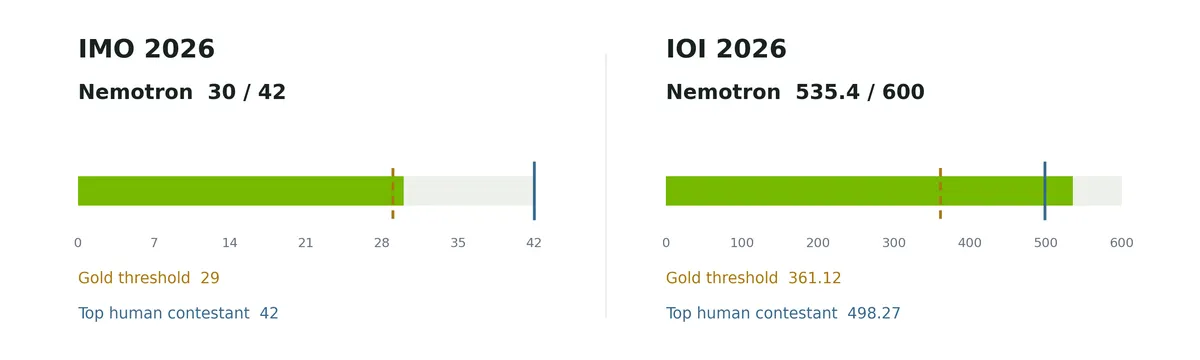
On the IOI 2026 problem set, a Nemotron-3-Ultra-CC run scored 535.4 out of 600. The gold cutoff was 361.12, and the top human contestant scored 498.27. This was an unofficial run whose score the authors report themselves. The human score is confirmed separately. The model has 550B total parameters with 55B active and was fine-tuned with SFT only. Its GenCorrect method runs up to five rounds of large-scale sampling, groups solutions by how they behave, and refines them against tests. [2] [6] [8] [9]
At IMO 2026, the Nemotron system scored 30 out of 42, one point above the gold line. It got full marks on four problems and one point each on problems 3 and 6. Two other systems, Huawei's Celia and RedNote's dots-note-3.0, were officially graded at a perfect 42. What sets Nemotron apart is that its whole pipeline is open, not that it scored highest. [7] [3] [11]
The method uses a lot of compute. Finding all six IMO proofs took about 707M tokens and 1,464 GB200 GPU-hours. The full run took about 2.31B tokens and 4,800 GPU-hours. Model size also mattered: one SFT epoch on the larger Ultra model beat the fully post-trained Nano model on coding benchmarks. [7] [1]
The model verifiers limit how well the system can do. In an audit of 300 proofs, they falsely accepted about 1.1% but falsely rejected about 81.3%. They also gave the hardest proofs about 32 points where official graders gave 30. [7]
the weights, data and pipelines are public, so others can rerun the work. Implication: teams whose outputs can be checked automatically could adapt the recipe. But thousands of GPU-hours per competition make it impractical for routine tasks.
Executive brief
NVIDIA reports that a fine-tuned Nemotron model scored 535.4/600 on the IOI 2026 problem set. That is 37 points above the best human contestant, who scored 498.27. NVIDIA calls it the first AI result to beat the top human on a full IOI set (arXiv). The run was unofficial and self-reported. A sister system based on Nemotron 3 Ultra scored 30/42 at IMO 2026, just above the gold line of 29. That gold looks less striking next to two officially graded AI systems that scored a perfect 42/42 (TechXplore). The main news is that NVIDIA released the weights, data and code, so others can rerun the work.
What changed and event timeline
NVIDIA announces IMO gold-level score
Nemotron 3 Ultra scored 30/42 under contest conditions, with no internet or tools. NVIDIA says the IMO team graded the proofs ().
Other AI systems get perfect IMO scores
IMO organisers graded Huawei's Celia and RedNote's dots-note-3.0 at 42/42 through the official channel. Several other labs claimed 42/42 from separate testing (;).
IOI 2026 held in Tashkent
China's Xu Qiwen won with 498.27, the human benchmark NVIDIA later compared against ().
IMO paper posted
It describes the generate-verify-refine system, its compute accounting and an audit of the model verifiers ().
IOI paper posted
The paper reports the prospective 535.4/600 score and the GenCorrect method ().
NVIDIA posts joint summary on Hugging Face
The post presents both results as one reusable recipe for specialising Nemotron, and links the open checkpoints, datasets and NeMo-Skills pipelines ().
Capabilities and access
- Nemotron-3-Ultra-CC: 550B total / 55B active parameters, a mixture-of-experts model fine-tuned with SFT only, no code-specific RL. It is on Hugging Face (arXiv; HF blog).
- Nemotron-3-Nano-CC: 30B total / 3B active, trained with SFT and RL. The blog does not link it.
- IMO checkpoints: three Nemotron-3-Ultra-550B variants: the general-availability model (GA), an SFT model and an RL model (arXiv).
Read the full section
- Nemotron-3-Ultra-CC: 550B total / 55B active parameters, a mixture-of-experts model fine-tuned with SFT only, no code-specific RL. It is on Hugging Face (arXiv; HF blog).
- Nemotron-3-Nano-CC: 30B total / 3B active, trained with SFT and RL. The blog does not link it. A commenter on the post asked where it is.
- IMO checkpoints: three Nemotron-3-Ultra-550B variants: the general-availability model (GA), an SFT model and an RL model (arXiv).
- Released: both IMO specialist checkpoints, their training data, Nemotron-IMO-Bench (200 problems, CC BY 4.0) and the inference pipelines in NeMo-Skills.
Technical analysis for researchers and developers
- IMO search: round 1 generates 384 proofs per problem. Each proof gets 16 judgments from the SFT and RL checkpoints.
- IMO data: 414,890 SFT examples covering proof generation, refinement, verification and checking of verification. RL used 9,597 problems (arXiv).
- IOI method: 22,000 curated problems.
Read the full section
- IMO search: round 1 generates 384 proofs per problem. Each proof gets 16 judgments from the SFT and RL checkpoints. A proof is accepted only if both specialist verifiers accept it unanimously. There are up to eight refinement rounds. A final stage picks the submission by the mean of 48 judgments using IMO's 0–7 scoring (arXiv).
- IMO data: 414,890 SFT examples covering proof generation, refinement, verification and checking of verification. RL used 9,597 problems (arXiv).
- IOI method: 22,000 curated problems. GenCorrect runs up to five rounds of large-scale sampling, clustering of solutions by behaviour, and refinement checked against tests (arXiv PDF).
- Compute: finding all six IMO proofs took about 707M tokens and 1,464 GB200 GPU-hours. The full run used about 2.31B tokens and 4,800 GPU-hours.
Claims and evidence
- IOI 535.4/600, above the gold cutoff of 361.12 and the top human's 498.27: this comes from the authors and was not an official IOI entry.
- IMO 30/42: NVIDIA says official graders scored it. None of the reviewed sources includes a statement from IMO organisers about Nemotron's grade.
- IOI 2025 progression: Nano-CC went 130 → 291 after post-training, then 468 with GenCorrect, against a gold cutoff of 438.3. Ultra-CC reached 502.
Read the full section
- IOI 535.4/600, above the gold cutoff of 361.12 and the top human's 498.27: this comes from the authors and was not an official IOI entry. Coverage notes that no one has independently verified it (AI Weekly). The human score itself is confirmed (UzA).
- IMO 30/42: NVIDIA says official graders scored it. It got full marks on problems 1, 2, 4 and 5, and one point each on 3 and 6 (arXiv). None of the reviewed sources includes a statement from IMO organisers about Nemotron's grade.
- IOI 2025 progression: Nano-CC went 130 → 291 after post-training, then 468 with GenCorrect, against a gold cutoff of 438.3. Ultra-CC reached 502. These are retrospective runs on past problems (HF blog).
Context and prior work
- At IMO 2025, OpenAI and Google DeepMind both reached 35/42. Only DeepMind's score was certified by IMO coordinators (Gary Marcus).
- By IMO 2026 the top was perfect scores. Celia and dots-note-3.0 were officially graded at 42/42 (SCMP).
- The base architecture is a hybrid Mamba-Transformer mixture-of-experts model (Nemotron 3 Ultra report).
Read the full section
- At IMO 2025, OpenAI and Google DeepMind both reached 35/42. Only DeepMind's score was certified by IMO coordinators (Gary Marcus).
- By IMO 2026 the top was perfect scores. Celia and dots-note-3.0 were officially graded at 42/42 (SCMP). Nemotron's 30 is gold-level but well below them. What sets it apart is that the whole pipeline is open.
- The base architecture is a hybrid Mamba-Transformer mixture-of-experts model (Nemotron 3 Ultra report).
Limitations, safety and contested findings
- Both the search verifier and an independent model jury over-credited problems 3 and 6.
- Verifier errors are lopsided. In a 300-proof audit, the verifier panel falsely accepted about 1.1% of proofs but falsely rejected 81.3%.
- The IOI result may not generalise. The analyst also wants independent replication (Ken Ashe).
Read the full section
- Verifiers miscredit hard proofs. Both the search verifier and an independent model jury over-credited problems 3 and 6. They gave about 32 points where official graders gave 30, which the authors read as a shared blind spot (arXiv).
- Verifier errors are lopsided. In a 300-proof audit, the verifier panel falsely accepted about 1.1% of proofs but falsely rejected 81.3%.
- The IOI result may not generalise. One analyst argues it is a narrow pipeline that relies on clean pass/fail test feedback, which most real engineering lacks. The analyst also wants independent replication (Ken Ashe).
Business and practitioner implications
- NVIDIA's pattern is: start from a strong open base, curate domain data, post-train with SFT and optionally RL, then add a verify-and-refine loop at inference.
- For the larger Ultra model, one SFT epoch beat the fully post-trained Nano model on IOI, ICPC and LiveCodeBench Pro.
- Cost is real. Thousands of GB200 GPU-hours per competition puts this style of inference out of reach for routine tasks.
Read the full section
- A reusable recipe. NVIDIA's pattern is: start from a strong open base, curate domain data, post-train with SFT and optionally RL, then add a verify-and-refine loop at inference. Teams can apply this to their own domains (HF blog).
- Scale matters. For the larger Ultra model, one SFT epoch beat the fully post-trained Nano model on IOI, ICPC and LiveCodeBench Pro. Larger bases may need less RL.
- Cost is real. Thousands of GB200 GPU-hours per competition puts this style of inference out of reach for routine tasks.
- Verifiers set the ceiling. The approach works best where outputs can be checked automatically. The IMO verifier audit shows weak critics leave points on the table.