
FoundersOperators, strategy & lessons
Vercel CEO Guillermo Rauch says AI agents now account for about 60% of deployments, up from 3% at the start of 2026
Guillermo Rauch says coding agents have become Vercel's main customer. The company is rebuilding its cloud around them with an open-source agent framework and a multi-model gateway, while a Sandbox bounty uncovered a critical Linux flaw that lets code escape a virtual machine.
From the This Week in Startups video of November 28, 2026 and cited sources: Rauch says agent-driven deployments rose from 3% of Vercel deployments early in 2026 to about 60%. [1] [7]
SOURCES[1] Vercel's Founder: My Biggest Customer Isn't Human Anymore youtube.com[7] Scuttlebutt: Over 60% of Vercel deploys come from AI agents daily.scuttlebutt.co
 AT Pulse research deskPublished · Updated · 5 min read · AI-assisted analysis
AI-assisted, not human-edited. Methodology Corrections Who owns this site
- What happened
- Rauch says agent-driven deployments rose from 3% of Vercel deployments early in 2026 to about 60%. [1] [7]
- Original source
- This Week in Startups video, independent perspective
- Brief by
- AT Pulse research desk AI-assisted; publisher and contact on the desk page
- When
- November 28, 2026 video published
- Covered
- Nov 29 edition
- Evidence
- 10 sources across 8 sites; transcript sourced
- 1Vercel's Founder: My Biggest Customer Isn't Human Anymoreyoutube.com
- 2InfoQ: Vercel eve agentsinfoq.com
- 3Vercel: Introducing evevercel.com
- 4Vercel: Everything hackable will get hackedvercel.com
- 5Vercel: Findings from the $1M Vercel Sandbox challengevercel.com
- 6The Hacker News: Critical PwnEscape Linux kernel…thehackernews.com
RisingHow it’s measured
YouTube video · 3.4K views · 43 likes
Reach blends public engagement (views, likes, comments, shares, stars) from the platforms where the story or its original source lives: YouTube, Hacker News, GitHub, Substack and similar. A video and the article written from its transcript share one score, taken from the video. Platforms with no data are left out rather than counted as zero, and the age of a story never lowers its score.
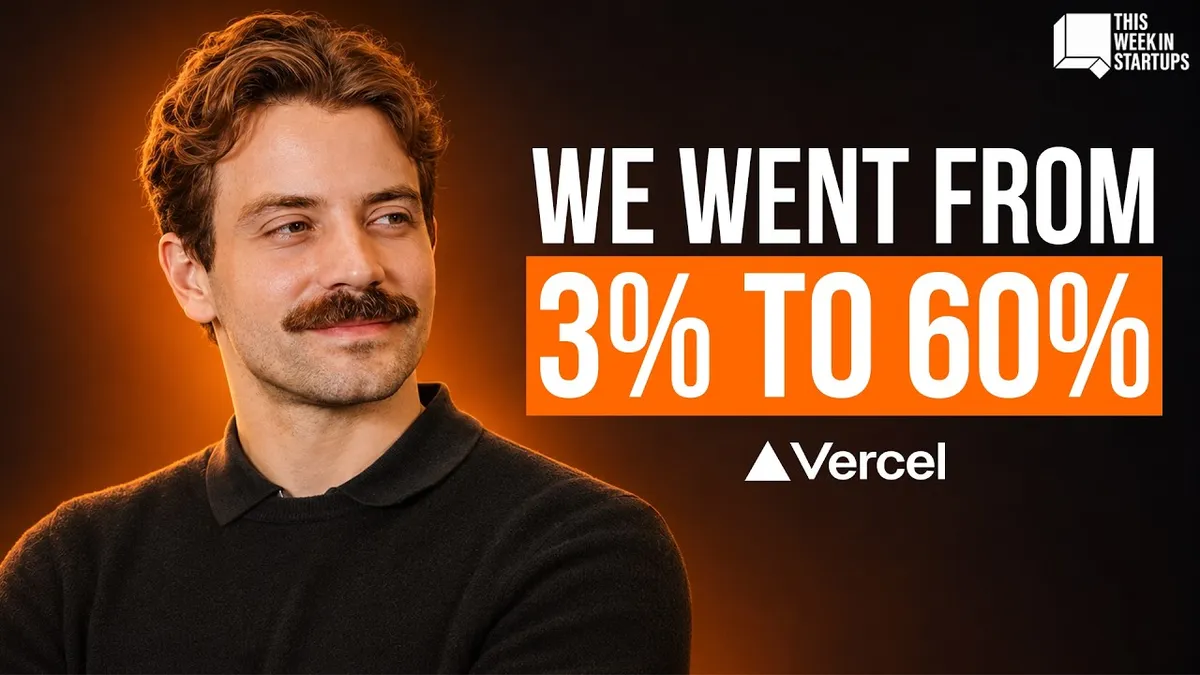
Rauch says agent-driven deployments rose from 3% of Vercel deployments early in 2026 to about 60%. He also says roughly 50–60% of traffic across Vercel's network is now machine-to-machine. In a separate interview he predicted the agent share would reach 90% by early 2027. [1] [7]
Vercel ran a two-week, $1M HackerOne challenge against its Sandbox product. It drew 1,285 reports, 57 of them valid, and paid out $242,000. One finding, PwnEscape (CVSS 9.3), is a flaw in the host's Linux networking code that lets code escape a VM. Fixing it requires patching host kernels, not guest kernels. No report showed access to customer data. [5] [6] [10]
Vercel is presenting itself as infrastructure for agents. Its products include eve, an Apache 2.0 TypeScript framework in which each agent is a directory of Markdown and code files. It also offers an AI Gateway that reaches many model providers with one key, and a GitHub code-review agent that recommends whether to merge a change. [1] [2] [3]
If agents increasingly choose and run infrastructure, APIs, documentation and error messages become the product they judge. The 60% figure comes from the company and is unaudited, so treat it as a rough indicator.
Read the full assessment
The need to patch host kernels for PwnEscape is concrete.
I'm writing the dossier now. The sources are checked against Vercel's blog, The Hacker News, InfoQ and the Series F coverage.
Executive brief
Vercel CEO Guillermo Rauch says AI agents went from 3% of deployments on Vercel at the start of 2026 to about 60% now. In his words, Vercel's "main customer is an agent more so than a human being" (video, 00:46; 02:10). No independent measurement of that figure exists; it comes only from Rauch, in several interviews. A public challenge Vercel ran to break its Sandbox product turned up a Linux kernel flaw that let code escape a virtual machine. Vercel's pitch is that the cloud has to be rebuilt for agents as both users and attackers.
Read the full section
Vercel CEO Guillermo Rauch says AI agents went from 3% of deployments on Vercel at the start of 2026 to about 60% now. In his words, Vercel's "main customer is an agent more so than a human being" (video, 00:46; 02:10). No independent measurement of that figure exists; it comes only from Rauch, in several interviews. The interview also covers security. A public challenge Vercel ran to break its Sandbox product turned up a Linux kernel flaw that let code escape a virtual machine. Vercel's pitch is that the cloud has to be rebuilt for agents as both users and attackers.
What changed and event timeline
Vercel launches eve
An open-source TypeScript framework for agents, released under Apache 2.0, where each agent is a directory of Markdown and code files. Vercel says it runs more than 100 production agents on it internally (;).
Vercel CTO warns about open-weight models
Malte Ubl wrote that Kimi K3, an open-weight model, has no effective cyber-offense safeguards. In Vercel's test it probed the Sandbox, mapped kernel escalation paths and wrote a fuzzer, but did not escape ().
$1M Sandbox challenge opens
It drew 1,285 reports, produced 57 valid findings and paid out $242,000 ().
PwnEscape disclosed
Paulos Yibelo of pwn.ai found a Linux networking flaw that lets code inside a virtual machine escape to the host machine. It is rated CVSS 9.3, fixes have been backported to stable kernels, and the host kernel must be patched ().
The 60% figure in another interview
Rauch repeated it on another podcast and predicted 90% by early 2027 ().
Startup Basics interview
Rauch called Vercel "agentic infrastructure" and demoed eve and AI Gateway ().
Capabilities and access
- eve: agents are built from Markdown instructions, TypeScript tools, skills, subagents and channels.
- AI Gateway: one API key for many model providers. Rauch named Grok 4.7 and an unnamed new Tencent model (31:05).
- Code-review agent: a GitHub integration that recommends whether to merge a change (26:40).
Read the full section
- eve: agents are built from Markdown instructions, TypeScript tools, skills, subagents and channels. It supports durable workflows, sandboxed execution (Docker locally, Vercel Sandbox in production), human approval steps, OpenTelemetry tracing, evals, MCP servers and OpenAPI specs (InfoQ).
- AI Gateway: one API key for many model providers. Rauch named Grok 4.7 and an unnamed new Tencent model (31:05).
- Code-review agent: a GitHub integration that recommends whether to merge a change (26:40).
- Rauch also mentioned an in-house coding agent, "FX" (the spelling comes from auto-captions, 17:45).
Technical analysis for researchers and developers
- Skills: Rauch describes them as Markdown that models are trained (via reinforcement learning) to fetch into context on demand. eve is built around this file-based context model (09:47).
- How Vercel tunes for agents: it says it systematically asks models what would make deploying on Vercel faster and less error-prone (10:38).
- Isolation: PwnEscape sits in the host's packet-handling path. Updating guest kernels does not fix it (THN).
Read the full section
- Skills: Rauch describes them as Markdown that models are trained (via reinforcement learning) to fetch into context on demand. eve is built around this file-based context model (09:47).
- How Vercel tunes for agents: it says it systematically asks models what would make deploying on Vercel faster and less error-prone (10:38).
- Isolation: PwnEscape sits in the host's packet-handling path. Updating guest kernels does not fix it (THN).
- Rewrites: Rauch says Vercel's CDN team is rewriting millions of lines of code into another language, with automatic, proof-like verification loops. No details have been published (28:18).
- Unmeasured: "agentic deployment" has no published definition or method.
Claims and evidence
- 3% → 60% agentic deployments: a company metric, self-reported, with no audit or definition (02:10).
- "50–60% of traffic" is machine-to-machine: stated with no methodology (02:56).
- "500,000 paying customers" in this interview (27:00). A newsletter cites 600,000 customers, a ~$700M run rate and a $10B valuation, all unsourced (Scuttlebutt).
Read the full section
- 3% → 60% agentic deployments: a company metric, self-reported, with no audit or definition (02:10).
- "50–60% of traffic" is machine-to-machine: stated with no methodology (02:56).
- "500,000 paying customers" in this interview (27:00). A newsletter cites 600,000 customers, a ~$700M run rate and a $10B valuation, all unsourced (Scuttlebutt).
- Funding: the last confirmed round is the September 30, 2025 Series F: $300M at a $9.3B post-money valuation, co-led by Accel and GIC. The figures were company-announced (Business Wire) and independently reported (Bloomberg). No round in 2026 has been confirmed.
Context and prior work
Vercel built Next.js and the v0 app builder, which had more than 3.5 million users at the time of the Series F (Business Wire). Vercel itself calls eve "Next.js for agents." InfoQ notes it competes with LangGraph and CrewAI (InfoQ). Rauch presents coding agents as the "pillar app" of AI, and personal and enterprise "personal software" as the next wave (19:11).
Limitations, safety and contested findings
- How PwnEscape was found: Rauch says it was found by "throwing agents at the problem" (25:15). The Hacker News credits an AI harness.
- Customer data: Vercel says no report showed access to customer data.
- Kimi K3: it failed to escape the Sandbox in Vercel's test (Vercel blog).
Read the full section
- How PwnEscape was found: Rauch says it was found by "throwing agents at the problem" (25:15). The Hacker News credits an AI harness. Vercel's own write-up does not say that AI found this specific bug (Vercel).
- Customer data: Vercel says no report showed access to customer data. Only memory leakage was reproduced against live infrastructure; host writes and root execution were shown only in research setups (Vercel; SECNEWS).
- Kimi K3: it failed to escape the Sandbox in Vercel's test (Vercel blog).
- Unconfirmed incidents: the host's anecdotes about European refrigerators and Binance are unverified, and the host himself says the cause is unknown (20:26).
Business and practitioner implications
- Agents as the user: if agents increasingly pick and operate infrastructure, documentation, error messages and APIs become the product surface for them.
- Security spending: Vercel's CTO puts quarterly AI security reviews at "tens of thousands of dollars," small next to the cost of an incident (Vercel).
- Model costs: a gateway layer makes switching models cheap. Rauch's on-screen per-million-token prices were $0.42/$1.25 for the Tencent model and $4/$20 for Opus (input/output).
Read the full section
- Agents as the user: if agents increasingly pick and operate infrastructure, documentation, error messages and APIs become the product surface for them. Vercel optimizes explicitly for Claude Code, Codex and Cursor (00:31).
- Security spending: Vercel's CTO puts quarterly AI security reviews at "tens of thousands of dollars," small next to the cost of an incident (Vercel).
- Model costs: a gateway layer makes switching models cheap. Rauch's on-screen per-million-token prices were $0.42/$1.25 for the Tencent model and $4/$20 for Opus (input/output). These are from a demo and unverified (31:50).
- Hosts running sandboxes: patch host kernels for PwnEscape.
The source trail.
Sources (10)
Vercel's Founder: My Biggest Customer Isn't Human Anymore
Transcript retrieved via youtube_auto_captions; language en. Timestamped text, not direct audiovisual review. Source: https://www.youtube.com/watch?v=kggP6KwWVu0. Automatic captions/transcription may contain errors.
www.youtube.com