
ValuationsMarks, multiples & secondaries
Databricks CRO Ron Gabrisko says dropping per-user fees boosted consumption and describes an AI-first sales team built on Genie
On a SaaStr podcast, Databricks CRO Ron Gabrisko said dropping a roughly $1,000 per-user fee unlocked consumption growth. He also described an AI-first sales operation where reps build Genie demos and automated outreach lifts reply rates without adding SDRs.
From the SaaStr article of November 28, 2026 and cited sources: Gabrisko's pricing lesson: customers said a fee of about $1,000 per user was holding back their expansion. [2] [1]
SOURCES[2] Linked video: Top 10 Learnings From Databricks CRO Ron… youtube.com[1] Top 10 Learnings From Databricks CRO Ron Gabrisko on… saastr.com
 AT Pulse research deskPublished · Updated · 4 min read · AI-assisted analysis
AI-assisted, not human-edited. Methodology Corrections Who owns this site
- What happened
- Gabrisko's pricing lesson: customers said a fee of about $1,000 per user was holding back their expansion. [2] [1]
- Original source
- SaaStr article, independent perspective
- Brief by
- AT Pulse research desk AI-assisted; publisher and contact on the desk page
- When
- November 28, 2026 article published
- Covered
- Nov 29 edition
- Evidence
- 11 sources across 7 sites
- 1Top 10 Learnings From Databricks CRO Ron Gabrisko on…saastr.com
- 2Linked video: Top 10 Learnings From Databricks CRO Ron…youtube.com
- 3Databricks: 2016 leadership changesdatabricks.com
- 4CNBC: $5B at $134Bcnbc.com
- 5Databricks: $188B strategic rounddatabricks.com
- 6TechCrunch: $188B valuationtechcrunch.com
RisingHow it’s measured
YouTube video · 40.4K views · 102 likes
Reach blends public engagement (views, likes, comments, shares, stars) from the platforms where the story or its original source lives: YouTube, Hacker News, GitHub, Substack and similar. A video and the article written from its transcript share one score, taken from the video. Platforms with no data are left out rather than counted as zero, and the age of a story never lowers its score.
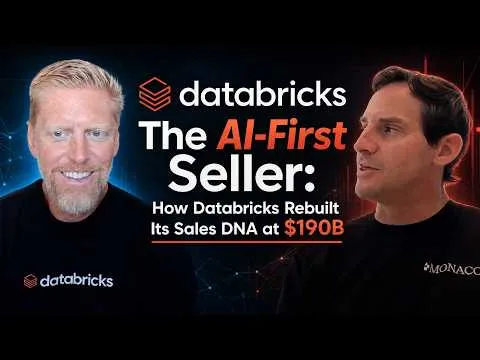
Gabrisko's pricing lesson: customers said a fee of about $1,000 per user was holding back their expansion. After Databricks made users free, he says, consumption jumped. He recommends choosing one scalable base unit, such as DBUs or tokens, and pricing add-ons like security or premium support as multipliers on it. He also advises letting customers start pay-as-you-go and asking for a commitment only after usage spreads across departments. [2] [1]
Every rep must be certified on Genie, Databricks' natural-language-to-SQL product. AE candidates pitch a real account at CEO level and then build a live Genie demo during the interview. Gabrisko says internal agents handle account research, executive prep, proposals and LinkedIn contact selection. Customer proofs of concept run on dummy data that resembles the customer's industry. [2] [9]
Gabrisko says personalized AI outreach raised reply rates from about 1–2% to 6–10%. SDR headcount has stayed flat while Databricks keeps adding AEs. He keeps the SDR team as a training academy for future AEs, and he says buyers now include CFOs and CMOs, not just IT. [2]
These lessons come from one executive's account, and Databricks' run-rate and valuation figures are company-announced.
Read the full assessment
If the pricing lesson holds, seat-based vendors may find that per-user fees cap usage, and AI outreach could let demand teams stay flat while closing teams grow.
Executive brief
Databricks CRO Ron Gabrisko says that early on, the company charged customers about $1,000 per user on top of its usage-based fees. Customers told him the seat fee was why they weren't expanding faster. Once users were made free, he says, consumption rose sharply (video, 32:20). On a SaaStr podcast he also said outbound reply rates went from 1–2% to 6–10% with AI-personalized outreach, and SDR headcount stayed flat while Databricks kept hiring AEs. These are his own operating figures and no outside source confirms them. Databricks' last confirmed valuation is $190B, not the "$200B" in SaaStr's headline.
What changed and event timeline
Gabrisko joins
His title at the time was SVP of Worldwide Sales, not CRO, which differs a little from the podcast's "joined as CRO" framing ().
First CRO Confidential episode
Host Sam Blond says this was the date of their earlier recording, so the new episode covers about two years of change ().
$134B valuation
Databricks completed a $5B equity round plus $2B in debt capacity and reported a revenue run-rate above $5.4B ().
$188B term sheet
Databricks signed a term sheet for a strategic round led by Coatue, an existing investor (;).
$5B closes at $190B
The company also reported a run-rate above $7B, growing more than 80% year over year (;).
SaaStr publishes ten takeaways
Jason Lemkin's post summarizes the podcast and rounds the valuation up to $200B ().
Capabilities and access
- Genie is the internal AI tool behind the sales motion. Product variants include Genie One for business users and Genie Code for developers.
- Every rep must be certified on Genie and uses it on their phone (video, 03:35).
- According to Gabrisko, internal agents built on Genie handle account research, exec prep docs, proposals and LinkedIn contact selection (video, 20:39).
Read the full section
- Genie is the internal AI tool behind the sales motion. It is Databricks' natural-language data product: a compound AI system that turns questions into SQL using Unity Catalog metadata and a knowledge store curated by the space's author (Databricks docs). Product variants include Genie One for business users and Genie Code for developers.
- Every rep must be certified on Genie and uses it on their phone (video, 03:35).
- According to Gabrisko, internal agents built on Genie handle account research, exec prep docs, proposals and LinkedIn contact selection (video, 20:39).
- No model versions are disclosed.
Technical analysis for researchers and developers
- AE candidates pick a real account, give a CEO-level AI pitch, then build and present a live Genie demo during the interview (video, 06:03).
- Proofs of concept may not run on production data, but they should run on dummy data that resembles the customer's industry.
- Pick one scalable base unit (DBUs for Databricks, tokens for LLMs).
Read the full section
- Interview as build test. AE candidates pick a real account, give a CEO-level AI pitch, then build and present a live Genie demo during the interview (video, 06:03).
- Demos on synthetic data. Proofs of concept may not run on production data, but they should run on dummy data that resembles the customer's industry. Examples include supply-chain forecasting and stockout prevention (video, 24:39).
- Pricing design. Pick one scalable base unit (DBUs for Databricks, tokens for LLMs). Price security, accelerators and premium support as multipliers or add-ons on that unit (video, 29:08).
- None of these practices come with reproducible metrics.
Claims and evidence
- "Many billions" in ARR: Databricks reported a run-rate above $7B and positive adjusted free cash flow over the trailing twelve months.
- $190B valuation, $5B round: this was company-announced and repeated by CNBC. The round was not confirmed in a filing.
- Under $1M ARR when he joined: stated on the podcast (video, 00:07), with no independent confirmation.
Read the full section
- "Many billions" in ARR: Databricks reported a run-rate above $7B and positive adjusted free cash flow over the trailing twelve months. These are company-reported and unaudited (Databricks).
- $190B valuation, $5B round: this was company-announced and repeated by CNBC. The two disagree on leads: Databricks names Coatue, while CNBC lists Coatue, Blackstone, MGX, T. Rowe Price and Sixth Street Growth (CNBC). The round was not confirmed in a filing.
- Under $1M ARR when he joined: stated on the podcast (video, 00:07), with no independent confirmation.
- 6–10% reply rates, flat SDR headcount, the consumption jump: Gabrisko's own anecdotes. No baselines or dates are given (video, 12:38).
Context and prior work
- Gabrisko earlier told 20VC that he took Databricks from $0 to $3.7B (20VC).
- His argument for usage pricing echoes his claim that AI coding companies moved from per-seat to token pricing after he warned them (video, 29:24).
- SaaStr has covered the same episode before, in a post that cited a $190B figure (SaaStr).
Read the full section
- Gabrisko earlier told 20VC that he took Databricks from $0 to $3.7B (20VC).
- His argument for usage pricing echoes his claim that AI coding companies moved from per-seat to token pricing after he warned them (video, 29:24).
- SaaStr has covered the same episode before, in a post that cited a $190B figure (SaaStr).
Limitations, safety and contested findings
- The source is a promotional-style interview. The host opens by calling Gabrisko "the greatest CRO to ever live" (video, 00:00).
- The host, Sam Blond, co-founded Monaco and repeatedly cites his own company's results, such as one SDR booking 400 meetings a month (video, 14:38).
- Databricks sells Genie, so endorsing it internally is also marketing.
Read the full section
- The source is a promotional-style interview. The host opens by calling Gabrisko "the greatest CRO to ever live" (video, 00:00).
- The host, Sam Blond, co-founded Monaco and repeatedly cites his own company's results, such as one SDR booking 400 meetings a month (video, 14:38).
- Databricks sells Genie, so endorsing it internally is also marketing.
- Gabrisko himself credits part of the inbound demand to a hot market rather than to the tools (video, 13:14).
Business and practitioner implications
- Seat fees can block consumption growth. Audit whether per-user charges are suppressing usage.
- Don't require a commit up front. Gabrisko recommends a pay-as-you-go entry point, then asking for a commit once usage spreads across departments (video, 33:35).
- He keeps SDRs as an academy that feeds future AEs, even as automation reduces demand-gen headcount (video, 15:45).
Read the full section
- Seat fees can block consumption growth. Audit whether per-user charges are suppressing usage.
- Don't require a commit up front. Gabrisko recommends a pay-as-you-go entry point, then asking for a commit once usage spreads across departments (video, 33:35).
- Keep the SDR pipeline. He keeps SDRs as an academy that feeds future AEs, even as automation reduces demand-gen headcount (video, 15:45).
- The buyer has changed. Databricks now sells to CFOs and CMOs, not only IT, and expects reps to spend at least 60% of their time with customers (video, 22:19).
The source trail.
Sources (11)
Top 10 Learnings From Databricks CRO Ron Gabrisko on Scaling Sales From Under $1M to a $200B Company
Article text retrieved; extracted text may omit tables or interactive elements. A transcript of the video linked from this page is supplied (linked video auto captions; https://www.youtube.com/watch?v=Pb9JiWvxikg); automatic text may contain errors.
saastr.comLinked video: Top 10 Learnings From Databricks CRO Ron Gabrisko on Scaling Sales From Under $1M to a $200B Company
linked video auto captions
www.youtube.com