
ExitsIPOs, listings & liquidity
Anthropic raises $81.3 billion in record IPO as Intuit sells Mailchimp for under a third of its 2021 price
Anthropic raised $81.3 billion at $83 a share in the largest IPO on record, then slipped below that price within days. A 20VC x SaaStr discussion set the listing against Mailchimp's discounted sale and questioned how far late-stage AI valuations can stretch.
From the SaaStr article of November 26, 2026 and cited sources: Anthropic sold 980 million shares at $83, above its $70–78 range, and opened at $111.50. [3] [9] [1]
SOURCES[3] CNBC: Anthropic below IPO price cnbc.com[9] StockAnalysis: Anthropic opens 34% above IPO stockanalysis.com[1] 20VC x SaaStr: Anthropic’s $1.5 Trillion IPO, Jensen… saastr.com
 AT Pulse research deskPublished · Updated · 5 min read · AI-assisted analysis
AI-assisted, not human-edited. Methodology Corrections Who owns this site
- What happened
- Anthropic sold 980 million shares at $83, above its $70–78 range, and opened at $111.50. [3] [9] [1]
- Original source
- SaaStr article, independent perspective
- Brief by
- AT Pulse research desk AI-assisted; publisher and contact on the desk page
- When
- November 26, 2026 article published
- Covered
- Nov 28 edition
- Evidence
- 20 sources across 15 sites
- 120VC x SaaStr: Anthropic’s $1.5 Trillion IPO, Jensen…saastr.com
- 2Linked video: 20VC x SaaStr: Anthropic’s $1.5 Trillion…youtube.com
- 3CNBC: Anthropic below IPO pricecnbc.com
- 4Wikipedia: Alpöge's proofen.wikipedia.org
- 5The Hacker News: OpenRouter/Dragosthehackernews.com
- 6CNBC: Intuit sells Mailchimpcnbc.com
RisingHow it’s measured
YouTube video · 19.5K views · 95 likes
Reach blends public engagement (views, likes, comments, shares, stars) from the platforms where the story or its original source lives: YouTube, Hacker News, GitHub, Substack and similar. A video and the article written from its transcript share one score, taken from the video. Platforms with no data are left out rather than counted as zero, and the age of a story never lowers its score.
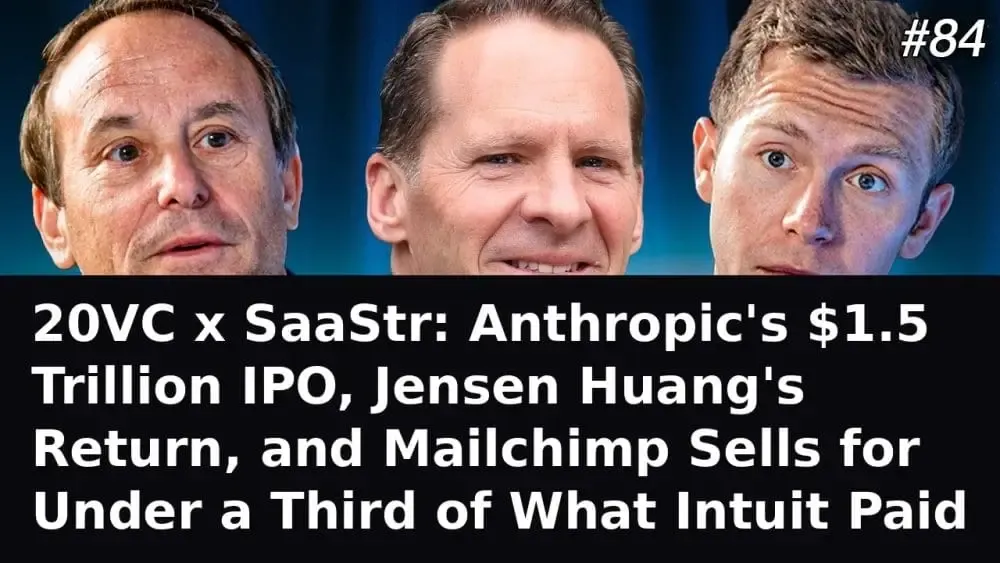
Anthropic sold 980 million shares at $83, above its $70–78 range, and opened at $111.50. By Nov 24 it had closed 6.5% lower on the day, below the offer price. Its headline valuation depends on the counting method: about $1.08 trillion on shares outstanding, about $1.5 trillion fully counted, and about $2 trillion if a $26 billion private placement is included. [3] [9] [1]
Software bought at 2021 prices is being repriced. Bending Spoons is buying Mailchimp for $3.68 billion; Intuit paid $12 billion for it in 2021. Jason Lemkin asked whether any 2021 investment growing below top-quartile rates is worth more than about 2x revenue. He also argued that agents will replace marketing automation as a category. [6] [2]
The hosts questioned the return math on late-stage AI rounds. Cognition is in talks at about $75 billion, up from $48 billion in September. Lemkin said a 10x return from there would need an exit near $1 trillion. Guest host Matt Murphy of Menlo Ventures, which backs Cognition's rival Factory, said he expects no 10x among Sierra, Ramp and Databricks. He favoured Databricks for a 3–5x return. [16] [2]
Security-driven deals and trust concerns ran alongside the IPO. Palo Alto agreed to buy Applied Compute for $4.5 billion in stock, and CrowdStrike's all-stock deal values Zscaler at about $43.9 billion. In a canary test by Dragos, prompts sent through OpenRouter were copied even when flagged for zero data retention. The hosts expect enterprise buyers to demand disclosure of the models running under the products they use. [7] [18] [5] [2]
The pricing, Mailchimp sale and deal terms are documented; the conclusions drawn from them are the hosts' views.
Read the full assessment
If public markets cool on Anthropic while 2021 software resets to low revenue multiples, late-stage investors face harder exit math on both AI leaders and followers.
Sources are checked; here is the dossier.
Executive brief
Anthropic sold 980 million shares at $83 to raise $81.3 billion, reported as the largest IPO ever. The day after, an Anthropic mathematician released a Lean-formalised proof of the Riemann hypothesis made with an unreleased Claude model. SaaStr's 20VC episode, with Anthropic investor Matt Murphy of Menlo Ventures filling in as guest host, sets these events beside three others: Jensen Huang's return to Nvidia, a prompt-theft scandal at OpenRouter, and B2B software from 2021 being repriced, with Mailchimp sold for less than a third of what Intuit paid.
What changed and event timeline
Palo Alto buys Applied Compute
The deal is all-stock and valued at $4.5B. The startup was founded in 2025 by former OpenAI researchers, has about 50 staff, and reports a $100M run-rate.
More detail
Anthropic prices above its range, and Intuit sells Mailchimp
The IPO priced at $83 against a $70–78 range and opened at $111.50. Mailchimp goes to Bending Spoons for $3.68B; Intuit paid $12B in 2021.
More detail
Riemann proof released
Levent Alpöge says he and Claude proved both the Riemann hypothesis and the generalised Riemann hypothesis. He published Lean code instead of a paper.
Huang reinstated, OpenRouter exposure disclosed
Nvidia's board voted unanimously to bring Huang back and cited input from the US government; Nvidia stock rose 31%. Separately, OpenRouter warned customers about data exposure involving a Chinese AI firm.
More detail
Anthropic below its IPO price
The stock closed down 6.5% for the day, under $83. Analysts at Canaccord, Wedbush and Oppenheimer stayed positive.
Capabilities and access
- Riemann work: used an unreleased Claude model, and no source names the version. The Lean FRO and Mathlib Initiative reported verifying the proof on Nov 21.
- Holding models back: Murphy connects the result to labs withholding models, because of what such capability could mean for attackers (video 1:00:57).
- Applied Compute: offers post-training and inference for open-weight models. Palo Alto will fold this into its enterprise AI security offering (Network World).
Read the full section
- Riemann work: used an unreleased Claude model, and no source names the version. The Lean FRO and Mathlib Initiative reported verifying the proof on Nov 21.
- Holding models back: Murphy connects the result to labs withholding models, because of what such capability could mean for attackers (video 1:00:57). This is his reading. Nothing in the reviewed sources states Anthropic's release policy for the model.
- Applied Compute: offers post-training and inference for open-weight models. Palo Alto will fold this into its enterprise AI security offering (Network World).
Technical analysis for researchers and developers
- Proof artefact: Alpöge's original Lean development was about 17M lines. MIT's Andrew Sutherland compiled it independently.
- Dragos test method: Dragos seeded about 2 million prompts with unique links and credentials, each of which could only be found by reading that prompt.
- Practical step: run canary checks on every inference provider rather than relying on its ZDR policy.
Read the full section
- Proof artefact: Alpöge's original Lean development was about 17M lines. Anthropic researcher Luke Sernau published a roughly 300K-line version on Nov 25 (Wikipedia). MIT's Andrew Sutherland compiled it independently. One automated check, confirming that the formal statement matches the hypothesis, was still pending at the time of TNW's report.
- Dragos test method: Dragos seeded about 2 million prompts with unique links and credentials, each of which could only be found by reading that prompt. Requests flagged Zero Data Retention (ZDR) were still copied. Stolen AWS keys were tried within hours (The Hacker News).
- Practical step: run canary checks on every inference provider rather than relying on its ZDR policy.
Claims and evidence
- Valuation: SaaStr puts it at about $1.08T on shares outstanding and about $1.5T fully counted. StockAnalysis gives about $1.5T and $2T at $83, counting a $26B private placement.
- Revenue: Lemkin says Anthropic is at "$100 billion in revenue" (video 1:10:01).
- Cognition at $75B: reported by Bloomberg from unnamed sources, with offers of $70–80B (Yahoo/Bloomberg). The $48B September round was company-announced.
Read the full section
- Valuation: SaaStr puts it at about $1.08T on shares outstanding and about $1.5T fully counted. StockAnalysis gives about $1.5T and $2T at $83, counting a $26B private placement. The headline number depends on the method.
- Revenue: Lemkin says Anthropic is at "$100 billion in revenue" (video 1:10:01). The S-1 showed a $47B run-rate in late May, and Anthropic counts cloud-channel sales on a gross basis (Motley Fool).
- Cognition at $75B: reported by Bloomberg from unnamed sources, with offers of $70–80B (Yahoo/Bloomberg). The $48B September round was company-announced. Murphy's firm, Menlo, backs rival Factory.
- Sierra at about $30B: reported talks (The Information). The $400M ARR figure is self-reported.
Context and prior work
- Murphy compares Anthropic with Google, which took 15 years to grow from $10B to $100B. He says Anthropic did it in one (video 14:26).
- Lemkin points to Sequoia's internal idea of a "Postmates effect": when a market gets big enough, even the third or fourth player can be worth billions.
- Security consolidation continues: the all-stock CrowdStrike–Zscaler deal values Zscaler at about $43.9B, with a combined ARR of more than $10B expected at closing (Zscaler 8-K).
Read the full section
- Murphy compares Anthropic with Google, which took 15 years to grow from $10B to $100B; he says Anthropic did it in one (video 14:26).
- Lemkin points to Sequoia's internal idea of a "Postmates effect": when a market gets big enough, even the third or fourth player can be worth billions. He uses it to argue against Cognition at $75B, saying a 10x return would need roughly a $1T exit (video 32:11).
- Security consolidation continues: the all-stock CrowdStrike–Zscaler deal values Zscaler at about $43.9B, with a combined ARR of more than $10B expected at closing (Zscaler 8-K).
Limitations, safety and contested findings
- Riemann: the WSJ reports that Alpöge guided Claude and it did not work on its own (Wikipedia).
- OpenRouter: an unnamed Chinese lab fetched more than half of the seeded prompts sent to its models.
- Huang: Bloomberg reports that President Trump pushed for the rehiring (Bloomberg). Government investigations are continuing.
Read the full section
- Riemann: the WSJ reports that Alpöge guided Claude and it did not work on its own (Wikipedia). Brian Conrad called releasing a proof its author does not fully understand "completely outrageous". James Maynard put his confidence at 98–99% (TNW).
- OpenRouter: an unnamed Chinese lab fetched more than half of the seeded prompts sent to its models. OpenRouter says it understands the data was deleted (The Next Web).
- Huang: Bloomberg reports that President Trump pushed for the rehiring (Bloomberg). Government investigations are continuing.
Business and practitioner implications
- Model disclosure: Murphy expects Fortune 5000 buyers to demand to know which models run underneath a product (video 1:01:50).
- 2021-vintage valuations: Lemkin asks whether any 2021 investment growing below the top quartile is worth more than 2x revenue (48:35).
- Late-stage bets: Murphy sees no 10x among Sierra, Ramp and Databricks, and prefers Databricks for a 3–5x return (39:18).
Read the full section
- Model disclosure: Murphy expects Fortune 5000 buyers to demand to know which models run underneath a product (video 1:01:50). Lemkin argues ZDR "has to actually work" (1:02:41).
- 2021-vintage valuations: Lemkin asks whether any 2021 investment growing below the top quartile is worth more than 2x revenue (48:35). He also calls marketing automation a dead category (50:48).
- Late-stage bets: Murphy sees no 10x among Sierra, Ramp and Databricks, and prefers Databricks for a 3–5x return (39:18).
- Hiring: startups face sharply higher pay for AI talent (1:10:01).
The source trail.
Sources (20)
20VC x SaaStr: Anthropic’s $1.5 Trillion IPO, Jensen Huang’s Return, and Mailchimp Sells for Under a Third of What Intuit Paid
Article text retrieved; extracted text may omit tables or interactive elements. A transcript of the video linked from this page is supplied (linked video auto captions; https://www.youtube.com/watch?v=UGSSg8vv8vg); automatic text may contain errors.
saastr.comLinked video: 20VC x SaaStr: Anthropic’s $1.5 Trillion IPO, Jensen Huang’s Return, and Mailchimp Sells for Under a Third of What Intuit Paid
linked video auto captions
www.youtube.com