
StocksEquities, earnings & valuations
Nvidia reinstates Jensen Huang as CEO; shares jump 31% and S&P 500 rebounds 4.6% after AI-led correction
Nvidia's board brought back Jensen Huang on 23 November, 11 days after he resigned, sending its stock up 31% and the S&P 500 up 4.6%. The rebound followed an AI-led correction that one commentator ties mainly to rising rates, costly AI financing and valuation doubts.
From the The Plain Bagel video of November 27, 2026 and cited sources: Nvidia's board voted unanimously on 23 November to reinstate Huang after input from senior US government officials. [2] [3] [9] [10]
SOURCES[2] CNBC: Jensen Huang reinstated as Nvidia CEO. Stock… cnbc.com[3] Al Jazeera: Nvidia board reinstates Jensen Huang as CEO aljazeera.com[9] Nvidia: Board Reinstates Jensen Huang nvidianews.nvidia.com
 AT Pulse research deskPublished · Updated · 5 min read · AI-assisted analysis
AI-assisted, not human-edited. Methodology Corrections Who owns this site
- What happened
- Nvidia's board voted unanimously on 23 November to reinstate Huang after input from senior US government officials. [2] [3] [9] [10] [11]
- Original source
- The Plain Bagel video, independent perspective
- Brief by
- AT Pulse research desk AI-assisted; publisher and contact on the desk page
- When
- November 27, 2026 video published
- Covered
- Nov 28 edition
- Evidence
- 15 sources across 13 sites; transcript sourced
- 1What's Going On With Markets?youtube.com
- 2CNBC: Jensen Huang reinstated as Nvidia CEO. Stock…cnbc.com
- 3Al Jazeera: Nvidia board reinstates Jensen Huang as CEOaljazeera.com
- 4Fortune: AI selloff drags S&P 500 into a correctionfortune.com
- 5GV Wire: Nvidia chief seen as target of Chinese spy plotgvwire.com
- 6political.org: S&P 500 down 4.4% erasing post-midterm rallypolitical.org
RisingHow it’s measured
YouTube video · 350.3K views · 5K likes
Reach blends public engagement (views, likes, comments, shares, stars) from the platforms where the story or its original source lives: YouTube, Hacker News, GitHub, Substack and similar. A video and the article written from its transcript share one score, taken from the video. Platforms with no data are left out rather than counted as zero, and the age of a story never lowers its score.
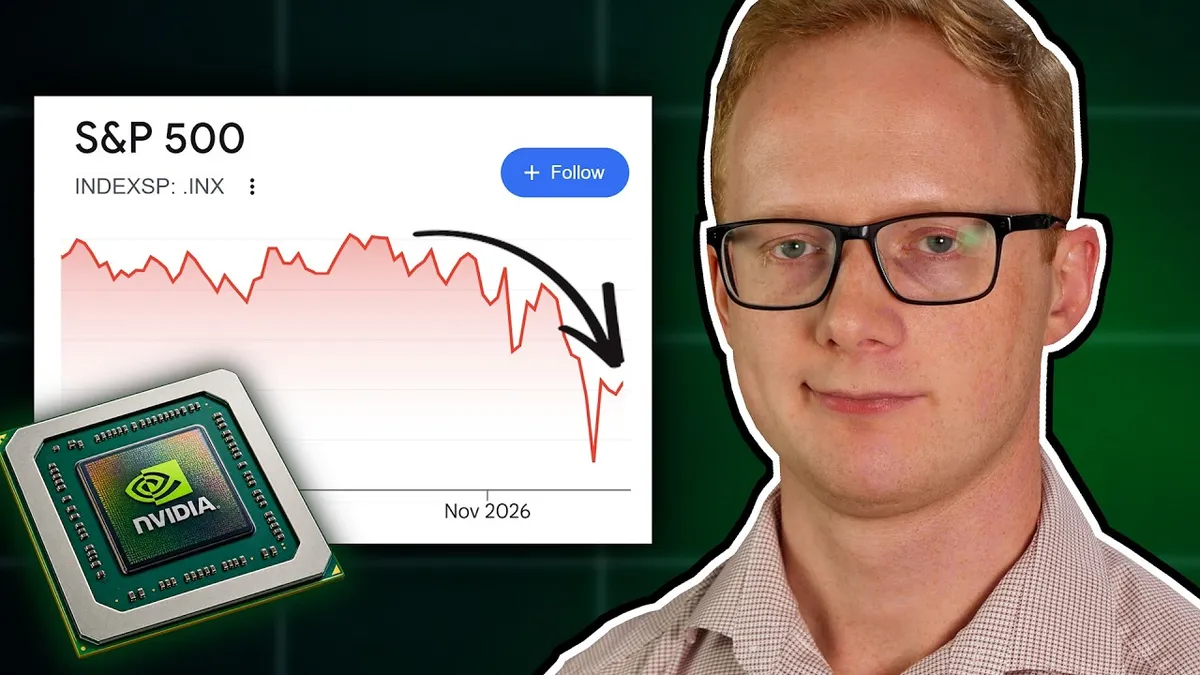
Nvidia's board voted unanimously on 23 November to reinstate Huang after input from senior US government officials. President Trump said he intervened personally. As part of the return, Nvidia created a National Security and Export Control Committee made up only of independent directors and a new Chief Compliance Officer role, and Colette Kress went back to being CFO. The shares closed up 31% that day, adding close to $1 trillion in market value, and the S&P 500 rose 4.6%. [2] [3] [9] [10] [11]
Two things explain why one CEO's status moved the whole market. First, Nvidia is about 5% of the S&P 500. Second, it acts as a financier for AI: according to the video, it holds $134.7 billion in investments, more than a third of its assets, and many are stakes in AI labs that buy its chips. Critics call this circular financing, and Huang's exit raised fears that this source of funding would shrink. [1]
The sell-off started before the Huang scandal and went beyond Nvidia. On 5 November the S&P 500 fell 4.4% as investors weighed Democratic campaign pledges to curb data-centre building. By 20 November the index was in correction and the Nasdaq had erased its 2026 gains. Behind this were 3.7% annual CPI inflation, an expected December Fed rate hike, and CoreWeave bonds yielding above 16–17%, which signal tighter financing for AI infrastructure. [1] [4] [6] [7] [12] [13] [14]
The evidence: one governance decision moved the S&P 500 several percent in a day.
Read the full assessment
The implication: because AI is so concentrated in the index, relies on vendor financing and faces distressed neocloud credit, key-person and policy risks now affect the whole market. Compute buyers face higher costs and supplier-solvency risk.
Executive brief
On 23 November 2026, Nvidia's board reinstated Jensen Huang as CEO, 11 days after he resigned. The shares closed up 31% that day, adding close to $1 trillion in market value, according to CNBC. A single governance event moved the whole market: the S&P 500 rose 4.6% that day (Al Jazeera). Three days earlier the index had closed in correction, more than 10% below its 6 October record (Fortune). In The Plain Bagel's commentary video, Richard argues the Huang saga was the most visible cause of the sell-off but not the main one. In his account, the bigger drivers are rising rates, the cost of financing AI infrastructure, and doubts about AI valuations.
What changed and event timeline
Report links Huang to a suspected Chinese asset
The New York Times reported that US officials believe Alice Huang, an executive at the Singapore data-centre firm Megaspeed, is a Chinese asset who cultivated Jensen Huang. Officials reportedly believed he was unaware of this ().
Sell-off after the midterms
The S&P 500 fell 4.4% and the Nasdaq fell 5.5%, the worst day for both since April 2025. Investors were weighing Democratic campaign pledges to curb data-centre construction (;).
Huang resigns
He stepped down after the affair disclosures, and CFO Colette Kress became interim CEO ().
Anthropic lists
Anthropic priced at $83 and closed its first day at $97.17, up 17%, after trading as high as $115.10 ().
Correction confirmed
The S&P 500 fell 3.59% to 6,918.45, its seventh straight decline. The Nasdaq gave up all its 2026 gains and the VIX rose above 30 ().
Huang reinstated
The board vote was unanimous and was taken after "input from senior levels" of the US government (). Trump said he intervened personally ().
Capabilities and access
There is no model release in this story.
Read the full section
There is no model release in this story. The relevant "capabilities" are about finance and control:
- Nvidia's governance changes on reinstatement: a new National Security and Export Control Committee made up only of independent directors, and a new Chief Compliance Officer role. Kress returns to the CFO job (Nvidia; SEC 8-K).
- Anthropic stock: now trades publicly as ANT on the Nasdaq. Its $83 IPO price valued the company at about $1.5 trillion (Deadline).
Technical analysis for researchers and developers
The video describes four ways the shock spreads: For developers, this means more expensive neocloud capacity is a real risk to compute supply.
Read the full section
The video describes four ways the shock spreads:
- Concentration: Nvidia makes up about 5% of the S&P 500 (video, 5:16).
- Vendor financing: Nvidia holds $134.7 billion of investments, more than a third of its assets. Many are stakes in AI labs that buy its chips, which critics call circular financing (video, 6:05).
- Rate sensitivity: higher rates make capital-heavy buildouts more expensive.
- Credit signals: some CoreWeave bonds yield above 16–17% (TIKR).
For developers, this means more expensive neocloud capacity is a real risk to compute supply.
Claims and evidence
- September CPI was up 3.7% year on year (core 2.6%). Confirmed by the BLS release as reported by CNBC.
- 99.5% odds of a 25bp Fed hike on 9 December (video, 10:24). Not confirmed.
- Four of the top five hyperscalers had negative free cash flow (video, 11:56), and AI drove about a quarter of US real GDP growth in Q2 (13:03).
Read the full section
- September CPI was up 3.7% year on year (core 2.6%). Confirmed by the BLS release as reported by CNBC.
- 99.5% odds of a 25bp Fed hike on 9 December (video, 10:24). Not confirmed. The latest independent figure found was about 90% as of 20 October (Axis Intelligence).
- Four of the top five hyperscalers had negative free cash flow (video, 11:56), and AI drove about a quarter of US real GDP growth in Q2 (13:03). No corroboration was found for either; both rest on the video alone.
- Size of Nvidia's 23 November jump: the video says 30%; CNBC reports a 31% close (CNBC); Al Jazeera reports a jump of more than 33% at the open.
Context and prior work
- The probe behind the 29 October report began in late 2024, after a Commerce Department official saw Nvidia chips still boxed at a Megaspeed site in Malaysia.
- Alexandria Ocasio-Cortez introduced a bill in March to pause new data-centre construction nationwide. The midterm results gave that idea new market weight (NPR).
- Nvidia restated earnings in the early 2000s, a precedent the video raises (7:44).
Read the full section
- The probe behind the 29 October report began in late 2024, after a Commerce Department official saw Nvidia chips still boxed at a Megaspeed site in Malaysia. Megaspeed reportedly went on to buy about $2 billion of GPUs (GV Wire/NYT).
- Sen. Bernie Sanders and Rep. Alexandria Ocasio-Cortez introduced a bill in March to pause new data-centre construction nationwide. The midterm results gave that idea new market weight (NPR).
- Nvidia restated earnings in the early 2000s, a precedent the video raises (7:44).
Limitations, safety and contested findings
Read the full section
- Investigations are still open. Nvidia's internal investigation, a California DOJ probe into chip transfers to China, and an SEC review of accounting all continue. Huang is expected to testify before Congress in December (CNBC).
- Nvidia's stock reversed quickly: it traded about 5% lower before the market opened on 24 November (CNBC).
- Analysts disagree on the cause. BNP Paribas's Benedicte Lowe called the 20 November moves "panic selling." E*Trade's Chris Larkin called them largely sentiment-driven against a solid fundamental backdrop (Fortune).
- Where markets stand is attributed to the video only: S&P 500 about 8% below its peak but still up 5% year to date (8:03, 13:55).
Business and practitioner implications
- Key-person risk is now a market-wide risk. One CEO's status swung the index by several percent in a single day.
- Credit markets are pricing AI infrastructure as risky. Buyers of compute should check the financial health of their providers.
- Policy exposure has grown under a Democratic Congress: data-centre moratorium proposals, tariff changes and export-control oversight.
Read the full section
- Key-person risk is now a market-wide risk. One CEO's status swung the index by several percent in a single day.
- Credit markets are pricing AI infrastructure as risky. CoreWeave's debt trades like distressed credit, so its next round of borrowing is likely to cost more (TIKR). Buyers of compute should check the financial health of their providers.
- Policy exposure has grown under a Democratic Congress: data-centre moratorium proposals, tariff changes and export-control oversight.
- The supply of AI stock will grow. The video expects insider lock-up expiries at Anthropic and SpaceX to add selling pressure over the next few years (15:52).
The source trail.
Sources (15)
What's Going On With Markets?
Transcript retrieved via youtube_auto_captions; language en. Timestamped text, not direct audiovisual review. Source: https://www.youtube.com/watch?v=bR2sb-QinFg. Automatic captions/transcription may contain errors.
www.youtube.com