
Personal investingPortfolios, retirement & planning
Ben Carlson Recommends Investing Books for an 18-Year-Old and Says Saving Matters More Than Strategy
Responding to a reader shopping for an 18-year-old, Ben Carlson recommends books on investor behavior, low-cost indexing and market history. He argues that for new investors, a steady savings rate matters more than picking the right strategy.
From the A Wealth of Common Sense article of November 26, 2026 and cited sources: The written list has eight picks: Zweig's book on money and the brain, Bogle on index investing, Ramit Sethi, Nick Murray, Bernstein's Four Pillars, Chancellor's history of speculation, Ellis's Winning the Loser's Game and Poor… [1] [2]
SOURCES[1] Books For New Investors awealthofcommonsense.com[2] Linked video: Books For New Investors youtube.com
 AT Pulse research deskPublished · Updated · 5 min read · AI-assisted analysis
AI-assisted, not human-edited. Methodology Corrections Who owns this site
- What happened
- The written list has eight picks: Zweig's book on money and the brain, Bogle on index investing, Ramit Sethi, Nick Murray, Bernstein's Four Pillars, Chancellor's history of speculation, Ellis's Winning the Loser's Game and Poor… [1] [2]
- Original source
- A Wealth of Common Sense article, independent perspective
- Brief by
- AT Pulse research desk AI-assisted; publisher and contact on the desk page
- When
- November 26, 2026 article published
- Covered
- Nov 28 edition
- Evidence
- 7 sources across 7 sites
- 1Books For New Investorsawealthofcommonsense.com
- 2Linked video: Books For New Investorsyoutube.com
- 3NVIDIA Announces CEO Transitionnvidianews.nvidia.com
- 4Al Jazeera: Nvidia board reinstates Jensen Huang as CEOaljazeera.com
- 5NVIDIA Board Reinstates Jensen Huanginvestor.nvidia.com
- 6About CS 007cs007.blog
RisingHow it’s measured
YouTube video · 17.7K views · 260 likes
Reach blends public engagement (views, likes, comments, shares, stars) from the platforms where the story or its original source lives: YouTube, Hacker News, GitHub, Substack and similar. A video and the article written from its transcript share one score, taken from the video. Platforms with no data are left out rather than counted as zero, and the age of a story never lowers its score.
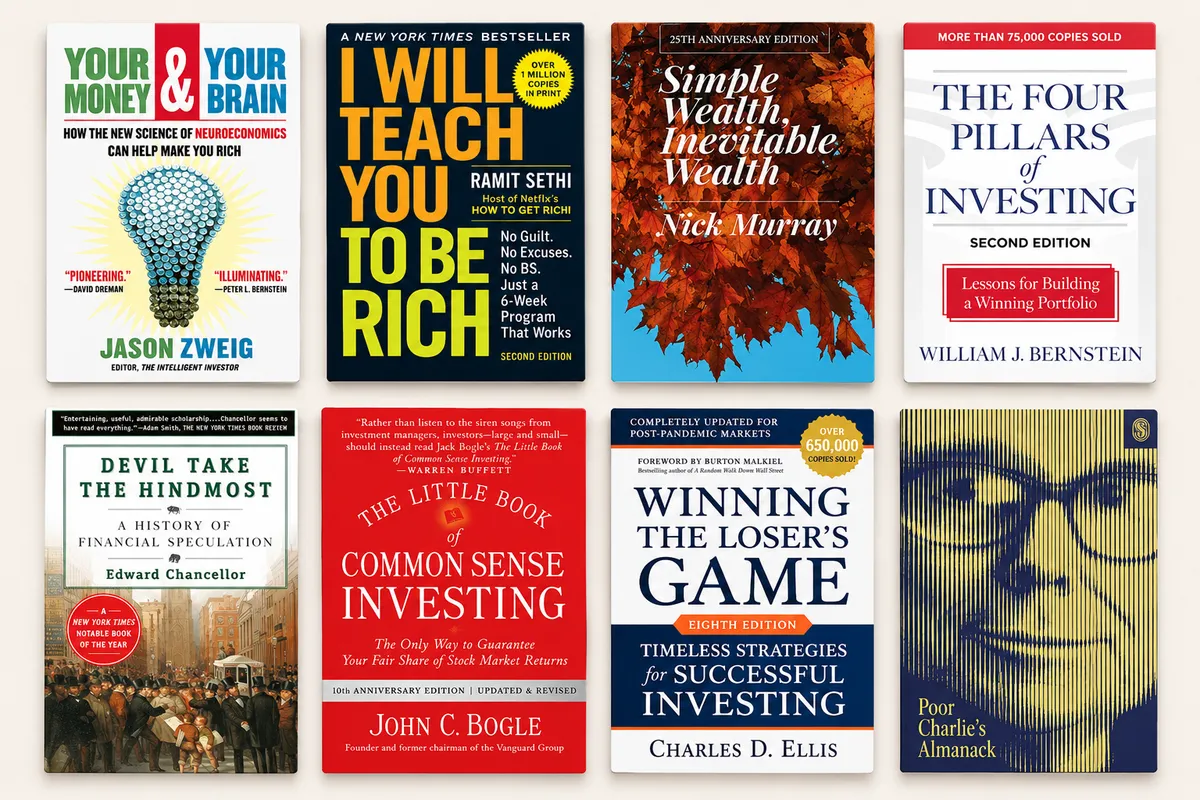
The written list has eight picks: Zweig's book on money and the brain, Bogle on index investing, Ramit Sethi, Nick Murray, Bernstein's Four Pillars, Chancellor's history of speculation, Ellis's Winning the Loser's Game and Poor Charlie's Almanack. The list Carlson gives in the episode is different. It adds Hagstrom's Buffett books and Housel's Psychology of Money, and it leaves out Chancellor, Ellis, Murray and Bogle. [1] [2]
For beginners, Carlson says steady contributions will matter far more than the choice of investing strategy. He suggests keeping the portfolio simple, raising the savings rate every year and saving half of each raise. For high earners such as athletes and AI engineers, he says to set aside a fixed share of income right away. [2]
Sudden wealth does not protect against ruin. An NBER study of about 900 NFL players drafted from 1996 to 2003 found that roughly one in six filed for bankruptcy within 12 years of retiring. Higher career earnings and longer careers did not lower that risk. [2] [7]
The episode uses Nvidia's turmoil as a lesson about holding too much of one stock. Jensen Huang resigned as CEO on November 12, and the board reinstated him unanimously on November 23, citing input from the US government. SEC and DOJ investigations are still open. Carlson tells a listener with 40% of his portfolio in Nvidia that paying tax on a gain means he already won, and that diversifying sooner is reasonable. [2] [3] [4] [5]
The NBER data show that high pay alone does not prevent financial ruin. Carlson's advice to save a fixed share first and index simply is opinion, but it fits people with sudden high incomes, a group he says now includes AI engineers.
Executive brief
Ben Carlson's reading list for new investors ran in a week when Nvidia had just shown, in real time, the market risks those books warn about. The company's CEO resigned on November 12 and the board reinstated him 11 days later, after a stock collapse, a petition and calls from the White House. Carlson's list post answers a reader asking what to give an 18-year-old. The answer is eight books on behavior, low-cost indexing and market history. In the linked episode he argues that, early on, how much you save matters more than how you invest. A peer-reviewed-style dataset backs the stakes: about one in six NFL players goes bankrupt within 12 years of retiring.
What changed and event timeline
Collins book reissued
The Simple Path to Wealth, the book the reader bought, came out in a revised and expanded edition with updated data and a "punchlist." The publisher says it has sold over a million copies (/JL-Collins/9798893310474)).
Huang resigns
Jensen Huang left as Nvidia's CEO and as a board director, effective immediately. The company gave no reason (). Al Jazeera reported the cause as extramarital affairs, including one involving an alleged spy ().
Board reinstates Huang
The board voted unanimously, citing input from the US government (). Shares rose more than 33% at Monday's open, while SEC and DOJ investigations continue ().
List published
Carlson posted eight book recommendations, from Zweig's Your Money and Your Brain to Poor Charlie's Almanack. He tied the post to an Ask the Compound episode that also covered Nvidia, leveraged ETFs and NFL players' finances ().
Capabilities and access
- The written list: Zweig, Bogle (Little Book of Common Sense Investing), Ramit Sethi, Nick Murray, Bernstein (Four Pillars), Chancellor (Devil Take the Hindmost), Ellis (Winning the Loser's Game) and Munger (post).
- The on-air list is different. It adds Hagstrom's Buffett books and Housel's Psychology of Money, and drops Chancellor, Ellis, Murray and Bogle (26:51).
- Free material: Carlson says Bernstein's If You Can is free on Kindle (29:46).
Read the full section
- The written list: Zweig, Bogle (Little Book of Common Sense Investing), Ramit Sethi, Nick Murray, Bernstein (Four Pillars), Chancellor (Devil Take the Hindmost), Ellis (Winning the Loser's Game) and Munger (post).
- The on-air list is different. It adds Hagstrom's Buffett books and Housel's Psychology of Money, and drops Chancellor, Ellis, Murray and Bogle (26:51).
- Free material: Carlson says Bernstein's If You Can is free on Kindle (29:46). Adam Nash publishes the slides for his Stanford course CS 007, "Personal Finance for Engineers" (cs007.blog).
Technical analysis for researchers and developers
The episode's most rigorous moment is about backtesting, not books.
Read the full section
The episode's most rigorous moment is about backtesting, not books.
- A listener's trend rule. A German listener describes holding a 2x leveraged S&P 500 ETF and exiting when the index closes 2% below its 200-day moving average. He says that since 1988, after costs and tax, this matched simply holding the 2x ETF while cutting the worst drawdown from 90% to about 45% (17:29). His code and data are not published.
- Carlson's cautions:
- Backtests that look too good usually mean the data has been mined.
- Ask why the edge should persist.
- Rules tied to fast signals can whipsaw you in and out.
- Backtests execute without emotion; people don't (21:40, 25:44).
Claims and evidence
- "One in six NFL players file for bankruptcy within 12 years" (13:14).
- The median of $3.2M in career earnings over a 3.3-year career is quoted from Carlson's own book, which he calls possibly dated.
- Nvidia since 2010: about 32,000% total, about 40% a year, trading at 10 times forward earnings (5:12, 8:18).
Read the full section
- "One in six NFL players file for bankruptcy within 12 years" (13:14). This matches an NBER study of about 900 players drafted from 1996 to 2003 (NBER w21085). The study also found that total earnings and career length did not lower the risk.
- NFL career figures. The median of $3.2M in career earnings over a 3.3-year career is quoted from Carlson's own book, which he calls possibly dated. No independent source here confirms it.
- Nvidia since 2010: about 32,000% total, about 40% a year, trading at 10 times forward earnings (5:12, 8:18). These are spoken figures from the host and are not checked against primary data.
Context and prior work
Read the full section
- Carlson's core themes are simplicity, saving and indexing. He says they match Collins's, whom he calls a friend (post).
- For the reader's question about which single blog post to share, he names no specific post (31:07).
- He calls Nash's CS 007 a favorite resource. The course is open to students of any major and is in about its eighth year (cs007.blog, 15:10).
Limitations, safety and contested findings
- This is commentary: a personal list with no ranking method.
- The written and spoken lists diverge, as noted above.
- Carlson's Nvidia remarks are his own reading. He credits Ben Thompson's view at Stratechery that Nvidia was organized around Huang (6:07).
Read the full section
- This is commentary: a personal list with no ranking method.
- The written and spoken lists diverge, as noted above.
- Carlson's Nvidia remarks are his own reading. He credits Ben Thompson's view at Stratechery that Nvidia was organized around Huang (6:07). He also said on air that he is no longer giving price targets.
- Huang's reinstatement is politically contested. Senator Elizabeth Warren said Huang and Nvidia still owe Congress answers (Al Jazeera).
- The auto-generated captions may contain errors.
Business and practitioner implications
- For people with sudden, high incomes, including AI engineers, whom Carlson compares to pro athletes (15:46): his key point is to save a fixed share of income first.
- On using AI to learn: he told students not to rely on a ChatGPT summary and to read the books themselves (30:14).
- For employers and teams: the NBER data suggests financial education matters even when pay is high.
Read the full section
- For people with sudden, high incomes, including AI engineers, whom Carlson compares to pro athletes (15:46): his key point is to save a fixed share of income first. He suggests saving half of each raise (24:07).
- On using AI to learn: he told students not to rely on a ChatGPT summary and to read the books themselves (30:14).
- For employers and teams: the NBER data suggests financial education matters even when pay is high.
The source trail.
Sources (7)
Books For New Investors
Article text retrieved; extracted text may omit tables or interactive elements. A transcript of the video linked from this page is supplied (linked video auto captions; https://www.youtube.com/watch?v=l-ENmLkrelA); automatic text may contain errors.
awealthofcommonsense.comLinked video: Books For New Investors
linked video auto captions
www.youtube.com