
AgentsAutonomy & tool use
Clay's head of AI says about half of agent use on Clay now runs through outside harnesses like Claude Code
Jeff Barg says Clay rebuilt its Sculptor agent as a coding agent that drives the Clay CLI in a cloud sandbox, and that outside harnesses such as Claude Code now account for close to half of agent usage on the platform.
From the Latent Space podcast episode of November 26, 2026 and cited sources: Barg puts the split between Clay's own agent and outside harnesses at much closer to 50/50 than he expected. [1] [2]
SOURCES[1] How Clay Builds GTM Agents — Jeff Barg, Head of AI lspace.beehiiv.com[2] Transcript: How Clay Builds GTM Agents — Jeff Barg, Head… rss.beehiiv.com
 AT Pulse research deskPublished · Updated · 5 min read · AI-assisted analysis
AI-assisted, not human-edited. Methodology Corrections Who owns this site
- What happened
- Barg puts the split between Clay's own agent and outside harnesses at much closer to 50/50 than he expected. [1] [2]
- Original source
- Latent Space podcast episode, independent perspective
- Brief by
- AT Pulse research desk AI-assisted; publisher and contact on the desk page
- When
- November 26, 2026 podcast episode published
- Covered
- Nov 27 edition
- Evidence
- 8 sources across 7 sites; transcript sourced
- 1How Clay Builds GTM Agents — Jeff Barg, Head of AIlspace.beehiiv.com
- 2Transcript: How Clay Builds GTM Agents — Jeff Barg, Head…rss.beehiiv.com
- 3Clay raises $115m at a $7.1bn valuation (TNW)thenextweb.com
- 4Census welcomes Avenue (Plushcap mirror)plushcap.com
- 5Sculpt 2025 product launches (Clay)clay.com
- 6Sculpt 2026 recap (Clay)clay.com
RisingHow it’s measured
YouTube video · 3.8K views · 21 likes
Reach blends public engagement (views, likes, comments, shares, stars) from the platforms where the story or its original source lives: YouTube, Hacker News, GitHub, Substack and similar. A video and the article written from its transcript share one score, taken from the video. Platforms with no data are left out rather than counted as zero, and the age of a story never lowers its score.
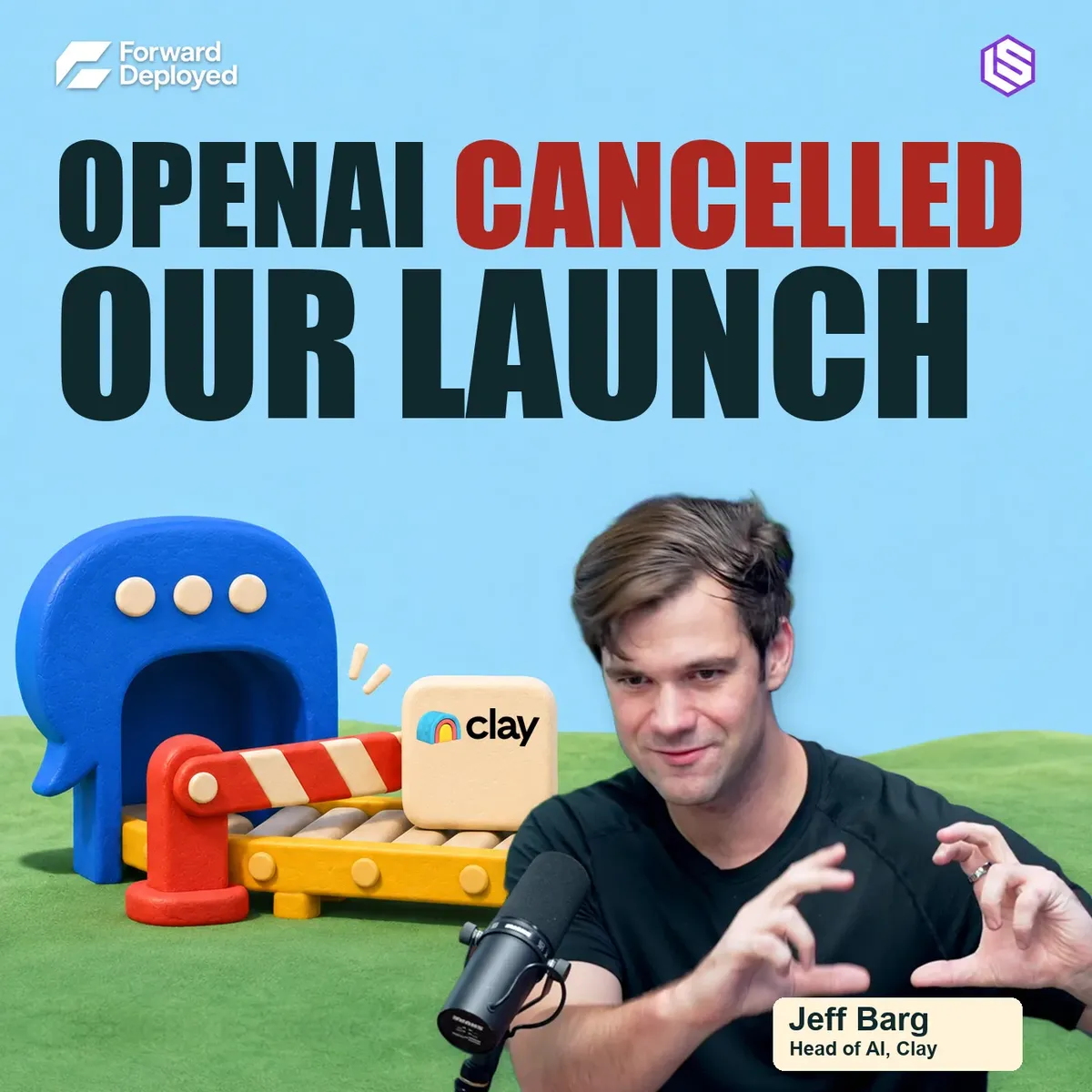
Barg puts the split between Clay's own agent and outside harnesses at much closer to 50/50 than he expected. He says Clay deliberately avoids making its agent clearly better than using Clay through Claude Code. The aim is to be go-to-market infrastructure that any agent can call, not to own the interface. [1] [2]
The first Sculptor was a model calling tools in a loop. Barg names three problems with it: the tools couldn't be chained, it had too few primitives, and it had no CRM or campaign-results data. The rebuild is a coding agent that uses Bash, Python and the Clay CLI in a sandbox. It draws on Audiences, an entity-resolved data layer built from CRM and Gong data. Clay also ships CLI, MCP and skills plugins for outside coding agents. [1] [2] [6] [7]
Barg's account of the Sculptor rebuild and the usage split. Implication: if outside agents drive much of a SaaS product's usage, its CLI and API become the main product surface, and its own agent has to compete on parity, not lock-in.
Executive brief
Clay's Head of AI, Jeff Barg, says roughly half of agent usage on Clay now runs through outside harnesses such as Claude Code, not Clay's own agent. He describes the split as "much closer to 50/50" than he expected. He also says Clay deliberately does not want its own agent to be "markedly better" than Clay used through Claude Code (Latent Space episode, ~49:24–50:28). Clay rebuilt its first-party agent, Sculptor, as a coding agent that drives the Clay CLI from a cloud sandbox. It is betting on being go-to-market infrastructure that any agent can call, rather than on owning the interface. Clay is valued at $7.1B (TNW).
What changed and event timeline
Avenue joins Clay
Census announced that the Avenue team had joined Clay and that Avenue's trigger alerts would move to Census. Barg, an Avenue co-founder, dates the deal to late 2024 (;).
Sculptor launches
At Sculpt 2025, Clay released Sculptor, a natural-language co-pilot for building workflows. It shipped alongside Claygent Builder, Claygent Connectors, Audiences and Sequencer ().
$115M Series D
Wellington led the round at a $7.1B valuation, more than double the $3.1B of August 2025. Clay cites 17,000+ customers and does not disclose revenue ().
Agent-led building at Sculpt 2026
Clay announced an agent that plans, runs and improves go-to-market plays. It also opened the Workflows beta to all users, previewed an Inbound SDR Agent and added CLI-based building ().
Barg interview published
On Latent Space, Barg describes the Sculptor rebuild, Clay's evals, an upcoming model router and the 50/50 split between Clay's agent and outside harnesses ().
Capabilities and access
Read the full section
- Claygents: per-cell agents that crawl the public web and write structured data into tables (~19:06).
- Sculptor: an orchestrator that builds the tables and workflows Claygents fill. A rebuilt version is live in limited form, with a broad rollout promised (~01:04:10).
- Agent plugins: the
clayCLI, MCP tools and skills for Claude Code, Codex and Cursor (GitHub). - ChatGPT app: listed among OpenAI's business apps (OpenAI).
- No underlying model versions are disclosed for the current agent.
Technical analysis for researchers and developers
- Architecture shift: the first Sculptor (built around Sonnet 3.5) was a model calling tools in a loop, tuned through system-prompt and tool-definition work.
- Evals: grouped by use case. Barg says evals for qualification tasks have been saturated for about a year (~33:30).
- Infrastructure: single-tenant data; mostly hand-rolled on Postgres, with ClickHouse, BullMQ and LangSmith for tracing.
Read the full section
- Architecture shift: the first Sculptor (built around Sonnet 3.5) was a model calling tools in a loop, tuned through system-prompt and tool-definition work. Barg names three failures: the tools could not be chained, the agent had too few primitives, and it lacked CRM and campaign-results data. The rebuild is a coding agent that uses Bash and Python with the CLI in a sandbox, backed by "Audiences," an entity-resolved layer of CRM and Gong data (~22:00–25:47; ~37:20).
- Evals: grouped by use case. They score both the agent's path (did it query the data layer?) and the result (did it build a workflow with the required properties?). Barg says evals for qualification tasks have been saturated for about a year (~33:30).
- Infrastructure: single-tenant data; mostly hand-rolled on Postgres, with ClickHouse, BullMQ and LangSmith for tracing. Running agents across a table creates sudden inference spikes, which forced throttling and fallback between providers (~42:30–46:41).
Claims and evidence
- 50/50 split between Clay's agent and outside harnesses: Barg says he does not remember the exact breakdown (~50:20). There is no independent data.
- Business has grown roughly 10x since late 2024 (~19:25). Not corroborated; Clay does not disclose revenue (TNW).
- Scoring 40M companies for ~$1,500 (~31:37). Treat the figure as an order-of-magnitude estimate.
Read the full section
- 50/50 split between Clay's agent and outside harnesses: Barg says he does not remember the exact breakdown (~50:20). There is no independent data.
- Business has grown roughly 10x since late 2024 (~19:25). Not corroborated; Clay does not disclose revenue (TNW).
- Scoring 40M companies for ~$1,500 (~31:37). His own inputs don't add up: 40M × 1,500 tokens is 60B tokens, which costs about $2,500 at the $42 per billion tokens he cites. Treat the figure as an order-of-magnitude estimate.
- Workflows timing: Barg dates the launch to "earlier this summer," but Clay's recap describes beta access for all users from October 8 (Clay recap).
Context and prior work
Clay started seven years ago as a low-code spreadsheet tool. It sits on top of hundreds of data providers and competes with database vendors such as ZoomInfo (~07:19). Its Signals product grew out of Avenue's work on operations observability. Clay coined the "GTM engineer" job title and backs it with a $1M scholarship fund (TNW).
Limitations, safety and contested findings
- Self-diagnosis fails: Barg says models are still poor at reading their own long traces to find where they went wrong.
- Repetitive failures: agents retry the same CLI commands with the same inputs without correcting them (~00:34).
- Platform risk: OpenAI postponed Clay's ChatGPT app launch "indefinitely" two days before release, then reversed itself three or four days later.
Read the full section
- Self-diagnosis fails: Barg says models are still poor at reading their own long traces to find where they went wrong. They get the cause wrong most of the time, so attempts at continual self-improvement don't work and the team still writes skills by hand (~01:10:09).
- Repetitive failures: agents retry the same CLI commands with the same inputs without correcting them (~00:34).
- Platform risk: OpenAI postponed Clay's ChatGPT app launch "indefinitely" two days before release, then reversed itself three or four days later. Clay had spent about 25% of engineering for a month on the integration (~55:10).
- Unmeasured outcomes: Clay's evals cannot yet tell whether the prospects in a campaign actually responded (~38:29).
Business and practitioner implications
- Make CLI/API parity a product priority: if half of usage arrives through outside agents, the CLI and API are the interface customers actually use.
- Route by task: frontier models matter for orchestration and deep research, while cheaper models handle simple lookups.
- Unit economics: Barg puts typical enrichment spend at $1–10 per qualified lead and $10–100 per booked call (~32:16).
Read the full section
- Make CLI/API parity a product priority: if half of usage arrives through outside agents, the CLI and API are the interface customers actually use.
- Route by task: frontier models matter for orchestration and deep research, while cheaper models handle simple lookups. Users "hate" the model selector, and Clay says it will launch a model router (~34:16–34:55).
- Unit economics: Barg puts typical enrichment spend at $1–10 per qualified lead and $10–100 per booked call (~32:16).
- Open-weight models and post-training are becoming viable only for cost savings at high inference volume (~28:25).
The source trail.
Sources (8)
How Clay Builds GTM Agents — Jeff Barg, Head of AI
Transcript retrieved via published_transcript; language en. Timestamped text, not direct audiovisual review. Source: https://rss.beehiiv.com/podcasts/transcriptions/01a2199d-b5fe-7880-a99c-19e0d991fd2b.vtt. Automatic captions/transcription may contain errors.
lspace.beehiiv.comTranscript: How Clay Builds GTM Agents — Jeff Barg, Head of AI
published_transcript
rss.beehiiv.com