
FoundersOperators, strategy & lessons
Jason Calacanis tells Swipe Health founder to turn 30 unpaid pilots into three paying customers
On Ask Jason, Jason Calacanis told Swipe Health's founder that 30 unpaid pilots after one month signal weakness, not traction, and urged converting a few into paying customers. He also said investors often cite traction as a polite way to pass.
From the This Week in Startups video of November 25, 2026 and cited sources: Calacanis said a founder with 30 pilots should drop 27 of them and turn three into paid customers. [1]
SOURCES[1] 30 Pilots, Zero Customers: Why VCs Keep Passing | Ask Jason youtube.com
 AT Pulse research deskPublished · Updated · 4 min read · AI-assisted analysis
AI-assisted, not human-edited. Methodology Corrections Who owns this site
- What happened
- Calacanis said a founder with 30 pilots should drop 27 of them and turn three into paid customers. [1]
- Original source
- This Week in Startups video, independent perspective
- Brief by
- AT Pulse research desk AI-assisted; publisher and contact on the desk page
- When
- November 25, 2026 video published
- Covered
- Nov 27 edition
- Evidence
- 10 sources across 10 sites; transcript sourced
- 130 Pilots, Zero Customers: Why VCs Keep Passing | Ask Jasonyoutube.com
- 2Computing: MIT report, 95% of GenAI pilotscomputing.co.uk
- 3The Register: GenAI FOMOtheregister.com
- 4Google Research: Space-based AI infrastructureresearch.google
- 5Texas Venture Fest: Austin 2026 (Luma)luma.com
- 6OPB: Google launches Project Suncatcheropb.org
RisingHow it’s measured
YouTube video · 4.4K views · 49 likes
Reach blends public engagement (views, likes, comments, shares, stars) from the platforms where the story or its original source lives: YouTube, Hacker News, GitHub, Substack and similar. A video and the article written from its transcript share one score, taken from the video. Platforms with no data are left out rather than counted as zero, and the age of a story never lowers its score.
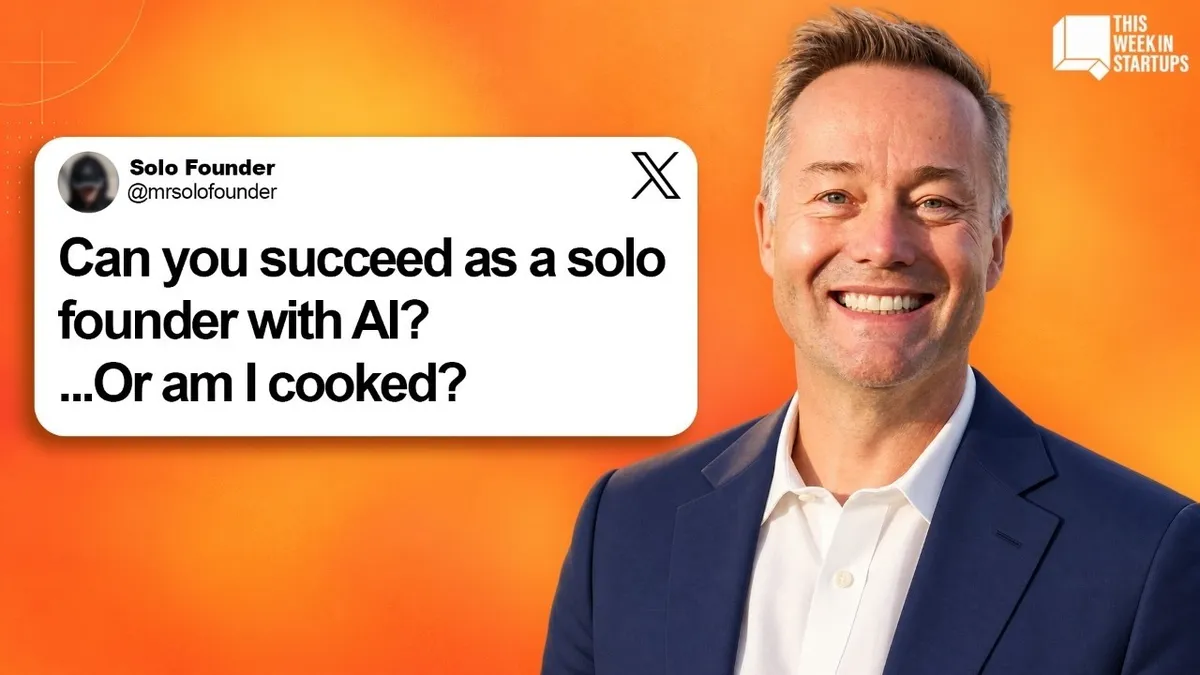
Calacanis said a founder with 30 pilots should drop 27 of them and turn three into paid customers. In his view, pilots, letters of intent and memoranda of understanding let founders avoid asking buyers for real commitment. [1]
He said investors who ask for more traction are often turning a founder down politely while holding other concerns, such as weak differentiation, low margins or a hard path to market. He suggested founders ask investors directly for candid feedback. [1]
The evidence is one investor's opinion, echoed by SaaStr's Jason Lemkin, and neither cites conversion data. The likely result is that B2B and AI founders get judged on paid conversions rather than pilot counts.
Executive brief
On This Week in Startups (Nov 25, 2026), investor Jason Calacanis told JK, founder of Swipe Health, that 30 unpaid pilots in one month count as a warning sign, not traction. His advice was to "fire 27 pilots" and turn three into paying customers (video, 44:07). He called pilots, LOIs and MOUs things founders hide behind. He added that "we want more traction" is often a polite way for a VC to decline (39:22). Enterprise AI has the same gap between pilot and production. MIT NANDA's widely cited (and disputed) 2025 report put deployment of custom enterprise AI tools at about 5% (Computing).
What changed and event timeline
MIT report puts a number on pilot purgatory
"The GenAI Divide" found that only 5% of custom enterprise AI tools reached production. The authors blamed poor integration, not model quality (;).
Google unveils Project Suncatcher
Google Research described solar-powered satellite constellations carrying TPUs and linked by free-space optical links as a way to scale ML compute in orbit ().
Texas Venture Fest
Organizers billed 3,500+ attendees across more than 15 Texas cities. The show's pre-recorded founder questions, including the 30-pilots question, were taped there (;).
Suncatcher prototype launches
A Google–Planet satellite carrying four TPUs launched on a SpaceX rocket. Project lead Travis Beals said he does not expect orbital compute to be cheaper within five years ().
Ask Jason episode airs
Topics included pilots vs. paying customers, moats for AI startups, orbital data centers, Austin vs. the Bay Area, and a pitch from Listabit, a Launch Accelerator company ().
Capabilities and access
This is commentary, not a product release.
Read the full section
This is commentary, not a product release. Practices described on the show:
- Calacanis uses a "Grokbot" to triage Slack, email and DMs into multiple-choice decisions (5:55).
- Co-host Lon Harris passes outputs between ChatGPT, Grok and Claude to cross-check them. He says this about doubled the quality of his Substack posts, a claim he did not measure (13:17).
- Listabit says its AI drafts listing agreements, offers and counteroffers, and that it plans a "realtor AI" trained on transaction data (51:54). It named no model or version.
Technical analysis for researchers and developers
- Data moat claim: Listabit says every deal it handles becomes training data: buyer and seller behavior, property defects, contingencies.
- Moats under vibe coding: Calacanis argued the moat is a team that keeps iterating for years, since "anybody can build anything" (23:42).
- Orbital compute: Google's open problems are thermal rejection, in-orbit repair and optical-link latency (OPB).
Read the full section
- Data moat claim: Listabit says every deal it handles becomes training data: buyer and seller behavior, property defects, contingencies. The goal is agent-to-agent negotiation with no humans involved (58:10). It disclosed no architecture, dataset size or evaluation.
- Moats under vibe coding: Calacanis argued the moat is a team that keeps iterating for years, since "anybody can build anything" (23:42).
- Orbital compute: Google's open problems are thermal rejection, in-orbit repair and optical-link latency (OPB). Its economics assume launch costs fall below $200/kg by the mid-2030s (Google Research).
Claims and evidence
- Unpaid pilots are weak signals. Calacanis's view is opinion (44:20).
- Listabit metrics are self-reported and come from a Launch portfolio company pitching on its investor's show.
- Launch Accelerator terms (Calacanis's own program): a typical $125K first check, 12 weeks, and visits to up to 30 VC offices (47:56).
Read the full section
- Unpaid pilots are weak signals. Calacanis's view is opinion (44:20). SaaStr's Jason Lemkin argues similarly that an unpaid pilot is just an extended demo (SaaStr via echai). Neither cites conversion data.
- Listabit metrics are self-reported and come from a Launch portfolio company pitching on its investor's show. Claims include 550 additional sellers, $500M in listing volume, and a 7.5–10% share of the winning agent's commission (52:51). They lack independent corroboration.
- Launch Accelerator terms (Calacanis's own program): a typical $125K first check, 12 weeks, and visits to up to 30 VC offices (47:56). No funding round, valuation or lead investor was announced.
Context and prior work
The question of pilots vs. paid customers is long-running in SaaS (Traction Thinking). The MIT report's procurement finding is relevant for founders: tools bought from external vendors succeeded about two-thirds of the time, versus about one-third for tools built internally (Computing). Starcloud flew an Nvidia H100 in orbit in November 2025, before Google's prototype (DCD).
Limitations, safety and contested findings
- The 95% figure is disputed. The study measured enterprise buyers, not startups' pilot conversion.
- The auto-captions garble the Austin and Bay Area rent figures (34:20).
- Calacanis said he did not know Swipe Health's product. His critique is generic advice.
Read the full section
- The 95% figure is disputed. Critics point to 52 interviews and 150 survey responses, a narrow definition of success (measurable ROI six months after the pilot), and authors who sell agentic frameworks (BigDATAwire). The study measured enterprise buyers, not startups' pilot conversion.
- The auto-captions garble the Austin and Bay Area rent figures (34:20).
- Calacanis said he did not know Swipe Health's product. His critique is generic advice.
- Several segments are sponsor reads (Deel, Upwork, Northwest Registered Agent).
Business and practitioner implications
- Founders: Report paid conversions, not pilot counts. A small fee filters for real buyers (SaaStr via echai).
- Investors: "More traction" rejections often hide other concerns, such as margins or how hard the product is to sell.
- Enterprise AI buyers: Integration effort, not model choice, decides whether a pilot reaches production.
Read the full section
- Founders: Report paid conversions, not pilot counts. A small fee filters for real buyers (SaaStr via echai).
- Investors: "More traction" rejections often hide other concerns, such as margins or how hard the product is to sell. Calacanis suggests founders ask directly whether they "have an ugly baby" (42:29).
- Enterprise AI buyers: Integration effort, not model choice, decides whether a pilot reaches production.
The source trail.
Sources (10)
30 Pilots, Zero Customers: Why VCs Keep Passing | Ask Jason
Transcript retrieved via youtube_auto_captions; language en. Timestamped text, not direct audiovisual review. Source: https://www.youtube.com/watch?v=ZGpRX5lfFB0. Automatic captions/transcription may contain errors.
www.youtube.com