
ExitsIPOs, listings & liquidity
Anthropic Raises $81 Billion in Record IPO as Nvidia Reinstates Jensen Huang and Applied Compute, Mailchimp and BILL Deals Are Struck
Anthropic's Nasdaq listing raised about $81 billion at a roughly $1.5 trillion valuation, the largest IPO by proceeds. The same week, Nvidia regained about $1 trillion as Huang returned, while deals for Applied Compute, Mailchimp and BILL showed sharply divergent pricing.
From the 20VC podcast episode of November 26, 2026 and cited sources: Anthropic listed on Nasdaq on November 19 under the ticker ANT. [2] [3]
SOURCES[2] Initial public offering of Anthropic – Wikipedia en.wikipedia.org[3] WUNC: Anthropic raises more than $100 billion wunc.org
 AT Pulse research deskPublished · Updated · 5 min read · AI-assisted analysis
AI-assisted, not human-edited. Methodology Corrections Who owns this site
- Original source
- 20VC podcast episode, independent perspective
- Brief by
- AT Pulse research desk AI-assisted; publisher and contact on the desk page
- When
- November 26, 2026 podcast episode published
- Covered
- Nov 27 edition
- Evidence
- 16 sources across 15 sites; no transcript
- 120VC: Jensen Huang's $1TRN Return: What Happens Now |…thetwentyminutevc.libsyn.com
- 2Initial public offering of Anthropic – Wikipediaen.wikipedia.org
- 3WUNC: Anthropic raises more than $100 billionwunc.org
- 4Fortune: $1 trillion price on Jensen Huangfortune.com
- 5Palo Alto Networks press release (SEC)sec.gov
- 6CNBC: Intuit to sell Mailchimpcnbc.com
Reach: not measured yet
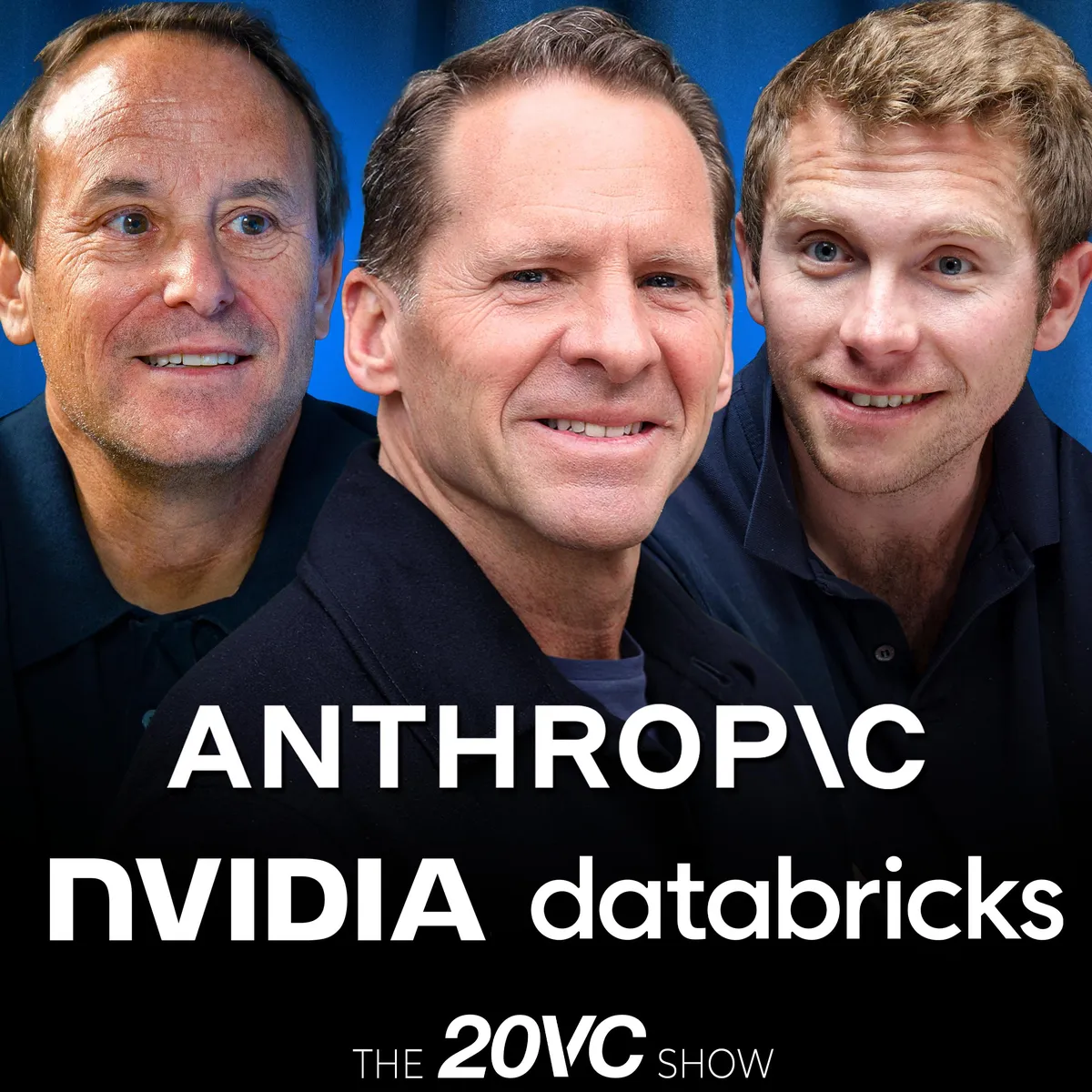
Anthropic listed on Nasdaq on November 19 under the ticker ANT. It sold shares at $83, raising about $81 billion at a valuation near $1.5 trillion, which beats SpaceX's $75 billion June offering as the largest IPO by proceeds. Counts that add founder share sales and $26 billion in private placements put the total above $107 billion. The stock closed its first day up 17%. [2] [3]
Secondary analysis of Anthropic's S-1 shows first-half 2026 revenue of $16.3 billion, up from $1.2 billion a year earlier. The $80.7 billion net loss is mostly a $72.4 billion non-cash fair-value charge. The filing also lists $265.6 billion in purchase commitments, which are mostly long-term and largely non-cancellable. [11]
Nvidia lost more than $1 trillion in market value after Jensen Huang resigned on November 12 following reports about his personal conduct. The stock then rose 31% when the board reinstated him on November 23. Investigations by the SEC, the FBI, California's attorney general and congressional committees remain open. [4]
Three deals show how buyers are pricing software. Palo Alto Networks agreed to buy Applied Compute, which builds tools for post-training and serving open-weight models, in an all-stock deal worth about $4.5 billion, 16 days after a round at a reported $3.25 billion valuation. Intuit agreed to sell Mailchimp to Bending Spoons for $3.68 billion, against the $12 billion it paid in 2021. TPG and Corpay agreed to take BILL private for $6.0 billion. [5] [13] [6] [9]
a listing of this size and a $3.68 billion Mailchimp sale, against a $12 billion purchase price, are documented.
Read the full assessment
Implication: late-stage AI companies now have a public liquidity path, while SaaS businesses without AI exposure may face lower exit valuations.
Executive brief
Anthropic's November 19 Nasdaq debut (ticker ANT) raised about $81 billion at $83 a share, valuing the company at roughly $1.5 trillion. By proceeds, it is the largest IPO on record (Wikipedia). WUNC counts over $107 billion once founder share sales and $26 billion in private placements are added (WUNC). In the same week, Nvidia regained about $1 trillion in market value when the board reinstated Jensen Huang as CEO. Three acquisitions also showed how acquirers are pricing AI exposure: Palo Alto Networks is buying Applied Compute, Intuit is selling Mailchimp at a steep loss, and BILL is going private.
What changed and event timeline
Huang resigns from Nvidia
He left all three of his roles after reports of extramarital relationships, one allegedly with a businesswoman tied to Chinese intelligence. Nvidia lost more than $1 trillion in value while he was gone ().
Palo Alto agrees to buy Applied Compute
The all-stock deal is worth about $4.5 billion. Applied Compute builds a platform for post-training and inference of open-weight models ().
Riemann hypothesis claim
Levent Alpöge, a mathematician at Anthropic, said he and Claude had proved the Riemann hypothesis. He released the proof only as a Lean formalization ().
Huang reinstated; CrowdStrike bids for Zscaler
Nvidia's stock rose 31%. CrowdStrike announced an all-stock deal for Zscaler worth about $43.9 billion (;).
- Late Nov 2026
BILL agrees to go private
TPG and Corpay will pay $63.25 a share in cash, valuing BILL at $6.0 billion ().
Capabilities and access
- Model behind the proof: an unreleased Claude frontier model. The claim covers the classical hypothesis and the generalized version for Dirichlet L-functions (Wikipedia). No public version or access route has been announced.
- Applied Compute: helps enterprises train, adapt and deploy open-weight models across public and sovereign clouds. CEO Yash Patil will become Palo Alto's Co-Chief AI Officer (SEC).
Read the full section
- Model behind the proof: an unreleased Claude frontier model. Alpöge worked with it for about six weeks and produced a Lean proof of roughly 17 million lines. The claim covers the classical hypothesis and the generalized version for Dirichlet L-functions (Wikipedia). No public version or access route has been announced.
- Applied Compute: helps enterprises train, adapt and deploy open-weight models across public and sovereign clouds. CEO Yash Patil will become Palo Alto's Co-Chief AI Officer (SEC).
Technical analysis for researchers and developers
- Lean proof: the formal proof can be checked by machine without a human-readable argument. Independent proof checkers have reportedly validated it (Wikipedia).
- Applied Compute: the deal suggests enterprises want to own post-training and serving of open-weight models. The reviewed sources do not document its architecture.
- Anthropic's compute costs: the S-1 lists $265.6 billion in purchase commitments, mostly long-term and largely non-cancellable (LongYield).
Read the full section
- Lean proof: the formal proof can be checked by machine without a human-readable argument. Alpöge said a full written argument would be extremely long and that he had not yet mastered all of the mathematics in it (Phys.org). Independent proof checkers have reportedly validated it (Wikipedia). That shows the formal steps are valid, but checking whether the formal statement faithfully encodes the hypothesis still needs expert review.
- Applied Compute: the deal suggests enterprises want to own post-training and serving of open-weight models. The reviewed sources do not document its architecture.
- Anthropic's compute costs: the S-1 lists $265.6 billion in purchase commitments, mostly long-term and largely non-cancellable (LongYield).
Claims and evidence
- Anthropic financials (filing-based, via secondary analysis): H1 2026 revenue of $16.3 billion, up from $1.2 billion a year earlier.
- Run-rate revenue (self-reported or press-reported): above $47 billion in May, according to Anthropic.
- Applied Compute: raised $350 million at a $3.25 billion post-money valuation on Nov 2, sixteen days before the deal.
Read the full section
- Anthropic financials (filing-based, via secondary analysis): H1 2026 revenue of $16.3 billion, up from $1.2 billion a year earlier. The $80.7 billion net loss is mostly a $72.4 billion non-cash fair-value charge (LongYield).
- Run-rate revenue (self-reported or press-reported): above $47 billion in May, according to Anthropic. Bloomberg reported more than $65 billion at the end of July (Mateos).
- Applied Compute: raised $350 million at a $3.25 billion post-money valuation on Nov 2, sixteen days before the deal. This figure comes from press reporting (Crypto Briefing), and the reviewed sources do not name the round's lead investors.
- Cognition: reported to be in talks to raise $2 billion or more at a $75 billion valuation. This rests on unnamed sources cited by Bloomberg. Cognition itself said it was on track for $1 billion in annualized revenue (self-reported) (TradingView/Reuters).
- Employee wealth: about 598 non-founder employees hold equity worth $100 million or more, according to estimates rather than filing data. CNBC puts the number at 400 or more (OfficeChai).
Context and prior work
Read the full section
- Previous IPO record: SpaceX raised $75 billion in June 2026 (WUNC).
- AI coding valuations: SpaceX bought Cursor earlier this year for $60 billion. Cognition's reported $75 billion target comes two months after its $48 billion round (TradingView/Reuters).
- Bending Spoons: the buyer of Mailchimp already owns AOL, Evernote, Vimeo and Airtable (CNBC).
Limitations, safety and contested findings
- Riemann proof: it has not been peer-reviewed, and the Clay Mathematics Institute still lists the hypothesis as unsolved.
- Nvidia: investigations by the SEC, the FBI, California's attorney general and congressional committees are still open (Fortune).
- Anthropic proceeds: reported totals differ ($81 billion vs. more than $107 billion) depending on which tranches are counted.
Read the full section
- Riemann proof: it has not been peer-reviewed, and the Clay Mathematics Institute still lists the hypothesis as unsolved. Brian Conrey, a leading Riemann hypothesis specialist, called it monumental but said he had not seen the manuscript. Alpöge acknowledged the timing, one day after the IPO, "could be viewed cynically" (Phys.org).
- Nvidia: investigations by the SEC, the FBI, California's attorney general and congressional committees are still open (Fortune).
- Anthropic proceeds: reported totals differ ($81 billion vs. more than $107 billion) depending on which tranches are counted.
Business and practitioner implications
- Security vendors are moving into the model stack. The Register reports customers expect higher bills (The Register).
- SaaS businesses without an AI story are being repriced.
- Key-person risk at AI suppliers is now quantified. Nvidia's value swung by about $1 trillion over Huang's departure and return.
Read the full section
- Security vendors are moving into the model stack. CrowdStrike expects the combined company to exceed $10 billion in ARR (company projection), yet its shares fell more than 7% after the announcement (TechCrunch). The Register reports customers expect higher bills (The Register).
- SaaS businesses without an AI story are being repriced. Mailchimp sold at less than a third of its 2021 price, and its revenue fell 1% (CNBC).
- Key-person risk at AI suppliers is now quantified. Nvidia's value swung by about $1 trillion over Huang's departure and return.
The source trail.
Sources (16)
20VC: Jensen Huang's $1TRN Return: What Happens Now | Anthropic Goes Public: Largest IPO Of All Time & How It Changes Venture | Applied Compute, Bill.com and Mailchimp Acquisitions Broken Down
Metadata only. Transcript unavailable: Audio transcription returned HTTP 429.
thetwentyminutevc.libsyn.com