
M&AAcquisitions & mergers
CrowdStrike Agrees to Buy Zscaler for $43.9B in All-Stock Deal as Founder Jay Chaudhry Backs It With About 34% Stake
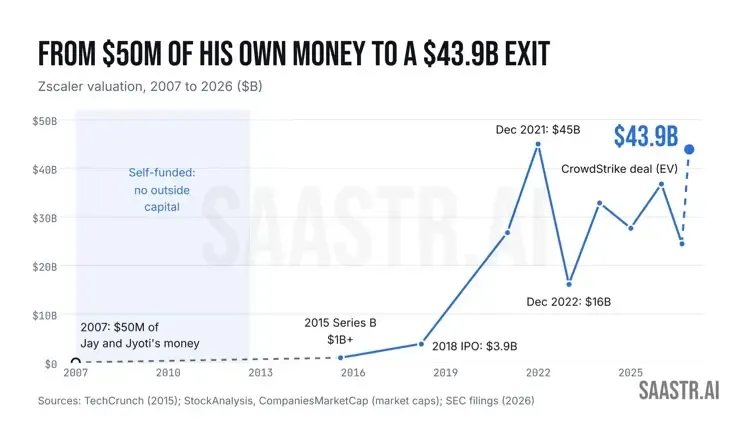
CrowdStrike will acquire Zscaler in an all-stock deal valued at about $43.9B, the largest cybersecurity acquisition on record. Founder Jay Chaudhry, who self-funded the company for years and rejected a roughly $2B pre-IPO offer, holds about 34% with his affiliates.
From the SaaStr article of November 25, 2026 and cited sources: Zscaler shareholders will receive 1.135 CrowdStrike shares per Zscaler share, an implied $260.41 and a 34% premium, leaving them with about 15.9% of the combined company. [2] [9] [11]
SOURCES[2] CrowdStrike/Zscaler press release (SEC Ex. 99.1) sec.gov[9] TechCrunch: CrowdStrike to acquire Zscaler for $44B techcrunch.com[11] ABC News/AP abcnews.com
 AT Pulse research deskPublished · Updated · 5 min read · AI-assisted analysis
AI-assisted, not human-edited. Methodology Corrections Who owns this site
- What happened
- Zscaler shareholders will receive 1.135 CrowdStrike shares per Zscaler share, an implied $260.41 and a 34% premium, leaving them with about 15.9% of the combined company. [2] [9] [11]
- Original source
- SaaStr article, independent perspective
- Brief by
- AT Pulse research desk AI-assisted; publisher and contact on the desk page
- When
- November 25, 2026 article published
- Covered
- Nov 27 edition
- Evidence
- 14 sources across 12 sites
- 1Jay Chaudhry Put $50M of His Own Money Into Zscaler and…saastr.com
- 2CrowdStrike/Zscaler press release (SEC Ex. 99.1)sec.gov
- 3Zscaler 2012 funding press releasezscaler.com
- 4TechCrunch 2012: Zscaler takes first outside investmenttechcrunch.com
- 5Bloomberg: Zscaler rebuffed takeover offers before 2018 IPObloomberg.com
- 6Global Venturing: Zscaler IPO filingglobalventuring.com
Reach: not measured yet
Zscaler shareholders will receive 1.135 CrowdStrike shares per Zscaler share, an implied $260.41 and a 34% premium, leaving them with about 15.9% of the combined company. Both boards approved the deal unanimously. It is expected to close in the second half of CrowdStrike's fiscal 2028. Chaudhry will run the Zscaler business and join CrowdStrike's board. [2] [9] [11]
Chaudhry and his affiliates hold about 34% of Zscaler and have agreed to vote for the deal, a stake far larger than most venture-backed founders keep at exit. The company was funded internally from its 2007 founding until a $38M round in 2012, when it was already cash-flow positive with 2,500 customers. Before its 2018 IPO, Zscaler turned down takeover offers of about $2B, including one from Cisco. [1] [2] [3] [4] [5]
The deal adds Zscaler's zero-trust network platform to CrowdStrike's endpoint security, which Forrester described as filling CrowdStrike's biggest gap. The two companies plan a unified sensor but have published no specification for it. The integration is large: Zscaler runs about 200 service locations handling 750B transactions a day, while CrowdStrike's earlier acquisitions were small. Putting both layers with one vendor also concentrates the damage from any outage. [10] [12]
Sources disagree on why CrowdStrike is buying now. Zscaler's fiscal 2026 revenue rose 25% to $3.353B, but its guidance for fiscal 2027 calls for 16.6%–17.5% growth. Lemkin reads the timing through that slowdown. Forrester argues that CrowdStrike, growing 27%, is buying to consolidate its platform rather than for growth. [1] [7] [8] [12]
The filing confirms an unusually large founder stake, which sources link to self-funding and late outside capital. Combining endpoint and network security could simplify buying but concentrates failure risk.
Read the full assessment
The projected $1B in revenue synergies are company estimates, not independent forecasts.
Executive brief
CrowdStrike announced on November 23, 2026 that it will buy Zscaler in an all-stock deal worth about $43.9B, the largest cybersecurity acquisition on record. The detail founders will notice is that Jay Chaudhry and his affiliates hold about 34% of Zscaler's shares and have agreed to vote for the deal, according to the deal announcement filed with the SEC. Founders of venture-backed companies usually hold far less by the time of an exit. SaaStr's Jason Lemkin, a VC, credits this stake to Chaudhry funding the company himself, raising outside money late and turning down an offer of about $2B before the IPO. Strategically, CrowdStrike's endpoint security gets combined with Zscaler's zero-trust network platform.
What changed and event timeline
Zscaler founded with Chaudhry's own money
Lemkin says Chaudhry put in about $50M. Zscaler's own 2012 release says the company had been "funded internally" up to then but gives no amount.
First outside round
Zscaler raised $38M from an unnamed lead investor plus Lightspeed. At the time it was cash-flow positive, with 2,500 customers and 8M users in 160 countries.
IPO, and buyout offers turned down
Bloomberg reported that while Zscaler was pitching its IPO, Cisco and at least one other buyer offered about $2B. Chaudhry wanted to keep his fifth company. The IPO raised $192M.
Fiscal 2026 ends
Revenue was $3.353B, up 25%, with $779M of free cash flow. Guidance for fiscal 2027 calls for revenue growth of 16.6%–17.5%.
More detail
CrowdStrike agrees to buy Zscaler
Zscaler holders get 1.135 CrowdStrike shares per Zscaler share, an implied $260.41 and a 34% premium. Both boards approved unanimously.
More detail
Capabilities and access
- What CrowdStrike gains: Zscaler's zero-trust network platform, which fills what a Forrester analyst called CrowdStrike's "biggest gap."
- Customers: the companies already share about 2,000 customers. Zscaler brings about 8,000 enterprises (ABC/AP).
- Nothing changes yet: the deal is expected to close in the second half of CrowdStrike's fiscal 2028.
Read the full section
- What CrowdStrike gains: Zscaler's zero-trust network platform, which fills what a Forrester analyst called CrowdStrike's "biggest gap." The companies plan a unified sensor covering both endpoints and network traffic (Cybersecurity Dive).
- Customers: the companies already share about 2,000 customers. Zscaler brings about 8,000 enterprises (ABC/AP).
- Nothing changes yet: the deal is expected to close in the second half of CrowdStrike's fiscal 2028. Chaudhry will run the Zscaler business and join CrowdStrike's board.
Technical analysis for researchers and developers
- Scale of what gets integrated: Forrester notes Zscaler runs about 200 service locations handling 750B transactions a day.
- Architecture risk: putting the endpoint agent and zero-trust access control in one vendor's hands concentrates the impact of any failure.
- Product plan: a "unified sensor" has been announced, but no technical specification, benchmarks or integration roadmap has been published.
Read the full section
- Scale of what gets integrated: Forrester notes Zscaler runs about 200 service locations handling 750B transactions a day. CrowdStrike's past acquisitions were small tuck-ins (Forrester).
- Architecture risk: putting the endpoint agent and zero-trust access control in one vendor's hands concentrates the impact of any failure. Forrester points to CrowdStrike's July 2024 outage as the example.
- Product plan: a "unified sensor" has been announced, but no technical specification, benchmarks or integration roadmap has been published.
Claims and evidence
- Deal terms (price, ratio, 84.1%/15.9% ownership split, 34% premium): company-announced and filed with the SEC (SEC). AP/ABC reports the same figures.
- Chaudhry's stake: the filing shows about 34% under the support agreement. Lemkin's "up to 40%" has no source.
- $50M of his own money: only Lemkin gives this amount. No independent source confirms it.
Read the full section
- Deal terms (price, ratio, 84.1%/15.9% ownership split, 34% premium): company-announced and filed with the SEC (SEC). AP/ABC reports the same figures.
- Chaudhry's stake: the filing shows about 34% under the support agreement. Lemkin's "up to 40%" has no source.
- $50M of his own money: only Lemkin gives this amount. No independent source confirms it.
- "Outside investors held about 16% at IPO": not found in other sources. At IPO, TPG was the only holder above 5%, with 8.7% (Global Venturing).
- ARR: self-reported. Lemkin cites $3.771B; the deal release cites $3.9B for a more recent quarter.
- Market reaction: Lemkin says CrowdStrike fell 9.6% while the Nasdaq rose 6.5%. AP reported CrowdStrike down more than 7% and Zscaler up 20% before the open. No other source confirms Lemkin's figures.
Context and prior work
- Zscaler was Chaudhry's fifth company. Earlier exits included SecureIT, which he sold for about $70M in stock (NBC LA/CNBC).
- Before the IPO, Zscaler raised $148M from Lightspeed, Dell, Google Capital and TPG. TPG Growth led an $82M Series B.
- Chaudhry has previously denied rumors that Broadcom wanted to buy Zscaler (ITPro).
Limitations, safety and contested findings
- Forrester flags uncertain approval in the EU and UK, and concern that CrowdStrike could use Falcon Flex bundling against rivals such as Microsoft Defender.
- Integration risk is high: this is CrowdStrike's largest deal ever, and Zscaler's data centers will need to merge without losing performance.
- Two views on why CrowdStrike is buying: Forrester's van der Hout says CrowdStrike, growing 27%, doesn't need the deal for growth and is buying to consolidate the platform.
Read the full section
- Forrester flags uncertain approval in the EU and UK, and concern that CrowdStrike could use Falcon Flex bundling against rivals such as Microsoft Defender.
- Integration risk is high: this is CrowdStrike's largest deal ever, and Zscaler's data centers will need to merge without losing performance.
- Two views on why CrowdStrike is buying: Forrester's van der Hout says CrowdStrike, growing 27%, doesn't need the deal for growth and is buying to consolidate the platform. Lemkin reads the timing through Zscaler's slowing growth.
- The roughly $1B in revenue synergies and $500M in cost synergies are company projections.
Business and practitioner implications
- Security buyers: Forrester advises asking for proven interoperability and building renewal protections against material service changes before consolidating vendors.
- Founders: the evidence that holds up is a self-funded start, a first round taken while already cash-flow positive, and a large founder stake shown in the filing.
- Investors: Zscaler holders end up owning about 15.9% of the combined company, so their outcome now depends on how CrowdStrike's stock performs.
Read the full section
- Security buyers: Forrester advises asking for proven interoperability and building renewal protections against material service changes before consolidating vendors. Watch whether Red Canary, CrowdStrike's MDR service, keeps supporting competing EDR tools.
- Founders: the evidence that holds up is a self-funded start, a first round taken while already cash-flow positive, and a large founder stake shown in the filing. The exact figures for self-funding and outside ownership at IPO come only from Lemkin.
- Investors: Zscaler holders end up owning about 15.9% of the combined company, so their outcome now depends on how CrowdStrike's stock performs.
The source trail.
Sources (14)
Jay Chaudhry Put $50M of His Own Money Into Zscaler and Took No VC for Five Years. CrowdStrike Just Paid $43.9B.
Article text retrieved; extracted text may omit tables or interactive elements.
saastr.com