
BusinessMarkets, money & strategy
Nothing shows Ear (note) earbuds whose charging case records, transcribes and summarises meetings, launching December 8
Nothing's Ear (note), launching December 8, adds a Record button that captures calls through the earbuds and in-person meetings through the case microphones, then transcribes and summarises them in an app. Price, AI models, data handling and subscription terms remain undisclosed.
From the The Verge · AI article of November 25, 2026 and cited sources: The product has two ways to capture audio. [1] [6]
SOURCES[1] Nothing offers a full look at its AI earbuds and charging… theverge.com[6] The Rundown: Nothing's Ear (note) puts an AI recorder in… therundown.ai
 AT Pulse research deskPublished · Updated · 5 min read · AI-assisted analysis
AI-assisted, not human-edited. Methodology Corrections Who owns this site
- Original source
- The Verge · AI article, independent perspective
- Brief by
- AT Pulse research desk AI-assisted; publisher and contact on the desk page
- When
- November 25, 2026 article published
- Covered
- Nov 27 edition
- Evidence
- 9 sources across 8 sites
- 1Nothing offers a full look at its AI earbuds and charging…theverge.com
- 29to5Google: Nothing plans AI smart glasses9to5google.com
- 39to5Google: Nothing teases screenless AI product9to5google.com
- 4Beebom: Nothing's first AI device teased with record buttongadgets.beebom.com
- 5Tech Times: Nothing Ear (note) unveiledtechtimes.com
- 6The Rundown: Nothing's Ear (note) puts an AI recorder in…therundown.ai
RisingHow it’s measured
YouTube video · 1.4M views · 13.4K likes
Reach blends public engagement (views, likes, comments, shares, stars) from the platforms where the story or its original source lives: YouTube, Hacker News, GitHub, Substack and similar. A video and the article written from its transcript share one score, taken from the video. Platforms with no data are left out rather than counted as zero, and the age of a story never lowers its score.
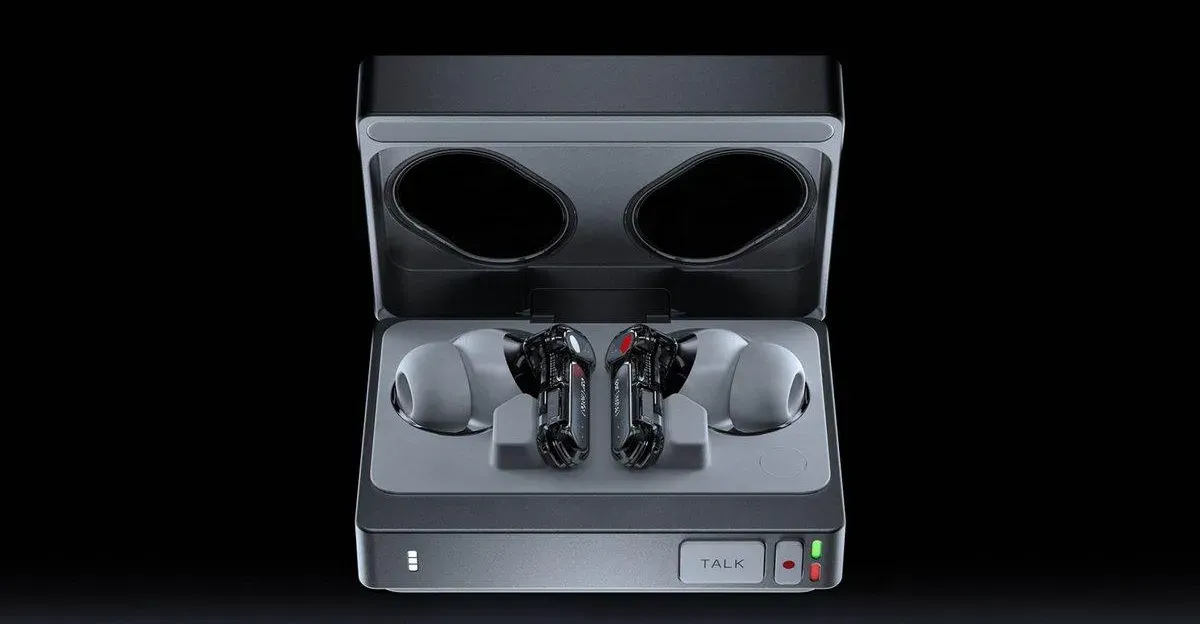
The product has two ways to capture audio. A Record button picks up phone calls through the earbuds and room conversations through microphones in the aluminium case. A Talk button, carried over from the Ear (3), records the wearer's own voice notes. A companion app stores the recordings, transcripts and summaries. [1] [6]
Carl Pei calls the Record button an early step toward a hardware 'context layer' for AI. He argues that models are already capable enough and what they lack is real-world context. Nothing has confirmed there will be a subscription but has not said what it costs. [1] [4] [5]
Key technical details have not been published. Nothing has not named the speech or language models, said whether processing happens on the device, the phone or in the cloud, or released accuracy benchmarks or an API. Bloomberg's reporting mentions support for AI agents, but that does not come from a Nothing spec sheet. [5] [8]
So far the evidence covers announced features and design, not how well the product works. In practice, recording meetings moves from a phone app into hardware people carry every day.
Read the full assessment
Enterprises will need to know where audio is processed, how long it is kept and how consent is shown before allowing it.
Executive brief
Nothing is putting a meeting recorder in an earbud charging case. The Ear (note) case can record, transcribe and summarise conversations in the room, and the earbuds record phone calls. CEO Carl Pei calls this a "first step toward a hardware context layer for AI" (The Verge). The product goes on sale December 8, 2026. Nothing has not announced the price, the AI models it uses, how data is handled or how the subscription works. No one has tested it independently yet. It enters a busy field that includes Plaud's earbuds and Amazon's Bee.
What changed and event timeline
Bloomberg reports AI earbuds plan
Mark Gurman reported that Nothing was building camera-equipped AI glasses for 2027, and that new earbuds and phones would come first ().
Pei teases a screenless device
Pei said Nothing's first "AI-native" product would ship the following month. He said it has "no new screen" and "couldn't have been an app" ().
Record button revealed
A teaser showed a metal body, green and red status LEDs and a large record button. Coverage linked it to Pei's essay on the "context gap" ().
Name and date confirmed
Nothing announced the Ear (note) and its December 8 launch. Pei said there will be a subscription but gave no price ().
Full design shown
Nothing showed the buds and case in detail. The case has Talk and Record buttons, and Pei described the Record button as a step toward a "hardware context layer" ().
Capabilities and access
- Product: Nothing Ear (note). No AI model or version has been named (Tech Times).
- Talk button: records your own voice notes, as on the Ear (3).
- Record button: records calls through the buds and in-person meetings through the case microphones (The Verge).
Read the full section
- Product: Nothing Ear (note). No AI model or version has been named (Tech Times).
- Talk button: records your own voice notes, as on the Ear (3).
- Record button: records calls through the buds and in-person meetings through the case microphones (The Verge).
- App: a companion app holds recordings, transcripts and summaries. Per Bloomberg, it also supports "various AI agents" and a basic voice-control system built by Nothing.
- Hardware: aluminium case and Hi-Res Audio support (The Rundown).
- Not yet announced: price, subscription cost and which phones it works with (SoundGuys).
Technical analysis for researchers and developers
Nothing has published no architecture details. Two design points are documented: The planned glasses are reported to rely on the phone and the cloud for AI processing (9to5Google). Nothing has not said whether the Ear (note) works the same way.
Read the full section
Nothing has published no architecture details. It has not said whether transcription and summarisation run on the device, on the phone or in the cloud, or which speech recognition or language models it uses. There are no benchmarks for word error rate, speaker separation or summary quality, and no API or agent-integration specification.
Two design points are documented:
- Two capture paths. Calls come through the buds and room audio through the case. That puts the case microphones in charge of far-field pickup.
- Existing software base. Nothing already turns voice notes into summaries and to-dos on its phones through Essential Space (Beebom). The Ear (note) app probably builds on that pipeline, but this is an inference, not a confirmed fact.
The planned glasses are reported to rely on the phone and the cloud for AI processing (9to5Google). Nothing has not said whether the Ear (note) works the same way.
Claims and evidence
No independent tests, reviews or evaluations exist yet.
Read the full section
- Recording, transcription and summaries: company announcement, reported by The Verge.
- "Best in-ear audio to date": Nothing's own marketing claim. It has not been measured (The Verge).
- Agent support and app features: these come from Bloomberg's reporting via Gurman, not from a Nothing spec sheet (Android Central).
- Subscription: Pei has said there will be one, with no figures (Tech Times).
No independent tests, reviews or evaluations exist yet.
Context and prior work
- Ear (3): introduced the Talk button and case microphones. Transcription happened automatically only on Nothing phones (SoundGuys).
- Plaud One: $249 earbuds with an eSIM case that picks up voices up to 5 m away.
- Others: Viaim earbuds at about $200 (SoundGuys), Amazon Bee, Plaud Note Pro, and Apple Watch Series 12 recaps (The Verge).
Read the full section
- Ear (3): introduced the Talk button and case microphones. Transcription happened automatically only on Nothing phones (SoundGuys).
- Plaud One: $249 earbuds with an eSIM case that picks up voices up to 5 m away. They connect to Gmail, Notion and Slack and include 300 free transcription minutes a month (TechCrunch).
- Others: Viaim earbuds at about $200 (SoundGuys), Amazon Bee, Plaud Note Pro, and Apple Watch Series 12 recaps (The Verge).
Limitations, safety and contested findings
- Consent: Android Central notes concerns about consent and how people are told they are being recorded.
- Track record: on the Ear (3), Super Mic recordings sounded muffled and robotic, app support was patchy and the recording indicator was hard to see (SoundGuys).
- Privacy: Nothing has not addressed privacy or data handling (Tech Times).
Read the full section
- Consent: Android Central notes concerns about consent and how people are told they are being recorded. Nothing reportedly has safeguards but has not described them (Android Central).
- Track record: on the Ear (3), Super Mic recordings sounded muffled and robotic, app support was patchy and the recording indicator was hard to see (SoundGuys). Whether the Ear (note) fixes these problems is unproven.
- Privacy: Nothing has not addressed privacy or data handling (Tech Times).
Business and practitioner implications
- Strategy: Pei argues that AI models are smart enough already and what they lack is real-world context (Beebom).
- Revenue: a subscription would move Nothing toward recurring income. Most competitors already charge for transcription and storage (Tech Times).
- For enterprises: wait for documentation on where data is processed, how long it is kept and how consent is indicated before allowing these devices in meetings.
Read the full section
- Strategy: Pei argues that AI models are smart enough already and what they lack is real-world context (Beebom). Nothing is betting that capturing that context in hardware is where it can stand out.
- Revenue: a subscription would move Nothing toward recurring income. Most competitors already charge for transcription and storage (Tech Times).
- For enterprises: wait for documentation on where data is processed, how long it is kept and how consent is indicated before allowing these devices in meetings.
- For developers: there is no public API yet. Plaud's integrations with Gmail, Notion and Slack set the bar Nothing will be compared against.
The source trail.
Sources (9)
Nothing offers a full look at its AI earbuds and charging case
Article text retrieved; extracted text may omit tables or interactive elements. A linked video was found but its transcript could not be retrieved (lpEWy4Ipy44: captions unavailable (TranscriptsDisabled); lpEWy4Ipy44: audio transcription failed (Audio transcription returned HTTP 429)); do not claim to have watched it.
theverge.com