
Personal investingPortfolios, retirement & planning
Elm Wealth Puts Risk-Adjusted Value of Capital-Gains Tax Deferral at About 0.13% a Year
Elm Wealth's Victor Haghani and James White estimate that deferring capital-gains tax is worth 0.66% a year before risk adjustments and about 0.13% after. They argue that buy-and-hold ETFs capture most of that value without direct-indexing or long/short fees.
From the Elm Wealth article of November 24, 2026 and cited sources: The base case assumes a 6% return, a 24% tax rate and a 30-year hold. [1]
SOURCES[1] Elm Wealth: Tax Deferral: Don't Pay Now to Pay Later… elmwealth.com
 AT Pulse research deskPublished · Updated · 5 min read · AI-assisted analysis
AI-assisted, not human-edited. Methodology Corrections Who owns this site
- What happened
- The base case assumes a 6% return, a 24% tax rate and a 30-year hold. [1]
- Original source
- Elm Wealth article, independent perspective
- Brief by
- AT Pulse research desk AI-assisted; publisher and contact on the desk page
- When
- November 24, 2026 article published
- Covered
- Nov 25 edition
- Evidence
- 12 sources across 7 sites
- 1Elm Wealth: Tax Deferral: Don't Pay Now to Pay Later…elmwealth.com
- 2Chaudhuri, Burnham, Lo: An Empirical Evaluation of…ideas.repec.org
- 3MIT DSpace copydspace.mit.edu
- 4ITEP: Wyden's Billionaires Income Taxitep.org
- 5Penn Wharton Budget Model: Billionaires Income Taxbudgetmodel.wharton.upenn.edu
- 6Elm Wealth: Direct Indexed Tax-Loss Harvesting: Is the…elmwealth.com
Reach: not measured yet

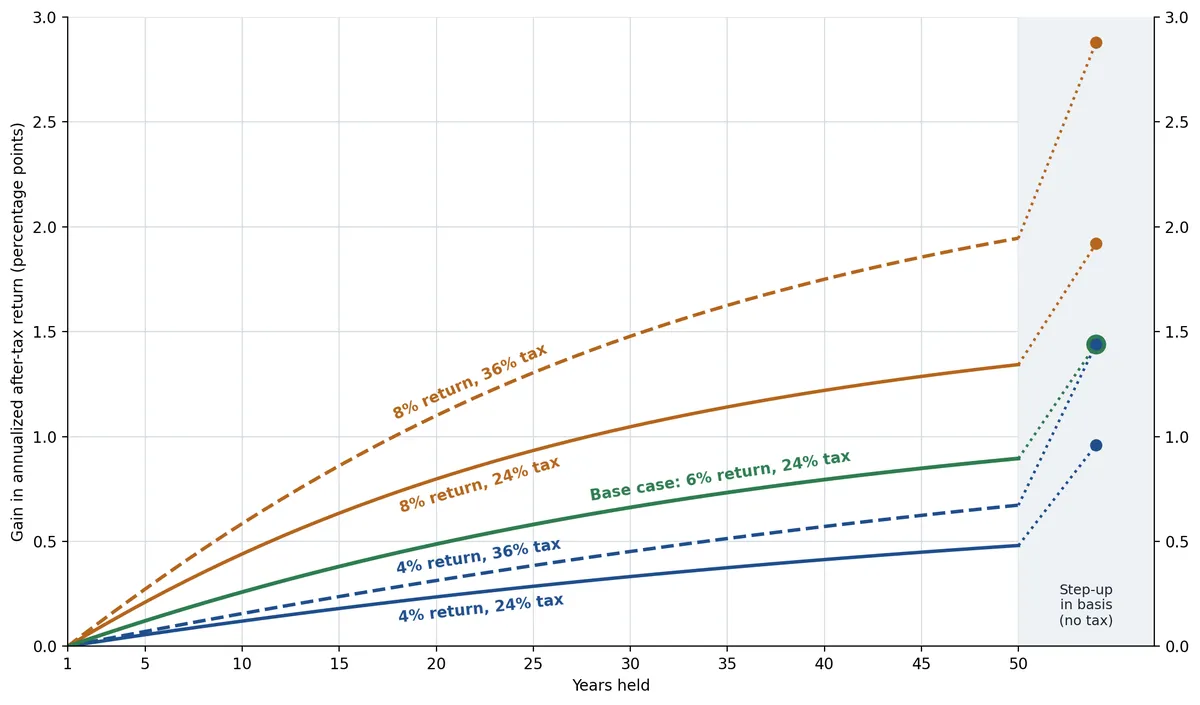
The base case assumes a 6% return, a 24% tax rate and a 30-year hold. Under those assumptions, deferral is worth 0.66% a year. The theoretical ceiling is 1.44%, which is the return multiplied by the tax rate, and 30 years captures less than half of it. After adjusting for market risk, tracking error and the risk that tax rates change, about 0.13% a year remains. These are Elm's own modeling results, and Elm offers ETF-based tax-loss harvesting itself. [1]
Fees weigh heavily because investment fees are generally no longer tax-deductible. On a zero-basis position taxed at 30%, a 0.5% fee equals about 0.71% of after-tax wealth. For concentrated stock positions, the authors estimate that the risk adjustment from roughly 12% tracking error cancels out most of the value of deferral. Elm's earlier work found that long/short fees and financing costs eat half to three-quarters of the tax avoided over 10 years. [1] [7]
AQR, which sells tax-aware long/short strategies, argues the opposite. It says experienced managers can add pre-tax alpha and get financing at about 80 basis points. It also says 130/30 and 150/50 structures keep producing harvestable losses after long-only direct indexing's losses taper off. Both firms agree that without pre-tax alpha, the long/short approach does not work. [8] [11] [12]
The authors acknowledge that deferral can be worth much more in some cases: a planned move to a lower-tax state, a near-term step-up in basis at death, or falling tax rates. One of their examples puts the value at 3.1% a year over five years. [1]
Elm's arithmetic can be reproduced, but its key inputs are assumptions. Academic estimates of 0.82–1.08% a year measure broader tax-loss harvesting, not deferral alone.
Read the full assessment
Implication: paid tax-management strategies need pre-tax alpha or a specific client situation to justify their fees.
Executive brief
Elm Wealth's Victor Haghani and James White argue that most of the value of deferring capital-gains tax comes free, just from buying and holding broad ETFs. Their base case is a 6% return, a 24% tax rate and a 30-year hold. On those numbers, deferral is worth 0.66% a year before risk, and only about 0.13% after adjusting for market risk, tracking error and the chance that tax rates change. That is before any fee. Their conclusion is that paying a direct-indexing or long/short manager for extra deferral rarely makes sense. AQR, which sells tax-aware long/short strategies, publishes research arguing the other side. No independent coverage of the new article was found.
What changed and event timeline
Elm questions direct indexing
Elm argued that harvesting losses with a set of sector and regional ETFs finds about as many losses as direct indexing run under typical tracking-error limits ().
Long/short critique
Elm estimated that a 0.7% fee plus 0.6% financing costs would eat half to three-quarters of the tax avoided over 10 years, and would exceed the tax saved after about 20 years ().
AQR rebuttal
AQR responded to five common criticisms of tax-aware long/short strategies. It agreed that without pre-tax alpha the approach is a bad idea ().
Risk-adjusted deferral value
Elm's new article puts a price on deferral after adjusting for risk and concludes that extra deferral is worth little ().
Capabilities and access
The article compares four ways of getting deferral (Elm Wealth):
Read the full section
The article compares four ways of getting deferral (Elm Wealth):
- Buy-and-hold ETFs: deferral at no extra cost.
- ETF-based tax-loss harvesting: when an ETF falls below cost, sell it and buy a similar but not "substantially identical" ETF that tracks a different index. The authors say Schwab, Betterment, Wealthfront and Elm offer this at no extra fee.
- Direct indexing with tax-loss harvesting: holding the index's individual stocks, which costs fees and adds tracking error.
- Leveraged long/short and exchange funds: usually sold to people with concentrated, low-basis stock positions.
Technical analysis for researchers and developers
- Upper bound: deferral can never be worth more than return × tax rate per year (1.44% at 6% and 24%).
- Worked example: $100 grows to $461 with tax deferred to the end, versus $381 if taxed every year.
- Risk adjustments:
Read the full section
- Upper bound: deferral can never be worth more than return × tax rate per year (1.44% at 6% and 24%). Thirty years captures less than half of that, and reaching 90% takes about 200 years.
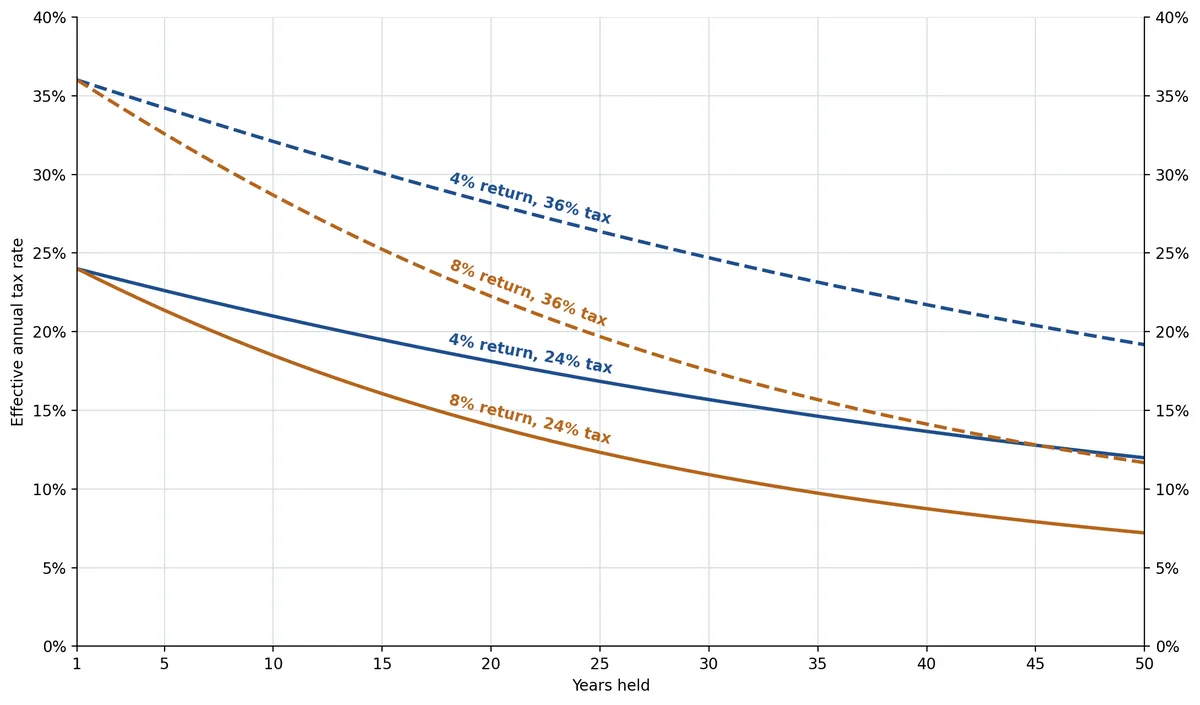
- Worked example: $100 grows to $461 with tax deferred to the end, versus $381 if taxed every year. Recomputing confirms 5.22% vs 4.56% after tax, and that 30-year deferral cuts the effective tax rate from 24% to 13%.
- Risk adjustments:
- Using a 4.5% risk-adjusted return instead of 6% knocks off 0.25%.
- Tracking error knocks off 0.15%: total risk becomes √(16²+5²) ≈ 16.8%, scaled against a 3% excess return.
- Tax-rate risk, set by the authors' judgment at half the market adjustment, knocks off 0.125%.
- Concentrated positions: assuming 12% tracking error gives 20% total risk and about 1% a year of risk adjustment. That roughly cancels the value of deferral at zero basis over 30 years.
Claims and evidence
- Most material claims are Elm's own modeling.
- Academic estimates are larger. Chaudhuri et al. found 0.82–1.08% a year of harvesting value from historical data.
- Index-provider research is mixed. MSCI found ETF portfolios realized no gains, while direct indexing realized gains of 0.15–4.7% of initial value a year.
Read the full section
- Most material claims are Elm's own modeling. The 0.13% net figure and the "nothing left over" result for concentrated positions come from Elm, an adviser that offers ETF-based harvesting itself. The arithmetic can be reproduced, but the 4.5% risk-adjusted return and the tax-risk haircut are the authors' assumptions.
- Academic estimates are larger. Chaudhuri et al. found 0.82–1.08% a year of harvesting value from historical data. That figure measures something broader than Elm's deferral-only number (IDEAS).
- Index-provider research is mixed. MSCI found ETF portfolios realized no gains, while direct indexing realized gains of 0.15–4.7% of initial value a year. ETFs harvested no losses because of wash-sale constraints, which differs from Elm's swap-to-a-different-index approach (MSCI).
Context and prior work
The article builds on Elm's earlier work: the direct-indexing comparison (2024), the long/short critique (2025), and an April 2026 follow-up on long/short (Elm Wealth). It argues that 130/30 and 150/50 structures keep producing losses after long-only direct indexing's losses taper off (AQR). It also argues that pre-tax alpha increases the tax benefits (AQR).
Read the full section
The article builds on Elm's earlier work: the direct-indexing comparison (2024), the long/short critique (2025), and an April 2026 follow-up on long/short (Elm Wealth). AQR's research takes the opposite view. It argues that 130/30 and 150/50 structures keep producing losses after long-only direct indexing's losses taper off (AQR). It also argues that pre-tax alpha increases the tax benefits (AQR).
Limitations, safety and contested findings
- Excluded from the model: dividends, short-term gains, "conversion" of short-term gains into long-term ones, trusts, and plans to give appreciated assets to charity.
- Where deferral is worth more: the authors acknowledge that a planned move to a lower-tax state, a near-term step-up in basis at death, or falling tax rates can make deferral much more valuable.
- The main dispute is pre-tax alpha. Elm assumes long/short books don't beat the market. Both sides agree that without alpha the strategy fails (AQR).
Read the full section
- Excluded from the model: dividends, short-term gains, "conversion" of short-term gains into long-term ones, trusts, and plans to give appreciated assets to charity.
- Where deferral is worth more: the authors acknowledge that a planned move to a lower-tax state, a near-term step-up in basis at death, or falling tax rates can make deferral much more valuable. One example is 3.1% a year over five years.
- The main dispute is pre-tax alpha. Elm assumes long/short books don't beat the market. AQR argues experienced managers can add alpha and negotiate financing at about 80 basis points for a 200/100 portfolio. Both sides agree that without alpha the strategy fails (AQR).
Business and practitioner implications
This summarizes published research and is not investment or tax advice.
Read the full section
- Fee comparisons: investment fees are generally no longer deductible, so a 0.5% fee comes straight off after-tax return. On a zero-basis position taxed at 30%, that 0.5% equals about 0.71% of after-tax wealth (Elm Wealth).
- Product teams: the case for direct indexing or long/short becomes a debate about pre-tax alpha and specific client situations (relocation, step-up, falling rates), not tax mechanics alone.
- Policy risk: proposals to tax unrealized gains, like Wyden's 2021 bill, are a recurring risk to the value of deferral (Penn Wharton).
This summarizes published research and is not investment or tax advice.