
FundingRounds, leads & terms
Boom Supersonic fires its first Sprint Core engine core and plans to sell it as an AI data-center turbine before using it to power its Overture jet
Boom Supersonic's Sprint Core first ran on November 21, 2026. It is the shared core for Boom's 42 MW Superpower data-center turbine and its Symphony airliner engine. Boom plans to pay for its Overture supersonic jet with turbine sales.
From the Y Combinator video of November 24, 2026 and cited sources: Sprint Core started on its second attempt at Colorado Air and Space Port and reached 6,500 rpm, with nearly 2,000 sensors recording data. [2] [7] [8]
SOURCES[2] Aviation Week: Boom Fires Up First Superpower Engine Core… aviationweek.com[7] The Flight Brief: Boom Lit a Superpower Core. It Was a… theflightbrief.com[8] New Atlas: Concorde's heir fires up its engine core newatlas.com
 AT Pulse research deskPublished · Updated · 5 min read · AI-assisted analysis
AI-assisted, not human-edited. Methodology Corrections Who owns this site
- What happened
- Sprint Core started on its second attempt at Colorado Air and Space Port and reached 6,500 rpm, with nearly 2,000 sensors recording data. [2] [7] [8]
- Original source
- Y Combinator video, independent perspective
- Brief by
- AT Pulse research desk AI-assisted; publisher and contact on the desk page
- When
- November 24, 2026 video published
- Covered
- Nov 25 edition
- Evidence
- 9 sources across 9 sites; transcript sourced
- 1How To Build A Jet Engine From Scratchyoutube.com
- 2Aviation Week: Boom Fires Up First Superpower Engine Core…aviationweek.com
- 3TechRepublic: Crusoe Walks Away From $1.25B Boom Turbine…techrepublic.com
- 4Wikipedia: Boom XB-1en.wikipedia.org
- 5Boom Supersonic press release (Dec 9, 2025)boomsupersonic.com
- 6TechCrunch: Boom Supersonic raises $300Mtechcrunch.com
RisingHow it’s measured
YouTube video · 71.3K views · 1.3K likes
Reach blends public engagement (views, likes, comments, shares, stars) from the platforms where the story or its original source lives: YouTube, Hacker News, GitHub, Substack and similar. A video and the article written from its transcript share one score, taken from the video. Platforms with no data are left out rather than counted as zero, and the age of a story never lowers its score.
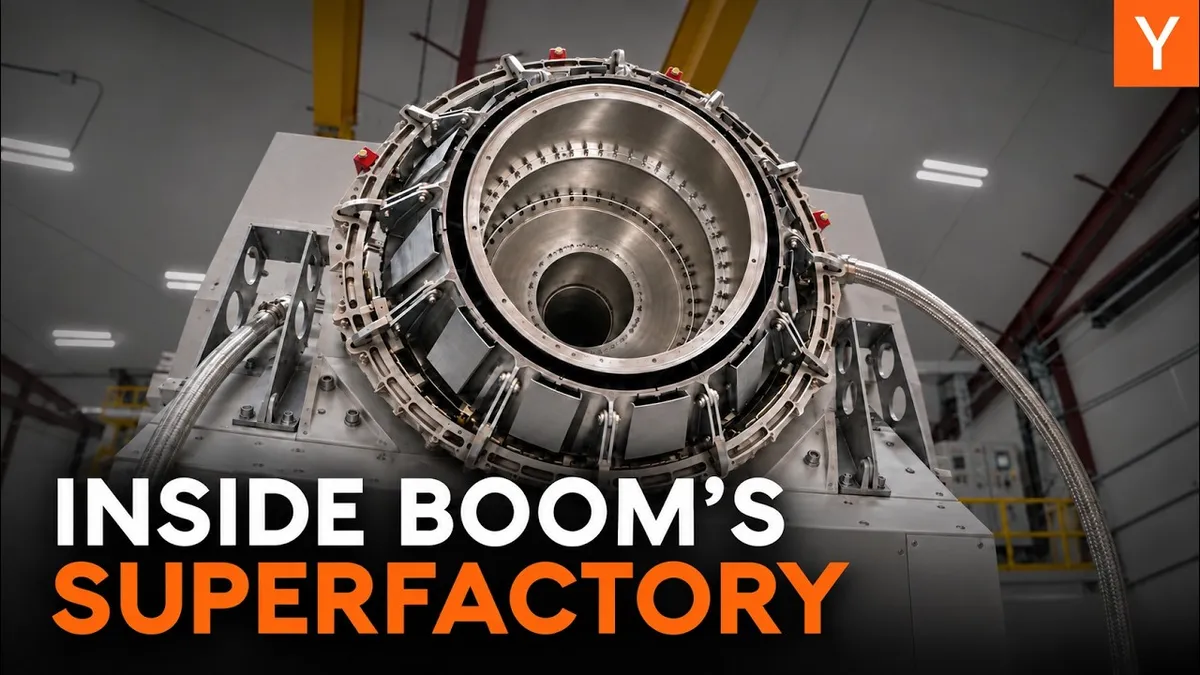
Sprint Core started on its second attempt at Colorado Air and Space Port and reached 6,500 rpm, with nearly 2,000 sensors recording data. The run was kept short on purpose. The core has a six-stage high-pressure compressor driving a single-stage turbine. Superpower adds a low-pressure spool and a free power turbine. Boom says more than three-quarters of the parts are shared with Symphony. [2] [7] [8]
Boom will sell gas turbines first and use the money to build the jet. CEO Blake Scholl's projections are his own: he says Boom becomes cash-flow positive when it ships its first turbine, and that making two turbines a month would be a multibillion-dollar business. Turbine shipments are targeted for mid-2027. The plan follows a $300M Series B led by Darsana Capital Partners. [1] [5] [6]
The video describes demand as plentiful and cites one prospect that wants 1.6 GW every 30 days. It does not mention that Crusoe, the launch customer, cancelled its $1.25B, 29-turbine order in September 2026. Crusoe also has a separate turbine deal with GE Vernova. [1] [3]
Boom is responding to a supply bottleneck in hot-section turbine blades by making most parts itself. It is printing blades in-house, building an all-digital single-crystal blade foundry, and using an internal real-time blade-design tool. Boom expects to make about 85% of each Superpower unit, by weight, in its own factory. [1] [7]
The evidence so far: the core has run once, and the launch customer has left. The implication is that Overture's funding now depends on Boom proving Superpower in the field and signing new buyers ahead of mid-2027 deliveries.
Executive brief
Boom Supersonic's first full engine core lit on November 21, 2026, but it will first be sold to power data centers, not aircraft. The core, called "Sprint Core," is shared between Superpower, a 42 MW natural-gas turbine for AI data centers, and Symphony, the planned engine for the Overture airliner. It lit on the second attempt and reached 6,500 rpm (Aviation Week). The YouTube video tells an upbeat demand story. It leaves out one fact: Crusoe, the launch customer, cancelled its $1.25B, 29-turbine order in September 2026 (TechRepublic).
What changed and event timeline
XB-1 goes supersonic
Boom's demonstrator jet broke the sound barrier three times over Mojave, with a top speed of Mach 1.1. This is the credibility base for the company's later engine pivot ().
Superpower launch and $300M Series B
Boom announced a 42 MW turbine, Crusoe as launch customer (29 units, 1.21 GW) and a company-claimed backlog above $1.25B. Darsana Capital Partners led the round (;).
Crusoe walks away
Crusoe ended the 29-turbine deal. Scholl told TechCrunch that turbines are no longer part of Crusoe's near-term primary power mix. Crusoe separately holds a GE Vernova deal for 29 LM2500XPRESS units ().
Sprint Core first light
The core lit on its second try at Colorado Air and Space Port and spun to 6,500 rpm with nearly 2,000 sensors. The run was deliberately short (;).
Factory video published
CEO Blake Scholl presents the turbine-first strategy and says turbine shipments will start in mid-2027 ().
Capabilities and access
- Superpower (company specs): 42 MW ISO rating, full output above 110°F, no water needed, runs on natural gas with diesel backup, housed in a unit about the size of a shipping container (Boom).
- Symphony: about 40,000 lbf thrust for Overture at Mach 1.7. Boom says more than 75% of parts are shared with Superpower (New Atlas).
- Availability: nothing is commercially available yet. Deliveries are targeted for mid-2027, with about 250 MW to sites other than Crusoe's planned next year (TechRepublic).
Read the full section
- Superpower (company specs): 42 MW ISO rating, full output above 110°F, no water needed, runs on natural gas with diesel backup, housed in a unit about the size of a shipping container (Boom).
- Symphony: about 40,000 lbf thrust for Overture at Mach 1.7. Boom says more than 75% of parts are shared with Superpower (New Atlas).
- Availability: nothing is commercially available yet. Deliveries are targeted for mid-2027, with about 250 MW to sites other than Crusoe's planned next year (TechRepublic).
Technical analysis for researchers and developers
- Core layout: a six-stage high-pressure compressor driving a single-stage high-pressure turbine.
- Design tooling (Scholl's account): an in-house CAD kernel and GPU cluster run blade aerodynamics simulation in real time in a tool called "Bladerunner."
- Evaluation: no performance data, pressure ratios or efficiency figures have been published.
Read the full section
- Core layout: a six-stage high-pressure compressor driving a single-stage high-pressure turbine. Superpower adds a low-pressure spool and a free power turbine in a twin-shaft setup (The Flight Brief).
- Design tooling (Scholl's account): an in-house CAD kernel and GPU cluster run blade aerodynamics simulation in real time in a tool called "Bladerunner." Boom is also building an all-digital single-crystal blade foundry (video, 12:55; video, 12:01).
- Evaluation: no performance data, pressure ratios or efficiency figures have been published.
Claims and evidence
- Funding: $300M Series B led by Darsana. No filing has confirmed them, and valuation was not disclosed.
- Cash flow and profit: the claims that Boom turns cash-flow positive with the first shipment and that two turbines a month make a multibillion-dollar business are Scholl's own projections (video, 4:56).
- Demand: Scholl says Sam Altman answered his text with "as many as you can make" (video, 4:08).
Read the full section
- Funding: $300M Series B led by Darsana. The amount and lead were announced by Boom and independently reported by TechCrunch. No filing has confirmed them, and valuation was not disclosed.
- Cash flow and profit: the claims that Boom turns cash-flow positive with the first shipment and that two turbines a month make a multibillion-dollar business are Scholl's own projections (video, 4:56).
- Demand: Scholl says Sam Altman answered his text with "as many as you can make" (video, 4:08). Altman is OpenAI's CEO and, per Scholl, a day-one Boom investor. Y Combinator, another investor, promoted the test on X.
- Pricing: TechCrunch put Boom's price at about $1,033/kW, which it called high for aeroderivative turbines (TechCrunch).
Context and prior work
- Rolls-Royce exit: Rolls-Royce left the Overture engine program in September 2022. Boom announced its own engine program that December (video, 2:34).
- Supply shortage: Scholl says GE gas turbines are sold out through 2030 and that hot-section blades are the main bottleneck.
- Market: jet-engine-derived (aeroderivative) gas turbines for data centers are an established market. GE Vernova's LM2500XPRESS is a direct competitor (TechRepublic).
Read the full section
- Rolls-Royce exit: Rolls-Royce left the Overture engine program in September 2022. Boom announced its own engine program that December (video, 2:34).
- Supply shortage: Scholl says GE gas turbines are sold out through 2030 and that hot-section blades are the main bottleneck. One blade quote was 18 months and $1.3M per engine set, versus a $1.1M printer that arrives in two weeks (video, 7:39; video, 7:56).
- Market: jet-engine-derived (aeroderivative) gas turbines for data centers are an established market. GE Vernova's LM2500XPRESS is a direct competitor (TechRepublic).
Limitations, safety and contested findings
- Short run: one short core run proves the core starts. It does not show endurance, a full performance map or production-ready hardware (The Flight Brief).
- Demand claims vs the cancellation: the video says there is "firm customer demand" and cites one prospect seeking 1.6 GW every 30 days (video, 6:14).
- Overture timing: the 2029 Overture target looks shaky. United's CEO said it "won't happen in '29" (New Atlas).
Read the full section
- Short run: one short core run proves the core starts. It does not show endurance, a full performance map or production-ready hardware (The Flight Brief).
- Demand claims vs the cancellation: the video says there is "firm customer demand" and cites one prospect seeking 1.6 GW every 30 days (video, 6:14). It does not mention that Crusoe cancelled.
- Overture timing: the 2029 Overture target looks shaky. United's CEO said it "won't happen in '29" (New Atlas).
- Unproven reliability argument: Scholl argues that turbine hours in the field will make Symphony "the most tested new jet engine ever." That is untested (video, 5:12).
- Noise: residents near the Abilene site have raised noise concerns (TechCrunch).
Business and practitioner implications
- For data-center power buyers: treat Superpower as a 2027–28 option that may arrive late, not as committed capacity.
- What to watch:
- integrated-engine tests targeted for around mid-2027 (Aviation Week);
Read the full section
- For data-center power buyers: treat Superpower as a 2027–28 option that may arrive late, not as committed capacity. Crusoe's switch shows buyers hedging across GE Vernova, Bergen Engines, batteries and grid power (TechRepublic).
- What to watch:
- integrated-engine tests targeted for around mid-2027 (Aviation Week);
- production of 1 GW a year in 2028 and 2 GW in 2029 (The Flight Brief);
- a new named customer to replace Crusoe.
- For investors: the plan to fund the airliner from turbine sales depends entirely on turbine deliveries, so slips in those dates directly affect the plane.
The source trail.
Sources (9)
How To Build A Jet Engine From Scratch
Transcript retrieved via youtube_auto_captions; language en. Timestamped text, not direct audiovisual review. Source: https://www.youtube.com/watch?v=-ieJwYq4j-o. Automatic captions/transcription may contain errors.
www.youtube.com