
FundingRounds, leads & terms
Artemis Security CTO to explain how agent-run engineering produced 31,000+ merged pull requests in a quarter
Artemis Security is an AI security startup about a year old and backed by Theory Ventures. It credits more than 31,000 merged pull requests in one quarter to engineers who each run four to eight coding agents, with evaluation pipelines protecting quality.
From the Tomasz Tunguz article of November 24, 2026 and cited sources: CTO Dan Shiebler says each Artemis engineer runs four to eight Claude Code instances in parallel. [1] [5]
SOURCES[1] Tomasz Tunguz, "Engineering at Machine Speed" tomtunguz.com[5] First Round Review, "Inside Artemis' AI vs AI war" review.firstround.com
 AT Pulse research deskPublished · Updated · 4 min read · AI-assisted analysis
AI-assisted, not human-edited. Methodology Corrections Who owns this site
- What happened
- CTO Dan Shiebler says each Artemis engineer runs four to eight Claude Code instances in parallel. [1] [5]
- Original source
- Tomasz Tunguz article, independent perspective
- Brief by
- AT Pulse research desk AI-assisted; publisher and contact on the desk page
- When
- November 24, 2026 article published
- Covered
- Nov 25 edition
- Evidence
- 9 sources across 8 sites
- 1Tomasz Tunguz, "Engineering at Machine Speed"tomtunguz.com
- 2SecurityBrief, Artemis names Arun Singhsecuritybrief.news
- 3Fortune, Artemis raises $70Mfortune.com
- 4Globes, Artemis Security raises $70men.globes.co.il
- 5First Round Review, "Inside Artemis' AI vs AI war"review.firstround.com
- 6SecurityWeek, Artemis emerges from stealthsecurityweek.com
Reach: not measured yet
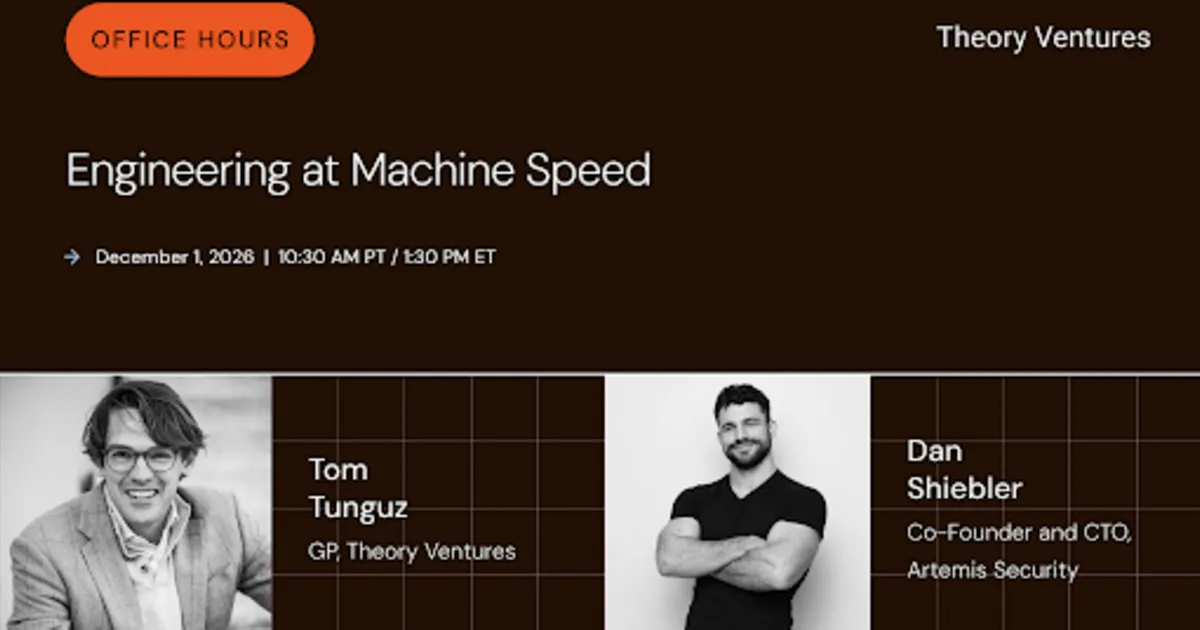
CTO Dan Shiebler says each Artemis engineer runs four to eight Claude Code instances in parallel. The company says most feature requests ship in under 24 hours. Shiebler will discuss the approach in a 15-minute Theory Ventures Office Hours session on December 1, 2026. [1] [5]
Quality control relies on evaluation pipelines and close inspection of individual failures, not on human code review alone. Architecture choices are judged partly by whether they help agents produce correct output. PR size, defect rates, revert rates and how the evaluations are built have not been disclosed. [1] [5]
The throughput figures are self-reported and promoted by an investor. If they hold, teams that lean on agents may depend on evaluation infrastructure and code agents can read easily.
Read the full assessment
Without defect, revert or incident data, the speed-versus-quality trade-off is still unproven.
I've finished checking the sources and am writing the dossier now.
Executive brief
Artemis Security is a security startup about a year old. Through its investor Theory Ventures, it says it merged more than 31,000 pull requests in one quarter. An October company release gave a similar number, about 30,000, but for the company's whole first year (Tunguz; SecurityBrief). CTO Dan Shiebler says each engineer runs 4–8 coding agents in parallel, and that evaluation pipelines keep quality steady. He will discuss this in a 15-minute Theory Ventures "Office Hours" session on December 1. Nobody outside the company has verified any of the velocity figures.
What changed and event timeline
Artemis leaves stealth with $70M
It announced combined seed and Series A funding about six months after founding. Customers include Mercury, Wix and Lemonade (;).
Founders describe agent-first engineering
On First Round Review, Shiebler described engineers running 4–8 Claude Code instances in parallel. The company had about 30 staff at the time ().
Company claims 100x revenue growth
A release about a new Chief Growth Officer claims more than 100-fold first-year revenue growth, 8,000+ features and 30,000 pull requests ().
Theory Ventures promotes the session
The announcement cites 31,000+ merged PRs in one quarter and says most feature requests ship in under 24 hours ().
Capabilities and access
- Tools: The only named tool is Claude Code, used in 4–8 parallel instances per engineer. The model version is not disclosed (First Round Review).
- Product: An AI-native detection and response platform.
- The session: Free registration, 15 minutes, with live call-in questions, on Dec 1, 2026 (Tunguz).
Read the full section
- Tools: The only named tool is Claude Code, used in 4–8 parallel instances per engineer. The model version is not disclosed (First Round Review).
- Product: An AI-native detection and response platform. It builds a model of the customer environment from telemetry, investigates alerts on its own, and can apply fixes (SecurityWeek).
- The session: Free registration, 15 minutes, with live call-in questions, on Dec 1, 2026 (Tunguz).
Technical analysis for researchers and developers
- Architecture for agents: Shiebler says the team judges architecture decisions partly by whether they make AI tools more or less likely to produce correct answers.
- Quality control: This rests on evaluation pipelines plus row-by-row inspection of individual failures, not on traditional human code review alone (Tunguz).
- Not published: PR size, revert or defect rates, how much of the work is automated, and how evaluations are built.
Read the full section
- Architecture for agents: Shiebler says the team judges architecture decisions partly by whether they make AI tools more or less likely to produce correct answers. He calls debugging the area where agents help most (First Round Review).
- Quality control: This rests on evaluation pipelines plus row-by-row inspection of individual failures, not on traditional human code review alone (Tunguz).
- Not published: PR size, revert or defect rates, how much of the work is automated, and how evaluations are built. The throughput can't be reproduced or compared with other teams.
Claims and evidence
No independent source confirms any of these figures.
Read the full section
| Claim | Source | Status |
| 31,000+ PRs merged in one quarter | Tunguz | Investor-promoted, self-reported |
| 30,000 PRs and 8,000+ features in year one | SecurityBrief | Company release. Doesn't match the per-quarter figure. |
| 100x revenue growth | SecurityBrief | Self-reported. No baseline given. |
| Over a billion events per hour | Tunguz/Theory | Investor post |
| $70M seed plus Series A | Fortune, Globes | Company-announced |
No independent source confirms any of these figures.
Context and prior work
- Earlier writing: Shiebler's July 2025 essay "Efficacy Engineering" is cited as background (Tunguz).
- Prior role: He previously led AI/ML at Abnormal Security (Fortune).
- Counterpoint: A 2025 randomized trial by METR found experienced open-source developers were 19% slower with early-2025 AI tools, even though they believed they were faster (METR).
Read the full section
- Earlier writing: Shiebler's July 2025 essay "Efficacy Engineering" is cited as background (Tunguz).
- Prior role: He previously led AI/ML at Abnormal Security (Fortune).
- Counterpoint: A 2025 randomized trial by METR found experienced open-source developers were 19% slower with early-2025 AI tools, even though they believed they were faster (METR). Artemis's newer agents and its brand-new codebase are different conditions from that study.
Limitations, safety and contested findings
- PR count conflict: One figure is about 30,000 PRs for a year, the other 31,000+ for a quarter.
- Funding lead conflict: Fortune and Globes name Felicis as lead. Theory's own post says Theory "led the round alongside" Felicis (Tunguz/Theory).
- Security risk of agent PRs: An academic study of 675 security-related agent-generated PRs in open-source repos found Semgrep flagged vulnerabilities in 15.4% of them.
Read the full section
- PR count conflict: One figure is about 30,000 PRs for a year, the other 31,000+ for a quarter. The sources don't explain the difference.
- Funding lead conflict: Fortune and Globes name Felicis as lead. Theory's own post says Theory "led the round alongside" Felicis (Tunguz/Theory). No source confirms the valuation or how the $70M splits between seed and Series A.
- Security risk of agent PRs: An academic study of 675 security-related agent-generated PRs in open-source repos found Semgrep flagged vulnerabilities in 15.4% of them. Common issues were inefficient regular expressions, command injection and path traversal (arXiv 2604.19965). This matters for a security vendor shipping at this pace.
Business and practitioner implications
- What "machine speed" needs: Evaluation infrastructure and code designed to be legible to agents, not just more agent licenses.
- PR counts mean little alone: Teams copying this should track defect, revert and incident rates alongside PR volume.
- Investor bias: Theory Ventures is an Artemis investor, and Tomasz Tunguz is promoting a portfolio company.
Read the full section
- What "machine speed" needs: Evaluation infrastructure and code designed to be legible to agents, not just more agent licenses.
- PR counts mean little alone: Teams copying this should track defect, revert and incident rates alongside PR volume.
- Investor bias: Theory Ventures is an Artemis investor, and Tomasz Tunguz is promoting a portfolio company. Read the velocity claims as marketing until outcome data appears.
- For security buyers: Ask how fast-shipped detectors are validated.