
StocksEquities, earnings & valuations
Nvidia reinstates Jensen Huang as CEO 11 days after his resignation
Nvidia's board unanimously brought Jensen Huang back on November 23, citing input from senior levels of the US government. The reversal followed a week in which the stock fell 23% amid a reported SEC accounting probe. Several investigations remain open.
From the A Wealth of Common Sense article of November 24, 2026 and cited sources: Huang resigned on November 12 after reports of two affairs, one allegedly involving a suspected Chinese spy. [4] [5] [7] [2]
SOURCES[4] NVIDIA Announces CEO Transition nvidianews.nvidia.com[5] CNBC: Huang resigns, live updates cnbc.com[7] CNBC: Nvidia Q3 FY2027 earnings cnbc.com
 AT Pulse research deskPublished · Updated · 4 min read · AI-assisted analysis
AI-assisted, not human-edited. Methodology Corrections Who owns this site
- What happened
- Huang resigned on November 12 after reports of two affairs, one allegedly involving a suspected Chinese spy. [4] [5] [7] [2] [9] [3]
- Original source
- A Wealth of Common Sense article, independent perspective
- Brief by
- AT Pulse research desk AI-assisted; publisher and contact on the desk page
- When
- November 24, 2026 article published
- Covered
- Nov 25 edition
- Evidence
- 9 sources across 7 sites
- 1The Most Powerful Force on Earth — A Wealth of Common Senseawealthofcommonsense.com
- 2NVIDIA Board Reinstates Jensen Huangnvidianews.nvidia.com
- 3Al Jazeera: Nvidia board reinstates Huangaljazeera.com
- 4NVIDIA Announces CEO Transitionnvidianews.nvidia.com
- 5CNBC: Huang resigns, live updatescnbc.com
- 6Stratechery: Obituariesstratechery.com
Reach: not measured yet
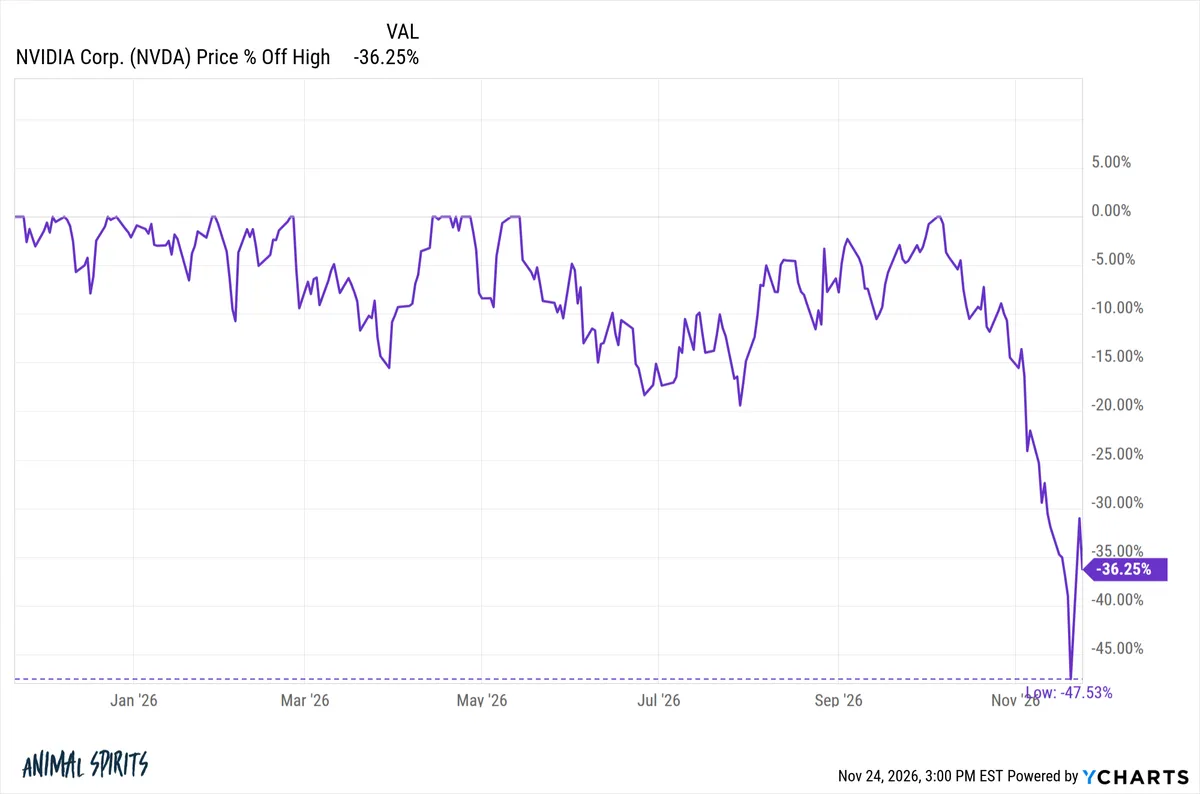
Huang resigned on November 12 after reports of two affairs, one allegedly involving a suspected Chinese spy. CFO Colette Kress became interim CEO. On November 17, Nvidia reported record company-reported revenue of $115.8B, and the board said it did not intend to bring Huang back. Six days later, it reinstated him unanimously. Trump said he had been represented at the board meeting, and the shares rose 31–33%. [4] [5] [7] [2] [9] [3]
Ben Carlson argues that market pressure forced the reversal and compares it to TARP in 2008, the Covid response in 2020 and the 2025 tariff pause. The cause is still disputed. A reported SEC accounting review, new export restrictions and leadership uncertainty all hit in the same week, and Trump separately took credit. [1] [8] [9]
Ben Thompson describes Nvidia as built around Huang personally. He reports about 60 direct reports, no succession plan, and key partnerships such as a long-standing informal arrangement with TSMC that depend on Huang himself. That makes Huang a concentrated key-person risk for the whole AI hardware supply chain. [6] [1]
Compliance pressure is increasing. Commerce moved to stop Chinese entities from renting Nvidia compute, and Nvidia's outlook assumes no China data-center compute revenue. The board created a national security and export control committee and is hiring a chief compliance officer. Thompson reports that Treasury wants bank-style verification of end users. [7] [2] [6]
the board reversed itself within days, after a steep sell-off and government input.
Read the full assessment
Implication: buyers of Nvidia compute should expect stricter end-user checks, possible government influence over vendor governance, and continued dependence on one executive.
Sources are gathered and checked against each other; here is the dossier.
Executive brief
Nvidia's board ousted Jensen Huang on November 12, 2026. Eleven days later it reinstated him, after the stock had its worst week since 2008 and the President pressed the board. Ben Carlson's commentary argues the market forced the reversal. The board itself credited input from "senior levels" of the US government (Nvidia). Huang's return came with the investigations still open, including SEC and DOJ probes (Al Jazeera). For anyone building on Nvidia hardware, a company producing more than $100B a quarter in data-center revenue is still organized around one person.
What changed and event timeline
Huang resigns
Reports of two affairs, one with a woman US intelligence allegedly identified as a Chinese spy, preceded his resignation. CFO Colette Kress became interim CEO and Harvey Jones became the board's first chair (;).
Stratechery's "Obituaries."
Ben Thompson argues Nvidia was an "exoskeleton" around Huang, with about 60 direct reports and no succession plan, so it was unusually exposed to collapse without him ().
Record quarter; board rules out a return
Revenue was $115.8B and data-center revenue $107.6B. Jones said the board did "not intend to reinstate" Huang ().
Worst week since 2008
NVDA closed at $125.53, down 14% on the day and 23% for the week, after Reuters reported SEC staff were examining possible accounting issues ().
Unanimous reinstatement
The board brought Huang back, citing input from the government. Trump said he was "represented in the board meeting." Shares rose 31–33% (;).
Capabilities and access
No model or product was released.
Read the full section
No model or product was released. What changed for customers is about supply and compliance:
Technical analysis for researchers and developers
The reviewed sources document no changes to Nvidia's architecture or roadmap. The board's November 12 release says operations, customer commitments and the product roadmap would continue without disruption (Nvidia).
Read the full section
The reviewed sources document no changes to Nvidia's architecture or roadmap. The board's November 12 release says operations, customer commitments and the product roadmap would continue without disruption (Nvidia). Two points matter for implementation:
- Rental and cloud access: Thompson reports Treasury Secretary Scott Bessent wants Nvidia to verify compliance the way a bank does, not just follow export rules literally (Stratechery). Teams running Nvidia compute through overseas or third-party data centers should expect more checks on who the end user is.
- Vendor concentration: Thompson says key relationships, including a decades-old handshake arrangement with TSMC, rest personally on Huang.
Claims and evidence
- Q3 FY2027 results ($115.8B revenue, up 103%; Q4 guidance about $130B) are company-reported and match analyst coverage (CNBC).
- "No national security risk" is the board's conclusion, relying on the government's view. DOJ said it had no evidence of unlawful conduct.
- The SEC accounting probe comes from Reuters' reporting. The SEC declined to comment, and an investigation does not establish wrongdoing (Investing.com).
Read the full section
- Q3 FY2027 results ($115.8B revenue, up 103%; Q4 guidance about $130B) are company-reported and match analyst coverage (CNBC).
- "No national security risk" is the board's conclusion, relying on the government's view. DOJ said it had no evidence of unlawful conduct. Independent confirmation is not available, and the board's own investigation continues (Nvidia; NBC News).
- The SEC accounting probe comes from Reuters' reporting. The SEC declined to comment, and an investigation does not establish wrongdoing (Investing.com).
- "The market forced the reversal" is Carlson's interpretation (A Wealth of Common Sense). Trump separately claimed credit.
Context and prior work
Carlson compares the episode to earlier cases where a market sell-off preceded a policy reversal: the TARP vote in 2008, the Covid response in 2020 and the tariff pause in 2025. By November 12, NVDA had already lost about $2T in value since its October 6 peak (CNBC).
Read the full section
Carlson compares the episode to earlier cases where a market sell-off preceded a policy reversal: the TARP vote in 2008, the Covid response in 2020 and the tariff pause in 2025. He also notes that about two-thirds of US households now own stocks (A Wealth of Common Sense). Thompson places the ouster in a longer conflict between Huang and successive US chip-export restrictions (Stratechery). By November 12, NVDA had already lost about $2T in value since its October 6 peak (CNBC).
Limitations, safety and contested findings
- Monday's gain: reports put it at 31% (NBC News) or more than 33% at the open (Al Jazeera).
- What drove the sell-off: the reported SEC probe, the export rules and leadership uncertainty all hit in the same week, so Huang's exit can't be isolated as the cause (Investing.com).
- Still pending: the California Attorney General's inquiry, House interviews on December 1–2 and a Senate Banking Committee hearing on December 3 (NBC News).
Read the full section
- Monday's gain: reports put it at 31% (NBC News) or more than 33% at the open (Al Jazeera).
- What drove the sell-off: the reported SEC probe, the export rules and leadership uncertainty all hit in the same week, so Huang's exit can't be isolated as the cause (Investing.com).
- Still pending: the California Attorney General's inquiry, House interviews on December 1–2 and a Senate Banking Committee hearing on December 3 (NBC News).
- Board credibility: the board ruled out Huang's return six days before reversing itself.
Business and practitioner implications
- Key-person risk: Carlson and Thompson both frame Huang's role in the AI buildout as a key-person risk (A Wealth of Common Sense).
- Analyst views before the reversal: KeyBanc's John Vinh called the exit a "material increase" in execution risk.
- Procurement: buyers should plan for stricter export-compliance checks and for government influence over vendor governance. This is not investment advice.
Read the full section
- Key-person risk: Carlson and Thompson both frame Huang's role in the AI buildout as a key-person risk (A Wealth of Common Sense).
- Analyst views before the reversal: KeyBanc's John Vinh called the exit a "material increase" in execution risk. Janus Henderson's Jeremiah Buckley saw a possible "clearing event" (CNBC).
- Procurement: buyers should plan for stricter export-compliance checks and for government influence over vendor governance. This is not investment advice.