
BusinessMarkets, money & strategy
Normal Tech essay argues AI will expand demand for management consultants, not replace them
Rod Moshtagi and Sayash Kapoor argue that consulting sells judgment, coordination, credibility and accountability, not just analysis. In their view, AI adoption is creating demand for consultants, even as agents fail most consulting benchmark tasks and firms pair AI revenue growth with layoffs.
From the AI as Normal Technology article of November 23, 2026 and cited sources: The essay calls strategic advice a credence good, meaning clients struggle to judge its quality even after receiving it. [1]
SOURCES[1] Management consulting is not a thin wrapper on… normaltech.ai
 AT Pulse research deskPublished · Updated · 5 min read · AI-assisted analysis
AI-assisted, not human-edited. Methodology Corrections Who owns this site
- What happened
- The essay calls strategic advice a credence good, meaning clients struggle to judge its quality even after receiving it. [1]
- Original source
- AI as Normal Technology article, independent perspective
- Brief by
- AT Pulse research desk AI-assisted; publisher and contact on the desk page
- When
- November 23, 2026 article published
- Covered
- Nov 24 edition
- Evidence
- 9 sources across 8 sites
- 1Management consulting is not a thin wrapper on…normaltech.ai
- 2AI agents failed at real-world consulting tasks…aol.com
- 3Navigating the Jagged Technological Frontier (SSRN PDF)mitsloan.mit.edu
- 4Accenture integrated reporting – financialaccenture.com
- 5Accenture's $865 million reinvention (Fortune)fortune.com
- 6BCG revenue, 22nd consecutive year of growthbcg.com
BreakoutHow it’s measured
Substack · 121 likes · 14 comments
Reach blends public engagement (views, likes, comments, shares, stars) from the platforms where the story or its original source lives: YouTube, Hacker News, GitHub, Substack and similar. A video and the article written from its transcript share one score, taken from the video. Platforms with no data are left out rather than counted as zero, and the age of a story never lowers its score.
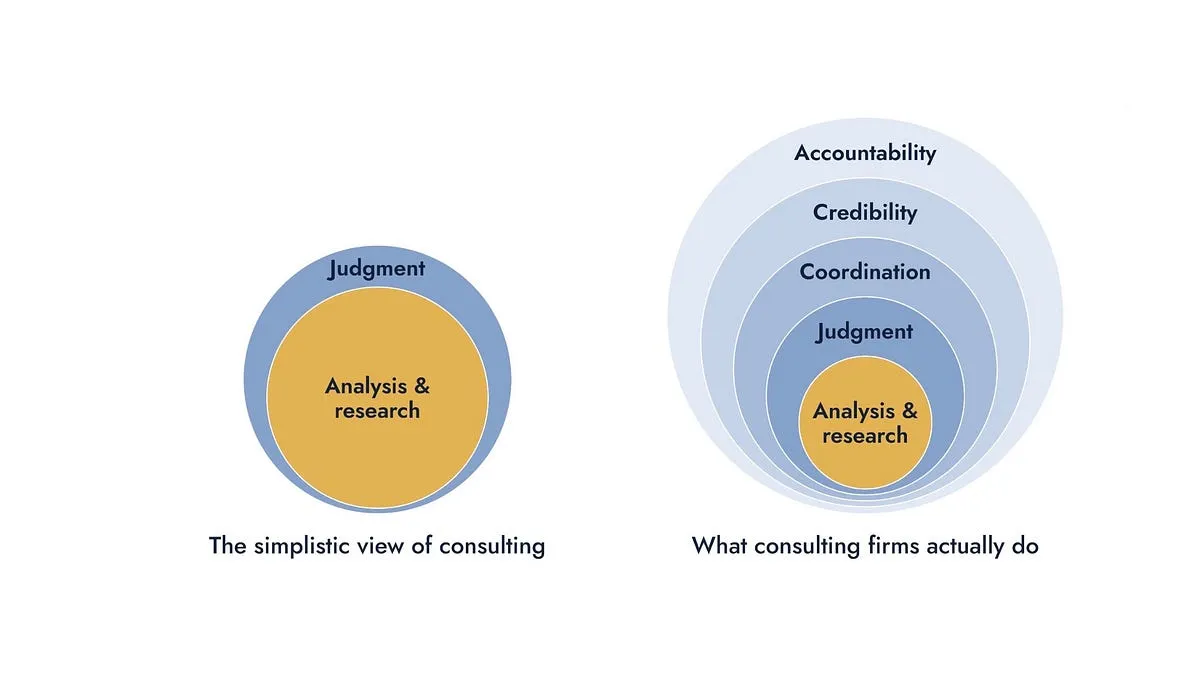
The essay calls strategic advice a credence good, meaning clients struggle to judge its quality even after receiving it. Results also depend on competitors, the economy and execution. That gives a noisy feedback signal, which makes judgment hard to train into models. Firms' private data from past engagements adds a further barrier. [1]
On Mercor's own APEX-Agents benchmark, built from consulting tasks, Opus 4.6 succeeded about 33% of the time and GPT-5.2 about 23%. Agents did better on short, single-tool research and analysis and struggled with long, multi-step planning across many files. Mercor's CEO still predicts consulting-grade chatbots within two years. [2]
AI work is growing inside consulting firms. Accenture's generative and agentic AI revenue tripled to $2.7B in fiscal 2025, and AI- and tech-focused services now make up over 40% of BCG's revenue. But Accenture also cut more than 11,000 staff under an $865M restructuring, so rising AI revenue has not meant stable headcount. [4] [5] [6]
The evidence shows AI work growing inside consulting firms while agents still fail most realistic consulting tasks.
Read the full assessment
The inferred implication is that buyers should budget for workflow redesign and accountability, not only licences, and that junior analytic roles face the most pressure.
Executive brief
Mercor's APEX-Agents benchmark tested AI agents on real consulting tasks. The best model, Anthropic's Opus 4.6, succeeded about 33% of the time, yet Mercor's CEO still predicted chatbots as good as top consulting firms within two years (AOL/Business Insider). A Nov 23, 2026 essay by Rod Moshtagi and Sayash Kapoor argues the opposite. In their view, consulting sells judgment, coordination, credibility and accountability as well as analysis, and AI adoption is creating new demand for consultants. It is commentary, and no other coverage of the essay was found in the reviewed sources. Firm revenue data supports parts of its argument, but layoffs at the same firms complicate the picture.
What changed and event timeline
GPT-4 field experiment at BCG
In a preregistered trial with 758 BCG consultants, GPT-4 users worked about 25% faster with better quality on in-frontier tasks. They did worse on a task outside the model's capability ().
Accenture grows AI revenue and cuts staff
Generative and agentic AI revenue tripled to $2.7B in fiscal 2025 (). In the same period Accenture cut more than 11,000 staff under an $865M restructuring ().
Agents fail most consulting tasks
On APEX-Agents, GPT-5.2 succeeded about 23% of the time and Opus 4.6 about 33%. Foody still forecast consulting-grade chatbots within two years ().
BCG's AI services grow 25%
BCG's 2025 revenue grew 7% to $14.4B. AI- and tech-focused services now make up more than 40% of revenue ().
Most AI gains stall before scaling
Of 152 CEOs, 89% report benefits from AI in specific areas, but only 26% have built AI into wider business transformation ().
Essay published
Moshtagi and Kapoor argue that consulting is not a "thin wrapper" on intelligence ().
Capabilities and access
- No model launch is involved. The story is an argument about AI's economic effects, not a release.
- Models in the cited evidence:
- GPT-4 in the 2023 BCG experiment (SSRN).
Read the full section
- No model launch is involved. The story is an argument about AI's economic effects, not a release.
- Models in the cited evidence:
- GPT-4 in the 2023 BCG experiment (SSRN).
- GPT-5.2 and Opus 4.6 on APEX-Agents, according to Business Insider's report. The benchmark is described as built with input from consultants at McKinsey, BCG, Deloitte, Accenture and EY (AOL/BI).
- Where agents do better: short tasks that use a single tool, and research and data analysis. They struggle with long, multi-file, multi-step planning.
Technical analysis for researchers and developers
- The essay's training-signal argument. Outcomes also depend on competitors, the economy and execution.
- Consulting firms hold private observations across hundreds of engagements, which models cannot see unless the data is leaked, bought or published.
- APEX-Agents-style evaluations score bounded deliverables.
Read the full section
- The essay's training-signal argument. Strategic advice is a "credence good": buyers struggle to judge its quality even after receiving it. Outcomes also depend on competitors, the economy and execution. That gives a noisy reward signal, which makes judgment hard to train (essay).
- The data moat. Consulting firms hold private observations across hundreds of engagements, which models cannot see unless the data is leaked, bought or published.
- What benchmarks miss. APEX-Agents-style evaluations score bounded deliverables. They do not measure coordination or implementation, and Mercor says a future version will cover the "whole value chain" (AOL/BI).
- A methodological caution. The BCG study found accuracy fell when tasks sat outside the model's capability (SSRN). Evaluations limited to well-scoped tasks can overstate how much of a job AI can replace.
Claims and evidence
- Strategy spending has held up. Strategy consulting grew 2.3% in 2025, with 4% forecast for 2026.
- AI work is growing at the firms.
- Execution is the bottleneck. The essay's evidence is BCG's own survey (BCG).
Read the full section
- Strategy spending has held up. Strategy consulting grew 2.3% in 2025, with 4% forecast for 2026. AI advice and implementation is forecast to grow 15% (Source Global Research).
- AI work is growing at the firms. The Accenture $2.7B figure and BCG's 25% AI growth are self-reported by the firms, not independently audited segment data (Accenture; BCG).
- Execution is the bottleneck. The essay's evidence is BCG's own survey (BCG). A consulting firm finding that clients need change management has a commercial interest in that conclusion.
- AI agents cannot yet do the work. This rests on Mercor's own benchmark, reported by Business Insider (AOL/BI).
Context and prior work
- Past technology shifts created consulting work. The essay cites Attewell's 1992 work on consultants and business computing.
- McKinsey's Kate Smaje said in November 2025 that pure strategy is under 20% of the firm's work (Business Insider).
- The coordination argument draws on Garicano, Li and Wu's Messy Jobs, which describes organisations as coalitions with diverging interests (Messy Jobs).
Read the full section
- Past technology shifts created consulting work. The essay cites Attewell's 1992 work on consultants and business computing. It also cites KPMG's e-business revenue rising from $678M in fiscal 1999 to $1.11B in fiscal 2000, and cloud-migration partnerships (essay).
- Implementation over strategy. McKinsey's Kate Smaje said in November 2025 that pure strategy is under 20% of the firm's work (Business Insider).
- Organisations as coalitions. The coordination argument draws on Garicano, Li and Wu's Messy Jobs, which describes organisations as coalitions with diverging interests (Messy Jobs).
- Commoditised advantage. A 2020 study found the Oakland Athletics' "Moneyball" edge disappeared within about five years of the method becoming public.
Limitations, safety and contested findings
- The essay's demand case leans on surveys and firms' self-reported revenue. The authors also concede that demand for "procedural" analysis may fall.
- Revenue growth has come with job cuts. Rising AI revenue does not mean stable consulting employment.
- Mercor's results show quick gains over earlier models, which supports forecasts of displacement for junior roles (AOL/BI).
Read the full section
- The essay's demand case leans on surveys and firms' self-reported revenue. The authors also concede that demand for "procedural" analysis may fall.
- Revenue growth has come with job cuts. Accenture cut more than 11,000 staff it judged could not be reskilled for AI work, even as AI revenue tripled (Fortune). Rising AI revenue does not mean stable consulting employment.
- Benchmark trajectory points the other way. Mercor's results show quick gains over earlier models, which supports forecasts of displacement for junior roles (AOL/BI).
- The BCG experiment had a downside. Consultants who used AI on a task outside its capability frontier did worse than those without AI (SSRN).
Business and practitioner implications
- For buyers: model access does not come with accountability or a way to get internal stakeholders to agree.
- For consulting firms: the essay recommends three changes (essay):
- build expertise that clients cannot sustain in-house;
Read the full section
- For buyers: model access does not come with accountability or a way to get internal stakeholders to agree. Budget for redesigning workflows, metrics and roles, not only for licences.
- For consulting firms: the essay recommends three changes (essay):
- build expertise that clients cannot sustain in-house;
- learn to deploy AI faster than AI companies learn change management;
- stay neutral across model providers, since token-based pricing or equity stakes create conflicts of interest.
- For developers: agents already handle bounded research and analysis. Long-horizon, multi-file planning remains the gap (AOL/BI).