
AgentsAutonomy & tool use
Anthropic launches Claude Ship, GitHub agents that review, fix and can approve pull requests
Anthropic's Claude Ship bundles three GitHub agents: Code Review, now generally available, plus PR Steward and Claude Approvals in public beta. Under a team-written policy, Claude can post approving reviews, meaning some changes could merge without any human reading them.
From the TechCrunch AI article of November 23, 2026 and cited sources: The main change is that the agent can now approve changes. [2] [3] [5]
SOURCES[2] Claude Code Docs: Claude Approvals code.claude.com[3] TechCrunch: Anthropic launches Code Review tool (Mar 2026) techcrunch.com[5] Anthropic: Introducing Claude Ship claude.com
 AT Pulse research deskPublished · Updated · 5 min read · AI-assisted analysis
AI-assisted, not human-edited. Methodology Corrections Who owns this site
- Original source
- TechCrunch AI article, independent perspective
- Brief by
- AT Pulse research desk AI-assisted; publisher and contact on the desk page
- When
- November 23, 2026 article published
- Covered
- Nov 24 edition
- Evidence
- 11 sources across 9 sites
- 1TechCrunch: Anthropic launches Claude Shiptechcrunch.com
- 2Claude Code Docs: Claude Approvalscode.claude.com
- 3TechCrunch: Anthropic launches Code Review tool (Mar 2026)techcrunch.com
- 4Microsoft Security: Securing CI/CD in an agentic worldmicrosoft.com
- 5Anthropic: Introducing Claude Shipclaude.com
- 6MarkTechPost: Claude Ship launchmarktechpost.com
RisingHow it’s measured
Hacker News · 4 likes · 2 comments
Reach blends public engagement (views, likes, comments, shares, stars) from the platforms where the story or its original source lives: YouTube, Hacker News, GitHub, Substack and similar. A video and the article written from its transcript share one score, taken from the video. Platforms with no data are left out rather than counted as zero, and the age of a story never lowers its score.

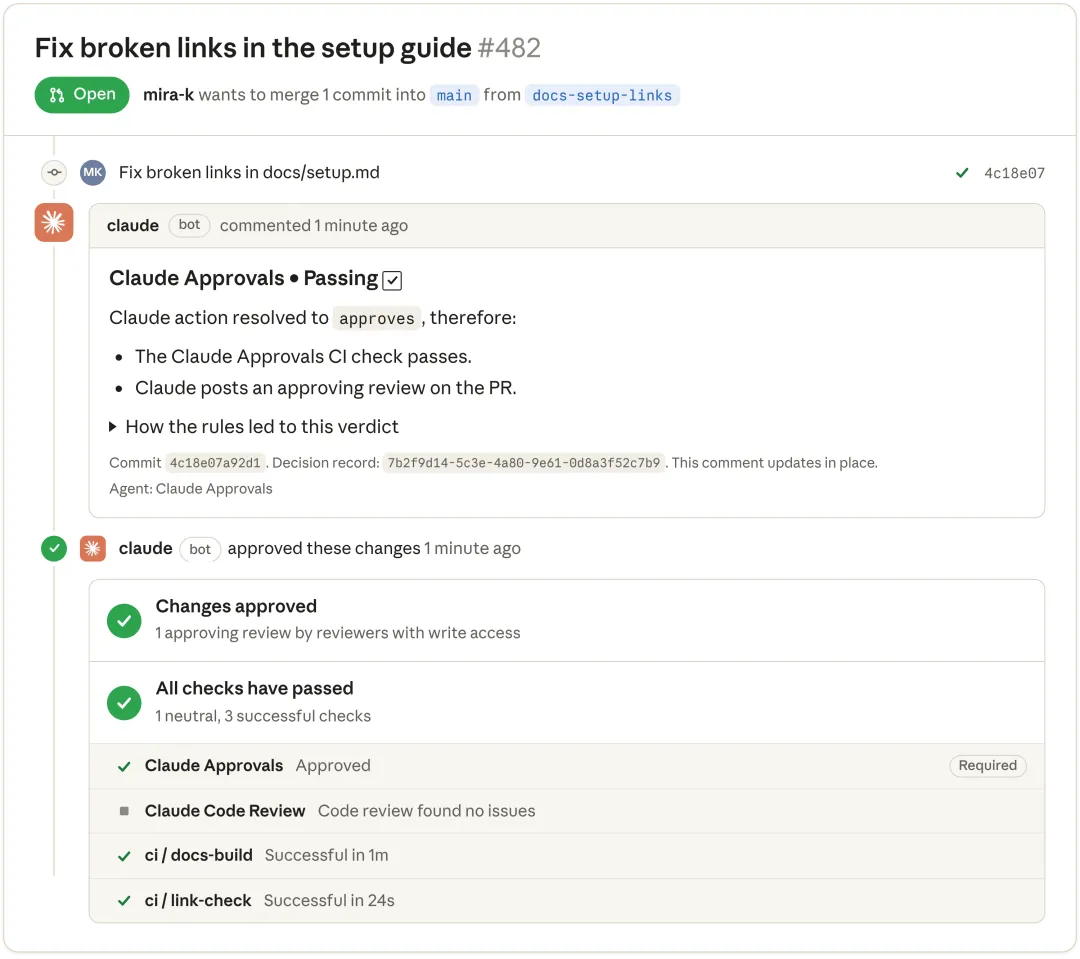
The main change is that the agent can now approve changes. Code Review launched in March and left approval to people. Now, teams can set rules in a .claude/approvals.yml file. Each rule names file paths, how many human approvals are needed, and whether Claude only comments or can approve. When several rules match, the strictest one applies. Rules cannot see CI results, so CI has to stay a separate required check. [2] [3] [5]
A change can merge with no human review in several ways: a rule requires zero human approvals; the author fills the only required approval; GitHub counts Claude's approval as a required review; or Claude approves without a Code Review run. Auto-merge and merge queues increase this risk. Anyone who can merge to the default branch can turn Approvals on. Earlier in 2026, Microsoft reported a prompt-injection flaw in the Claude Code GitHub Action that could expose secrets. Anthropic fixed it. [2] [4] [10]
The performance evidence comes from one internal trial, which Anthropic reported itself. On its Claude Code team, merged pull requests more than doubled and the share of reverted pull requests fell by more than 40%. No methodology was published. Press coverage so far repeats the announcement, and no outside accuracy or safety evaluation has been published. [5] [9] [10] [11]
The reviewed sources establish what the product can do and how policies are configured; they do not show it reliably catches bugs. The implication is that branch rules, human seats on sensitive paths and CI checks become the real safety controls.
Executive brief
On November 23, 2026, Anthropic launched Claude Ship, a set of GitHub agents that review, fix and approve pull requests. The notable part is approval: under a policy the team writes, Claude can post an approving review, and according to Anthropic's own docs a change can merge with no person having looked at it. Code Review is generally available. PR Steward and Claude Approvals are in public beta for Team and Enterprise plans (TechCrunch). Anthropic's evidence that it works is internal only: on the Claude Code team, merged PRs more than doubled and the share of reverted PRs fell by over 40%. No independent evaluation was found.
What changed and event timeline
Code Review arrives
Anthropic launched multi-agent PR review as a research preview, priced by tokens at roughly $15–25 per review. It explicitly did not approve PRs ().
CI secret-leak flaw fixed
Microsoft reported that the Claude Code GitHub Action's Read tool could reach secrets through prompt injection. Anthropic shipped a fix in Claude Code 2.1.128 ().
Internal trial
Anthropic says merged PRs on its Claude Code team more than doubled while the reverted share fell over 40% ().
Microsoft publishes guidance
Microsoft disclosed the flaw and recommended the "Agents Rule of Two": an agent should not process untrusted input, hold secrets and run tools all at once ().
Claude Ship launches
Code Review, PR Steward and Claude Approvals are bundled for GitHub repositories on Team and Enterprise plans (;).
Capabilities and access
- Code Review (GA): leaves inline comments ranked by severity. Depth can be set to Quick, Standard or Deep (docs).
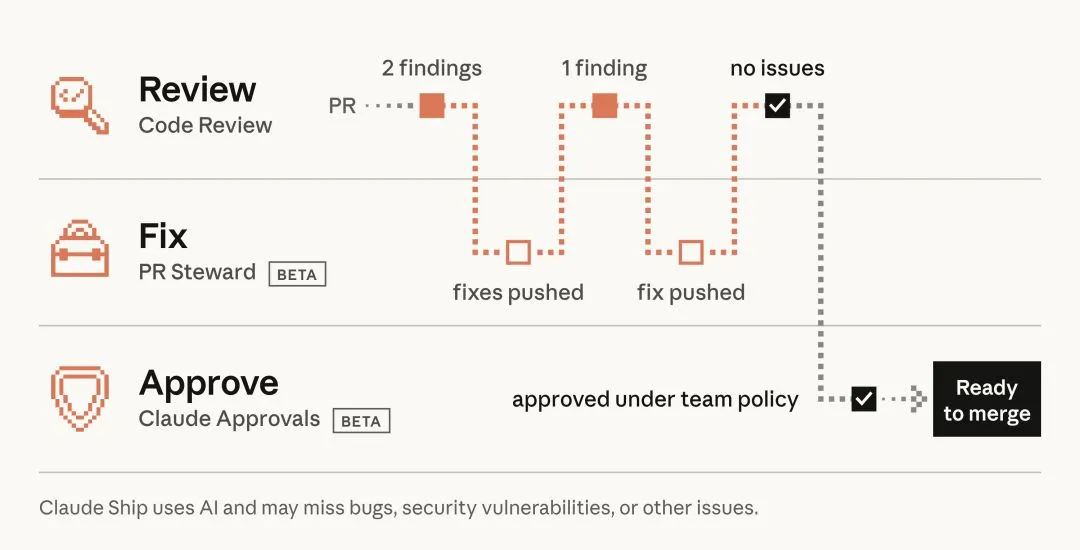
- PR Steward (beta): fixes failing checks, merge conflicts and review comments, then pushes commits. It is designed not to approve or merge.
- Claude Approvals (beta): a GitHub check driven by
.claude/approvals.yml(docs).
Read the full section
- Code Review (GA): leaves inline comments ranked by severity. Depth can be set to Quick, Standard or Deep (docs).
- PR Steward (beta): fixes failing checks, merge conflicts and review comments, then pushes commits. It is designed not to approve or merge. Developers steer it with
@claudeand halt it with@claude stop(Anthropic). - Claude Approvals (beta): a GitHub check driven by
.claude/approvals.yml(docs). - Access: github.com only, including GitHub Enterprise Cloud. Not available to organizations using Zero Data Retention, the HIPAA configuration or customer-managed encryption keys. Billing is by tokens from usage credits. The underlying model version is not disclosed.
Technical analysis for researchers and developers
- Policy model: a policy is a list of rules, each with
paths,seats(how many humans must approve),claude: comments|approvesandadvisoryreviewers. - Conditions: rules can read facts about the PR (lines changed, author, target branch) and answers from LLM classifiers, such as a risk rating.
- Loop: Code Review finds problems, Steward pushes fixes, and a fix can trigger another review. Branch protection decides what actually merges (docs).
Read the full section
- Policy model: a policy is a list of rules, each with
paths,seats(how many humans must approve),claude: comments|approvesandadvisoryreviewers. Where several rules match, the strictest applies (docs). - Conditions: rules can read facts about the PR (lines changed, author, target branch) and answers from LLM classifiers, such as a risk rating. Conditions cannot read CI results, so CI has to stay a separate required check.
- Loop: Code Review finds problems, Steward pushes fixes, and a fix can trigger another review. Branch protection decides what actually merges (docs).
- Gotcha: adding a policy file can silently stop automatic Code Reviews unless a rule lists
claude/code_review.
Claims and evidence
- Throughput and quality: the doubling of merged PRs and the 40%+ drop in reverts come from one team, Anthropic's own Claude Code team, with no published methodology.
- Earlier Code Review stats: substantive review comments rose from 16% to 54% of PRs. These are also internal figures (VentureBeat).
- Coverage so far: reporting from XDA, Cybersecurity News and Unite.AI restates the announcement. No independent accuracy or safety evaluation exists yet.
Read the full section
- Throughput and quality: the doubling of merged PRs and the 40%+ drop in reverts come from one team, Anthropic's own Claude Code team, with no published methodology. They are vendor-reported and not reproduced elsewhere (Anthropic).
- Earlier Code Review stats: substantive review comments rose from 16% to 54% of PRs. These are also internal figures (VentureBeat).
- Coverage so far: reporting from XDA, Cybersecurity News and Unite.AI restates the announcement. No independent accuracy or safety evaluation exists yet.
Context and prior work
Claude Ship builds on the March Code Review launch. The new step is giving the agent approval authority. Anthropic describes policies as a smarter alternative to CODEOWNERS files.
Read the full section
Claude Ship builds on the March Code Review launch. That product used parallel agents looking at the code from different angles, with a final agent that removed duplicates and ranked findings. Approval stayed with humans (TechCrunch). The new step is giving the agent approval authority. Anthropic describes policies as a smarter alternative to CODEOWNERS files. The stated reason is a bottleneck: agents now write so much code that human review can't keep up (Anthropic).
Limitations, safety and contested findings
- Anthropic's docs warn that Claude Ship may miss bugs and security vulnerabilities (docs).
- Ways a change can merge without human review: the policy uses
seats: 0, orseats: 1where the author fills the seat. - Who can switch it on: anyone able to merge to the default branch can enable Approvals.
Read the full section
- Anthropic's docs warn that Claude Ship may miss bugs and security vulnerabilities (docs).
- Ways a change can merge without human review: the policy uses
seats: 0, orseats: 1where the author fills the seat; GitHub counts Claude's approval toward a required review; or a rule withclaude: approvesruns with no Code Review. Auto-merge and merge queues widen this exposure (docs). - Who can switch it on: anyone able to merge to the default branch can enable Approvals.
- Attack surface: earlier research showed prompt injection through GitHub content against Claude Code in CI. Tiny edits to access-control rules can still be high-risk (Cybersecurity News; Microsoft Security).
Business and practitioner implications
- Roll out slowly: start with one repository in observe mode, and turn on Steward in manual mode first.
- Cap spending: PR Steward has no spend limit until one is set, and observe mode is still billed (docs).
- Keep humans on sensitive paths: require human seats for permissions, billing and workflow files.
Read the full section
- Roll out slowly: start with one repository in observe mode, and turn on Steward in manual mode first.
- Cap spending: PR Steward has no spend limit until one is set, and observe mode is still billed (docs). Eligible Enterprise organizations can claim promotional credits until January 15, 2027 (Anthropic).
- Keep humans on sensitive paths: require human seats for permissions, billing and workflow files. Keep CI as a required check, and audit branch rules for ways to merge without review.
- Compliance: regulated organizations using Zero Data Retention, HIPAA or customer-managed keys cannot use Claude Ship yet.