
FundingRounds, leads & terms
Swiss robotics startup coprod raises $6M pre-seed, co-led by Founderful and PROTOTYPE, for modular robot hardware
EPFL-founded coprod is building plug-compatible robot components for power, batteries, sensing and motion. One EtherCAT-based software layer ties them together. The aim is to cut custom robot development from years to months. Prototypes are being tested with integrators and labs, with sales planned for early 2027.
From the Tech.eu article of November 23, 2026 and cited sources: Coprod raised a $6M pre-seed round co-led by Founderful and PROTOTYPE. [2] [5]
SOURCES[2] PR Newswire: coprod sammelt 6 Millionen Dollar ein… prnewswire.com[5] CFOtech: Swiss robotics startup coprod raises USD $6 million cfotech.co.uk
 AT Pulse research deskPublished · Updated · 4 min read · AI-assisted analysis
AI-assisted, not human-edited. Methodology Corrections Who owns this site
- Original source
- Tech.eu article, independent perspective
- Brief by
- AT Pulse research desk AI-assisted; publisher and contact on the desk page
- When
- November 23, 2026 article published
- Covered
- Nov 23 edition
- Evidence
- 5 sources across 5 sites
- 1Tech.eu: Swiss startup coprod raises $6Mtech.eu
- 2PR Newswire: coprod sammelt 6 Millionen Dollar ein…prnewswire.com
- 3Tech Funding News: EPFL founders who built a robot in a…techfundingnews.com
- 4Sifted: ETH Zurich students' humanoid XALUNsifted.eu
- 5CFOtech: Swiss robotics startup coprod raises USD $6 millioncfotech.co.uk
Reach: not measured yet
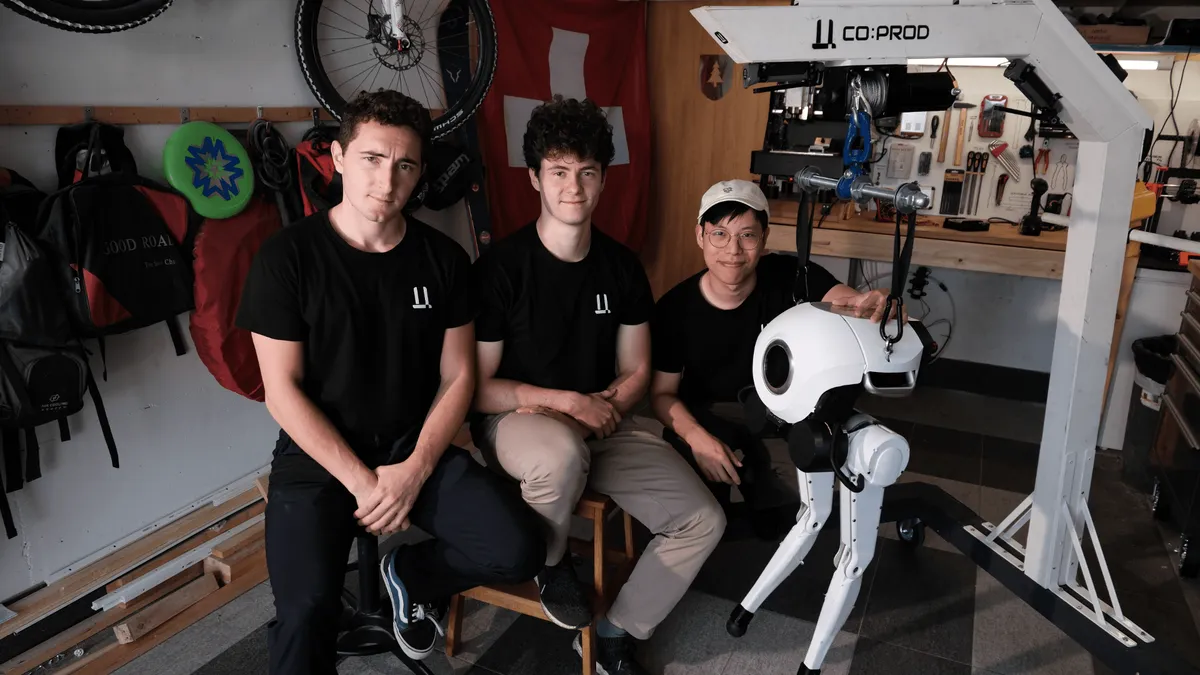
Coprod raised a $6M pre-seed round co-led by Founderful and PROTOTYPE. General Catalyst and Kima Ventures also took part, along with angels including Hugging Face co-founder Thomas Wolf and the Dassault family. No valuation was disclosed. [2] [5]
The product is four families of modular components (co:power, co:battery, co:sensor and co:motion) connected by co:system. That software layer uses an established industrial fieldbus, EtherCAT, for real-time control and offers C++ and Python APIs. A planned Lausanne facility will produce digital-twin models of each component to narrow the gap between simulation and real-world behaviour. [2] [3] [1]
The company says its approach can shrink custom robot development from two or three years to a few months, at $5,000–$25,000 per design iteration. These are its own figures. No datasheets, benchmarks or performance specifications have been published. [1]
The evidence so far is a disclosed funding round and prototypes being tested with integrators and labs. If datasheets and pricing at the 2027 launch support the claims, narrow, task-specific robots could become cheaper to build.
Read the full assessment
The trade-off is dependence on a single vendor's components.
Executive brief
Coprod, a Swiss robotics startup founded in late 2024 by three EPFL graduates, says its hardware can cut custom robot development from two or three years to a few months, at $5,000–$25,000 per design iteration (Tech.eu). On 23 November 2026 it announced a $6M pre-seed round, co-led by Founderful and PROTOTYPE (PR Newswire). Its bet is a set of plug-compatible components with one real-time software layer. The goal is to remove the "integration hell" of combining parts from different suppliers. No product is commercially available yet, and the speed and cost claims come only from the company.
What changed and event timeline
Coprod founded
EPFL graduates Loïc Delineau (CEO), Vincent Nguyen and Matthias Schuller started the company. Their first demonstration was a bipedal robot built in a garage in the Swiss Alps (;).
$6M pre-seed announced
General Catalyst, Kima Ventures and others joined. Angels include Thomas Wolf, the Dassault family and Florent Perrichon. No valuation was disclosed ().
End of 2027 (planned): full line certified
Coprod aims to have the full range qualified, certified and packaged by then. Volume production is planned in Shenzhen and Texas, with R&D staying in Switzerland ().
(planned): commercial launch
The first commercial component line is scheduled to go on sale. Prototypes are currently being tested with integrators and labs ().
Capabilities and access
- Products: modular "co:products" in four families: co:power, co:battery, co:sensor and co:motion (PR Newswire).
- Software: a unified stack called co:system, with APIs in C++ and Python and a configuration tool (same source).
- Access: only prototypes exist, and they are with integrators and labs. Commercial sales are planned for early 2027 (TFN).
Read the full section
- Products: modular "co:products" in four families: co:power, co:battery, co:sensor and co:motion (PR Newswire).
- Software: a unified stack called co:system, with APIs in C++ and Python and a configuration tool (same source).
- Access: only prototypes exist, and they are with integrators and labs. Commercial sales are planned for early 2027 (TFN). No version numbers, pricing tiers or datasheets have been published.
Technical analysis for researchers and developers
- Architecture: co:system uses an EtherCAT control plane to link modules in real time through a single API (TFN; PR Newswire).
- Sim-to-real: the planned Lausanne facility is meant to produce technical documentation and digital-twin models for each component, aimed at the gap between simulation and real-world behaviour (Tech.eu).
- Evidence gaps: no published latency, cycle-time, torque or reliability figures, and no benchmarks or open specifications.
Read the full section
- Architecture: co:system uses an EtherCAT control plane to link modules in real time through a single API (TFN; PR Newswire). EtherCAT is an established industrial fieldbus. Building on it suggests coprod is standardising on an existing protocol rather than inventing a proprietary bus.
- Sim-to-real: the planned Lausanne facility is meant to produce technical documentation and digital-twin models for each component, aimed at the gap between simulation and real-world behaviour (Tech.eu).
- Evidence gaps: no published latency, cycle-time, torque or reliability figures, and no benchmarks or open specifications.
Claims and evidence
Investor quotes come from the leads talking about their own portfolio company. Andreas Klinger of PROTOTYPE says coprod is fixing hardware's biggest problem, "integration hell" (TFN). Alex Stöckl of Founderful praises the team's drive and Switzerland's precision-manufacturing base (PR Newswire).
Read the full section
| Claim | Status |
| $6M pre-seed, co-led by Founderful and PROTOTYPE | Company-announced (PR Newswire). Reported consistently by Tech.eu, TFN and CFOtech. No filing confirms it. |
| Valuation | Not disclosed |
| Development time cut from 2–3 years to months; $5k–25k per iteration | Self-reported by the company |
| Facility cuts prototype cycles from two weeks to 24 hours | Self-reported, and the facility is not yet built |
| Components used in the ETH humanoid | Company-stated. The reviewed coverage of XALUN does not independently confirm it. |
Investor quotes come from the leads talking about their own portfolio company. Andreas Klinger of PROTOTYPE says coprod is fixing hardware's biggest problem, "integration hell" (TFN). Alex Stöckl of Founderful praises the team's drive and Switzerland's precision-manufacturing base (PR Newswire).
Context and prior work
Coprod's thesis is that hardware purpose-built for a task will beat general-purpose robots, "regardless of which model runs on it" (Tech.eu). That runs against the current focus on general humanoids and foundation models. Even so, a Hugging Face co-founder, Thomas Wolf, is among the angels. Switzerland's student and academic robotics scene, including the 350-plus-member ETH Robotics Club, gives coprod an early user base (Sifted).
Limitations, safety and contested findings
- The only deployment evidence is in student and academic projects. No paying customers are named.
- The certification timeline runs to end-2027, so industrial and safety qualification is still pending (Tech.eu).
- Splitting manufacturing between Shenzhen and Texas adds supply-chain and trade exposure.
Read the full section
- The only deployment evidence is in student and academic projects. No paying customers are named.
- The certification timeline runs to end-2027, so industrial and safety qualification is still pending (Tech.eu).
- Splitting manufacturing between Shenzhen and Texas adds supply-chain and trade exposure.
- The reviewed sources contain no conflicting figures. They also contain no independent technical assessment.
Business and practitioner implications
- Robotics startups and labs: if the claims hold, a custom robot could be prototyped for tens of thousands of dollars rather than with a multi-year engineering team.
- Developers: C++ and Python APIs over EtherCAT should feel familiar to people who work with ROS or industrial control.
- Investors: this is a pre-seed bet on standardising robot hardware. General Catalyst joining at this stage shows interest, but it is not validation.
Read the full section
- Robotics startups and labs: if the claims hold, a custom robot could be prototyped for tens of thousands of dollars rather than with a multi-year engineering team. That would make narrow, task-specific robots more viable.
- Developers: C++ and Python APIs over EtherCAT should feel familiar to people who work with ROS or industrial control. Lock-in to a single vendor's component set is the trade-off.
- Investors: this is a pre-seed bet on standardising robot hardware. General Catalyst joining at this stage shows interest, but it is not validation. Concrete checks come with the early-2027 launch: datasheets, pricing and outside customers.