
StocksEquities, earnings & valuations
Nvidia's Seven-Week, $2.6 Trillion Slide Helps Push S&P 500 Into Correction as Nasdaq Has Worst Week Since 2020
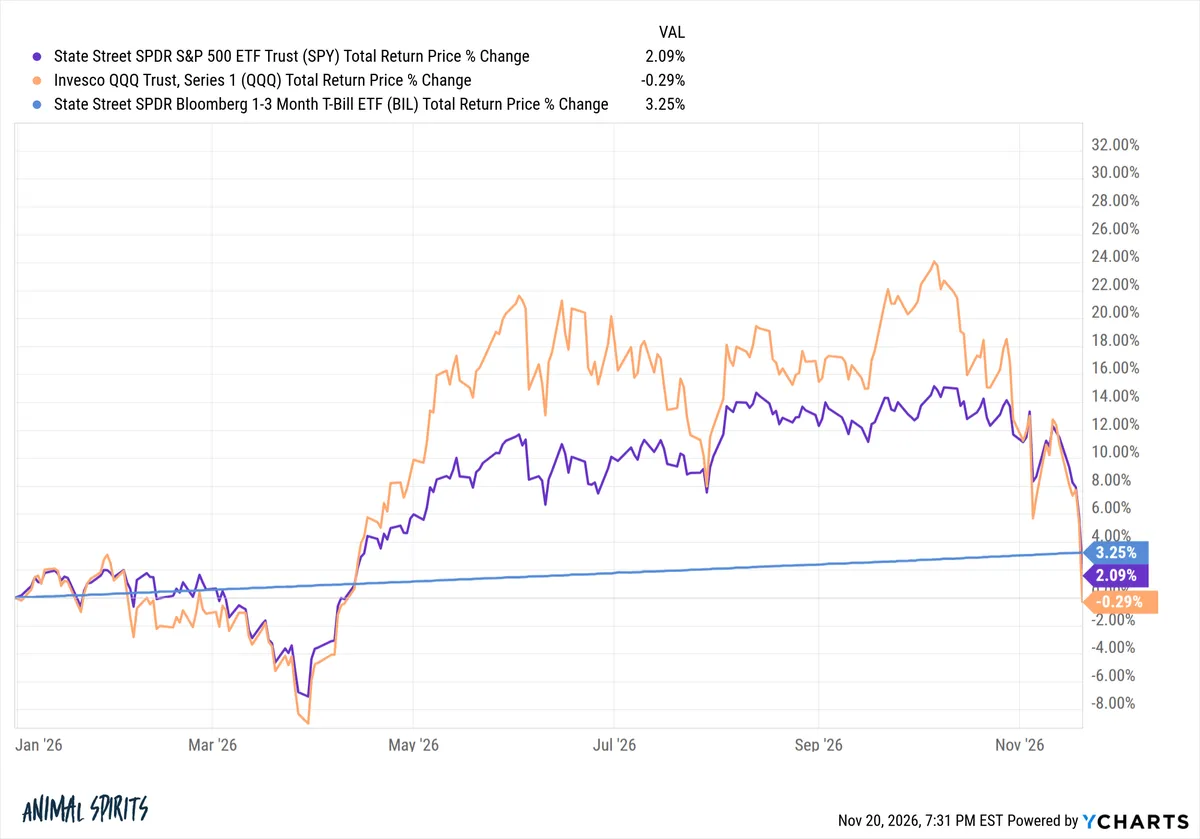
Nvidia's seven-week, roughly $2.6 trillion slide helped push the S&P 500 into a correction on November 20, amid Anthropic's record IPO, hotter inflation and rising rate-hike odds. Ben Carlson notes T-bills now beat both major stock indexes for 2026.
From the A Wealth of Common Sense article of November 22, 2026 and cited sources: Nvidia fell about 46% in seven weeks, wiping out roughly $2.6 trillion in market value in its longest losing streak since 2008. [2] [3] [6]
SOURCES[2] Nvidia's 7-week losing streak – CNBC cnbc.com[3] S&P 500 and Dow close in correction – CNBC cnbc.com[6] US stock futures rebound – Fox Business foxbusiness.com
 AT Pulse research deskPublished · Updated · 5 min read · AI-assisted analysis
AI-assisted, not human-edited. Methodology Corrections Who owns this site
- What happened
- Nvidia fell about 46% in seven weeks, wiping out roughly $2.6 trillion in market value in its longest losing streak since 2008. [2] [3] [6]
- Original source
- A Wealth of Common Sense article, independent perspective
- Brief by
- AT Pulse research desk AI-assisted; publisher and contact on the desk page
- When
- November 22, 2026 article published
- Covered
- Nov 23 edition
- Evidence
- 11 sources across 9 sites
- 1Risk is a Four Letter Wordawealthofcommonsense.com
- 2Nvidia's 7-week losing streak – CNBCcnbc.com
- 3S&P 500 and Dow close in correction – CNBCcnbc.com
- 4S&P 500 Falls Into a Correction – The Boston Reportthebostonreport.com
- 5CPI October 2026 – BLSbls.gov
- 6US stock futures rebound – Fox Businessfoxbusiness.com
Reach: not measured yet
Nvidia fell about 46% in seven weeks, wiping out roughly $2.6 trillion in market value in its longest losing streak since 2008. The drop followed CEO Jensen Huang's November 12 resignation over a code-of-conduct breach and a reported SEC accounting probe. CNBC reports the stock now trades at about 8.4 times forward earnings, compared with 29 times for AMD. [2] [3] [6]
On November 20 the S&P 500 fell 3.7% to 6,910.39, about 11.6% below its October 6 record. The Nasdaq Composite had its worst week since March 2020. According to Carlson, year-to-date gains of 15% to 24% in early October have shrunk to about +2% for the S&P 500 and slightly negative for the Nasdaq 100, leaving T-bills ahead of both. Carlson sees the drop as a healthy correction after three strong years. [1] [3] [4] [6]
Mechanical selling made the drop worse. CNBC reports that trend-following funds sold automatically after the S&P 500 broke below its 200-day moving average. Stocks, gold, silver and bitcoin fell together while Treasuries rallied, which analysts in the coverage read as forced selling to raise cash. Carlson's charts show leveraged 2x and 3x ETFs falling much further than the indexes they track. [1] [7] [8] [9]
Larger economic and AI-sector pressures added to the selling. October CPI rose 0.4%. The 10-year Treasury yield reached 5.17%, and markets price a December rate hike at 87% to 96%, depending on the source. Anthropic's revenue growth slowed to 47% in Q3 from 144% in Q2, CoreWeave is 71% below its high, and CNBC links the sell-off partly to worries about funding for AI data centers. [3] [5] [6] [7] [9]
Nvidia's slide tracked its CEO exit and a reported probe, not missed earnings, while broader selling coincided with rate and AI-funding worries.
Read the full assessment
Implication: compute-heavy AI projects may face tighter capital; October PCE (November 27) and December's Fed meeting are next tests.
Executive brief
Nvidia lost almost half its value in about seven weeks. CNBC put the drop at 46%, about $2.6 trillion in market value, and its seven-week losing streak is the longest since 2008 (CNBC). The fall helped push the S&P 500 into a correction on November 20 (CNBC). In a November 22 commentary, Ben Carlson notes that T-bills are now beating both the S&P 500 and the Nasdaq 100 for 2026. He calls the drop a "healthy correction" after three strong years (A Wealth of Common Sense). That reading is his opinion. Reporters point to other causes: Anthropic's IPO, Nvidia's leadership crisis, hot inflation and rising odds of a Fed rate hike.
What changed and event timeline
S&P 500 record
The index closed at a record 7,818.93. By November 20 it stood 11.62% below that level ().
Hotter inflation
October CPI-U rose 0.4% and core rose 0.3%. BLS could not publish 12-month changes because October 2025 data were never collected during the 2025 funding lapse ().
Huang resigns
Nvidia's board cited personal conduct that broke its code of conduct, and CFO Colette Kress became interim CEO (;).
Anthropic lists
Anthropic began trading on Nasdaq as ANT at $83 a share and raised about $81.3 billion (). CNBC calls it the largest IPO ever ().
Correction confirmed
The S&P 500 fell 3.7% to 6,910.39 and the Nasdaq Composite fell 5.28% to 22,617.73. Nvidia dropped about 14% after Reuters reported an SEC accounting probe ().
Futures rebound
Before the open, S&P 500 futures were up 2.5%, Nasdaq-100 futures up more than 3%, and Nvidia up more than 9% ().
Capabilities and access
- Index levels on Nov 20: S&P 500 at 6,910.39, down 8.6% for the week. Dow at 48,147.33.
- Year-to-date returns per Carlson: S&P 500 +2.1% and Nasdaq 100 −0.3%. In early October they were +15.1% and +24.1% (A Wealth of Common Sense).
- Anthropic (ANT): shares rose above $115, then closed the week at $88.91 (CNBC).
Read the full section
- Index levels on Nov 20: S&P 500 at 6,910.39, down 8.6% for the week. Dow at 48,147.33. Nasdaq Composite down about 10% for the week, its worst week since March 2020 (Fox Business).
- Year-to-date returns per Carlson: S&P 500 +2.1% and Nasdaq 100 −0.3%. In early October they were +15.1% and +24.1% (A Wealth of Common Sense).
- Anthropic (ANT): shares rose above $115, then closed the week at $88.91 (CNBC).
Technical analysis for researchers and developers
- Selling triggered by trend signals: The S&P 500 traded below its 200-day moving average on Tuesday and broke through it decisively on Thursday.
- Assets fell together: Stocks, gold, silver and bitcoin dropped at the same time while Treasuries rallied.
- Leverage: Carlson's charts show 2x and 3x ETFs, including single-stock funds, falling much further than their underlying indexes (A Wealth of Common Sense).
Read the full section
- Selling triggered by trend signals: The S&P 500 traded below its 200-day moving average on Tuesday and broke through it decisively on Thursday. That set off automatic selling by trend-following funds (commodity trading advisors, or CTAs), according to CNBC's account (CNBC).
- Assets fell together: Stocks, gold, silver and bitcoin dropped at the same time while Treasuries rallied. Analysts quoted in the coverage read this as forced selling to raise cash (Benzinga), and in metals as crowded futures positions unwinding rather than weaker physical demand (Discovery Alert).
- Leverage: Carlson's charts show 2x and 3x ETFs, including single-stock funds, falling much further than their underlying indexes (A Wealth of Common Sense).
Claims and evidence
- Nvidia's fundamentals vs. its price: CNBC reports quarterly revenue above $1 billion a day and a valuation of 8.4x forward earnings, against 29x for AMD (CNBC).
- Slowing AI growth: Anthropic's Q3 revenue growth fell to 47% from 144% in Q2. CoreWeave is 71% below its high (CNBC).
- Rate-hike odds: One source says markets price an 87% chance of a December hike (Discovery Alert). Another says 96% (Fox Business).
Read the full section
- Nvidia's fundamentals vs. its price: CNBC reports quarterly revenue above $1 billion a day and a valuation of 8.4x forward earnings, against 29x for AMD (CNBC). Price and fundamentals have moved apart. The SEC probe is reported by Reuters via CNBC and is unconfirmed.
- Slowing AI growth: Anthropic's Q3 revenue growth fell to 47% from 144% in Q2. CoreWeave is 71% below its high (CNBC).
- Rate-hike odds: One source says markets price an 87% chance of a December hike (Discovery Alert). Another says 96% (Fox Business).
Context and prior work
Carlson lists the S&P 500's returns as 26.1% in 2023, 24.9% in 2024 and 17.8% in 2025. The 10-year Treasury yield reached 5.17% on November 16 (Discovery Alert). Fed Governor Christopher Waller said inflation was heading in the wrong direction, with oil above $83 a barrel amid the Iran conflict (CNBC).
Read the full section
Carlson lists the S&P 500's returns as 26.1% in 2023, 24.9% in 2024 and 17.8% in 2025. He describes the market as being in roughly year 17 of a bull run (A Wealth of Common Sense). The 10-year Treasury yield reached 5.17% on November 16 (Discovery Alert). Fed Governor Christopher Waller said inflation was heading in the wrong direction, with oil above $83 a barrel amid the Iran conflict (CNBC).
Limitations, safety and contested findings
- How far the Nasdaq 100 has fallen: Carlson says 19.84% from its high.
- Size of Nvidia's drop: CNBC says 46%. The Motley Fool says nearly 50%, from $243 to $125 (Fool AU).
- Gold prices: reported as spot below $3,700 (Yahoo Finance) and as December futures near $3,577.60 (Discovery Alert).
Read the full section
- How far the Nasdaq 100 has fallen: Carlson says 19.84% from its high. Other reports say about 18% at the close, with a brief intraday move into bear-market territory (down 20%) (The Boston Report).
- Size of Nvidia's drop: CNBC says 46%. The Motley Fool says nearly 50%, from $243 to $125 (Fool AU).
- Gold prices: reported as spot below $3,700 (Yahoo Finance) and as December futures near $3,577.60 (Discovery Alert).
- No independent confirmation: "Healthy correction" is Carlson's opinion. None of the reviewed sources independently confirms it.
Business and practitioner implications
- AI infrastructure financing: CNBC links the sell-off partly to worries about slower data-center buildouts and less funding for AI projects (CNBC).
- Key-person risk: Nvidia's market value swung on its CEO's exit and a reported regulatory probe, not on missed earnings.
- Data to watch: October PCE inflation on November 27 and the Fed's December meeting (Fox Business).
Read the full section
- AI infrastructure financing: CNBC links the sell-off partly to worries about slower data-center buildouts and less funding for AI projects (CNBC). Teams that depend on capital-intensive compute deals face a tighter market.
- Key-person risk: Nvidia's market value swung on its CEO's exit and a reported regulatory probe, not on missed earnings.
- Data to watch: October PCE inflation on November 27 and the Fed's December meeting (Fox Business).
The source trail.
Sources (11)
Risk is a Four Letter Word
Article text retrieved; extracted text may omit tables or interactive elements.
awealthofcommonsense.com