
BusinessMarkets, money & strategy
Notable Capital, GIC and Baillie Gifford hold large paper gains on Anthropic after its $81.3 billion IPO
Three investors who backed Anthropic before its record Nasdaq listing hold large paper gains. Notable Capital entered at a $61.5 billion valuation, and GIC and Baillie Gifford joined later. All three credit developer adoption and enterprise revenue for their conviction.
From the TechCrunch AI article of November 23, 2026 and cited sources: Notable Capital, formerly GGV Capital, put about 10% of the U.S. portion of its $1 billion-plus fund into Anthropic's March 2025 Series E at $61.5 billion, even though many of its limited partners questioned the bet. [1] [2] [3]
SOURCES[1] TechCrunch: How Notable Capital, GIC, and Baillie Gifford… techcrunch.com[2] Anthropic: Series E anthropic.com[3] TechCrunch: Anthropic raises $3.5B techcrunch.com
 AT Pulse research deskPublished · Updated · 4 min read · AI-assisted analysis
AI-assisted, not human-edited. Methodology Corrections Who owns this site
- What happened
- Notable Capital, formerly GGV Capital, put about 10% of the U.S. portion of its $1 billion-plus fund into Anthropic's March 2025 Series E at $61.5 billion, even though many of its limited partners questioned the bet. [1] [2] [3]
- Original source
- TechCrunch AI article, independent perspective
- Brief by
- AT Pulse research desk AI-assisted; publisher and contact on the desk page
- When
- November 23, 2026 article published
- Covered
- Nov 23 edition
- Evidence
- 13 sources across 9 sites
- 1TechCrunch: How Notable Capital, GIC, and Baillie Gifford…techcrunch.com
- 2Anthropic: Series Eanthropic.com
- 3TechCrunch: Anthropic raises $3.5Btechcrunch.com
- 4Anthropic: Series Fanthropic.com
- 5GIC: GIC leads Series Ggic.com.sg
- 6Bloomberg: Anthropic finalizes $30B at $380Bbloomberg.com
Reach: not measured yet
Notable Capital, formerly GGV Capital, put about 10% of the U.S. portion of its $1 billion-plus fund into Anthropic's March 2025 Series E at $61.5 billion, even though many of its limited partners questioned the bet. At the IPO's roughly $1.5 trillion fully diluted valuation, that stake shows about a 15x paper return. The valuation itself rose about 24x, and the gap is consistent with dilution. The firm says its own analysis found developers choosing Claude 70% of the time, but it has not published the method. [1] [2] [3]
GIC and Baillie Gifford first invested in the $13 billion Series F at $183 billion. GIC then led the Series G at $380 billion and co-led the Series H at $965 billion. In total, GIC put in more than $4.5 billion for about 1%, and Baillie Gifford invested $1.5 billion. Their stated reasons were early developer demand for Claude Code and expansion into legal, life sciences, cybersecurity and Cowork. [1] [4] [5] [6] [7]
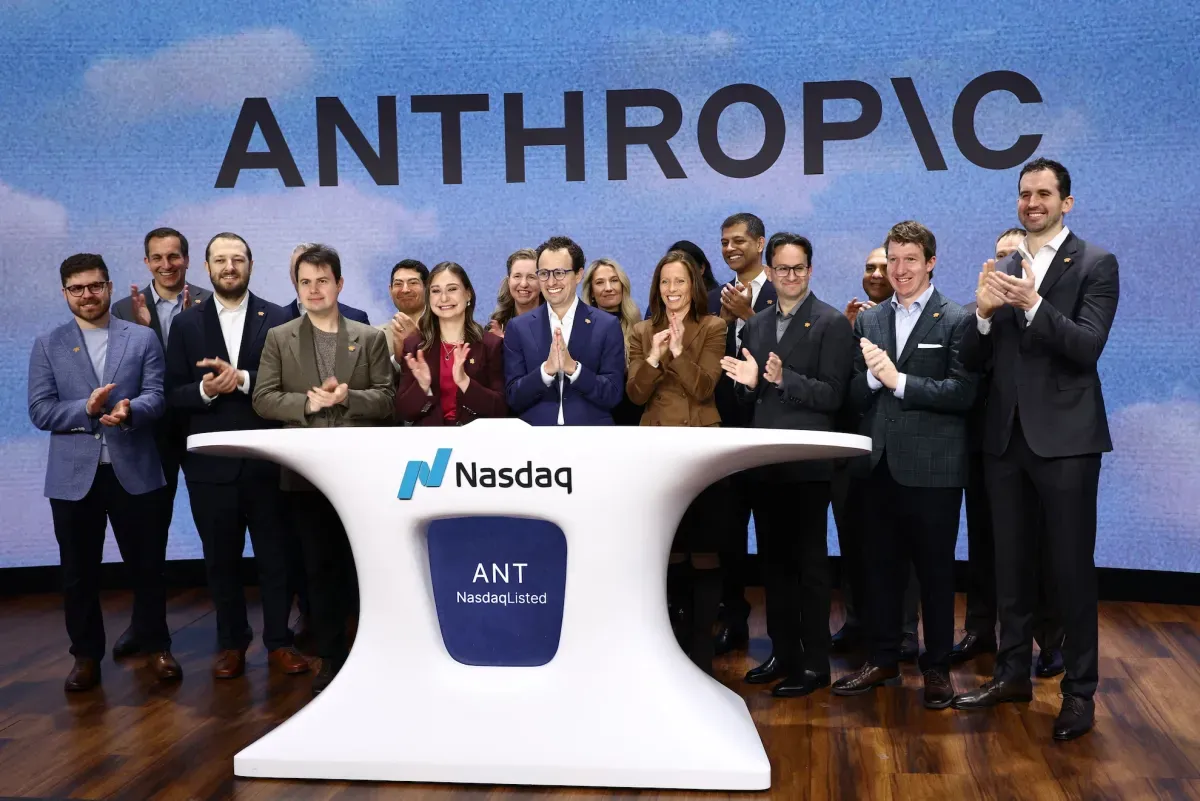
Shares priced at $83, above the $70–$78 range, and the IPO raised $81.3 billion. ANT opened at $111.50 and closed its first day at $97.17, up about 17%. Anthropic reported $33.24 billion in revenue for the nine months to September 30 and an $81 billion run rate. It also reported a $104 billion net loss, mostly from fair-value changes on convertible notes. [8] [9] [10] [12]
Reported figures show revenue rising fast alongside a large loss driven mainly by convertible-note revaluation. The investor accounts suggest developer usage was treated as a leading signal before revenue scaled.
Read the full assessment
Anthropic's quarterly filings will now give enterprise buyers disclosed finances for assessing vendor risk.
Executive brief
Notable Capital put about 10% of the U.S. portion of its $1 billion-plus fund into Anthropic's Series E at a $61.5 billion valuation. Many of its limited partners questioned the bet. Less than two years later, Anthropic's IPO valued the company at about $1.5 trillion fully diluted, which TechCrunch puts at a paper return of roughly 15x. Two late-stage investors also show large paper gains. Singapore's GIC invested more than $4.5 billion for a stake of about 1%, and Baillie Gifford invested $1.5 billion. All three firms say developer adoption and enterprise revenue were what convinced them.
What changed and event timeline
Series E at $61.5B
Lightspeed led a $3.5 billion round. Notable Capital's participation comes from TechCrunch's reporting; Anthropic's announcement names Lightspeed and other investors (;).
Series F at $183B
ICONIQ led a $13 billion round. Fidelity and Lightspeed co-led. GIC and Baillie Gifford were named participants, and it was the first Anthropic investment for both ().
Series G at $380B
GIC and Coatue led a $30 billion round. Anthropic reported a $14 billion revenue run rate at the time (;).
Series H at $965B
Altimeter, Dragoneer, Greenoaks and Sequoia led a $65 billion round, with GIC among six co-leads. Run rate was reported at $47 billion ().
Record IPO prices
Shares priced at $83, above the $70–$78 range, raising $81.3 billion. That beats SpaceX's June offering on initial proceeds ().
Nasdaq debut
ANT first traded at $111.50, fell to $92.72 during the day and closed at $97.17, up 17.07% (;).
Capabilities and access
The reviewed sources tie the investment theses to products, not to specific model versions:
Read the full section
The reviewed sources tie the investment theses to products, not to specific model versions:
- GIC's Chris Emanuel cites early developer pull for Claude Code (TechCrunch).
- Baillie Gifford's Lilian Li cites expansion into legal services, life sciences, Cowork and cybersecurity (same source).
- Claude is sold through AWS Bedrock, Google Vertex AI and Microsoft Azure Foundry (Yahoo Finance).
Technical analysis for researchers and developers
The reviewed sources contain no architecture or benchmark data.
Read the full section
The reviewed sources contain no architecture or benchmark data. What is documented is mostly about compute and finances:
- Compute: The Series H announcement lists 5 GW with Amazon, 5 GW of Google/Broadcom TPU capacity, GPU access from SpaceX, and Micron, Samsung and SK hynix as memory partners (Anthropic).
- Multi-cloud serving: Running on three clouds and two accelerator families affects where developers can deploy and the pricing and latency they face.
- Developer-share evidence: Notable's 70% figure comes from the firm's own analysis. Its method is not published, so it cannot be reproduced.
Claims and evidence
- Notable's thesis rested on developer data: Its team found developers used Claude 70% of the time, a reversal from the year before.
- About 15x paper return: Valuation alone rose about 24x ($61.5B to $1.5T).
- GIC invested $4.5B+ for about 1%: This comes from a single unnamed source (same).
Read the full section
- Notable's thesis rested on developer data: Its team found developers used Claude 70% of the time, a reversal from the year before. This comes from the firm itself, with no published methodology (TechCrunch).
- About 15x paper return: Valuation alone rose about 24x ($61.5B to $1.5T). The smaller figure is consistent with dilution, but no breakdown has been published.
- GIC invested $4.5B+ for about 1%: This comes from a single unnamed source (same).
- Revenue: $33.24B for the nine months to September 30, and an $81B run rate at the end of October (CNBC).
Context and prior work
- Notable Capital is the former GGV Capital, which split from its China operations in 2024 (TechCrunch).
- DeepSeek R1, released weeks before Series E, looked at the time like a threat to closed-model labs.
- The IPO raised $81.3B, and the total deal reached $107.3B including a $26B private placement (ynet).
Read the full section
- Notable Capital is the former GGV Capital, which split from its China operations in 2024 (TechCrunch). Partner Hans Tung argued that "mission-critical" work will need U.S.-based closed models.
- DeepSeek R1, released weeks before Series E, looked at the time like a threat to closed-model labs.
- The IPO raised $81.3B, and the total deal reached $107.3B including a $26B private placement (ynet).
Limitations, safety and contested findings
- All gains are on paper and depend on lock-ups and the share price.
- Net loss for the nine months was $104B, mostly from changes in the fair value of convertible notes, compared with $25.1B for 2025 (CNBC).
- Some coverage frames the offering as a test of a $1.5T AI valuation (American Bazaar).
Read the full section
- All gains are on paper and depend on lock-ups and the share price. During day one, the stock gave back a large part of its opening gain (Invezz).
- Net loss for the nine months was $104B, mostly from changes in the fair value of convertible notes, compared with $25.1B for 2025 (CNBC).
- Some coverage frames the offering as a test of a $1.5T AI valuation (American Bazaar).
- The investor accounts are self-reported looking back, and no independent reporting corroborates the stake sizes.
Business and practitioner implications
- For investors: Developer adoption was the leading signal in all three theses.
- For enterprises: Anthropic is now a public company that files quarterly reports.
- For developers: Hyperscaler partnerships and the 10 GW of committed capacity suggest Claude will stay available on several clouds.
Read the full section
- For investors: Developer adoption was the leading signal in all three theses. Notable valued it before revenue scaled, and GIC and Baillie Gifford added gross-margin and enterprise-spend evidence.
- For enterprises: Anthropic is now a public company that files quarterly reports. Buyers get disclosed finances to assess vendor risk, and there are new questions about pricing pressure.
- For developers: Hyperscaler partnerships and the 10 GW of committed capacity suggest Claude will stay available on several clouds. Amazon and Google will together own nearly 30% of Anthropic after the IPO, according to TechCrunch's reporting, so concentration risk is worth tracking.